Best starting point for broad clinical training: Mayo Clinic. Best fit for cancer-focused training: Memorial Sloan Kettering Cancer Center. Best fit for an imaging-research career: Stanford University. This 2026 shortlist helps you compare nuclear medicine fellowship programs by career fit, training pathway, and the work you want after graduation—not institutional name alone.
- The best nuclear medicine fellowship programs match your certification pathway, clinical interests, and intended attending role.
- Mayo Clinic belongs on the shortlist for broad clinical nuclear radiology training.
- Memorial Sloan Kettering belongs on the shortlist for cancer-focused molecular imaging and therapy training.
- Stanford University belongs on the shortlist for an academic imaging-research career.
- RadBoard supports radiology job searches; confirm fellowship requirements and certification eligibility directly with programs.
Why this matters
A fellowship title does not tell you whether the training fits your prior residency or your intended practice. Nuclear radiology, nuclear medicine, and molecular imaging overlap clinically, but their training and certification pathways are not interchangeable.
Start with the job you want. RadBoard aggregates 5,000+ radiology positions from 20 sources, giving you a way to examine employer requirements before choosing additional training. Those figures describe the radiology platform overall, not the number of nuclear medicine jobs or fellowships.
RadBoard is best for radiologists comparing career opportunities across multiple job sources. It is a job-search platform, not a fellowship accreditor or a certification authority.
For your 2026 applications, separate three questions: Can you enter the program? What will you actually do? Which credentials will the completed pathway support?
What makes the best nuclear medicine fellowship programs?
Judge each program against these six criteria before comparing names:
- Pathway fit: Confirm that your prior residency meets entry requirements and that the training supports your intended certification route.
- Clinical breadth: Ask about PET/CT, SPECT/CT, general nuclear medicine, and the fellow’s responsibility for interpretation and consultation.
- Therapy responsibility: Distinguish observing radiopharmaceutical treatment from participating in patient selection, treatment planning, administration, and follow-up.
- Teaching structure: Identify who supervises you, how feedback works, and whether teaching is scheduled rather than incidental.
- Research access: Ask for a defined mentor, a feasible project, and a realistic account of protected research time.
- Career alignment: Compare the curriculum with the clinical duties and credentials requested by your target employers.
Treat pathway fit as a gate, not a scoring bonus. A strong curriculum does not solve an eligibility mismatch. Obtain written clarification from the program and the relevant certifying board before committing to a route.
Nuclear medicine fellowship programs at a glance
This is an application shortlist, not an outcomes ranking. The use-case labels reflect institutional setting and career direction; they do not establish differences in case volume, teaching quality, graduate placement, or examination performance.
| Program or institution | Best for | Standout reason to investigate | Key limitation to resolve |
|---|---|---|---|
| Mayo Clinic nuclear radiology training | Broad clinical practice | Multispecialty clinical setting | Confirm the exact campus, curriculum, and certification pathway |
| Memorial Sloan Kettering molecular imaging and therapy training | Cancer-focused practice | Dedicated cancer-center setting | Confirm exposure outside oncology if you want general nuclear medicine work |
| Stanford University nuclear medicine and molecular imaging training | Imaging-research careers | Academic molecular imaging environment | Confirm that a specific mentor and project fit your training period |
Program names, entry routes, and curriculum details require direct confirmation for the 2026 application cycle. Compare the actual appointment you would accept—not every activity advertised across the department.
1. Mayo Clinic: best nuclear medicine training for clinical breadth
Mayo Clinic belongs on your shortlist if you want nuclear imaging training in a multispecialty clinical environment. Its institutional setting makes it a useful starting point for applicants who want to investigate both oncologic imaging and nononcologic nuclear medicine practice.
The deciding document is the rotation schedule. Ask the specific Mayo Clinic program to identify where fellows work, which services they cover, and how interpretation, consultation, and therapy responsibilities are divided.
Mayo Clinic pros:
- A multispecialty setting fits the search for broad clinical training.
- The clinical focus gives you a clear basis for asking about preparation for hospital-based practice.
- Comparing rotations with your intended attending duties makes curriculum gaps easier to identify.
Mayo Clinic cons and fit limits:
- The institution’s name does not establish the case mix of a particular fellowship or campus.
- Applicants seeking a narrowly defined laboratory project still need a separate mentor-and-project assessment.
Best for: Applicants prioritizing broad clinical nuclear radiology practice over a narrowly specified research niche.
For your 2026 interview, ask the program to walk through a representative working week. Request examples of what the fellow interprets, what the fellow discusses with referring clinicians, and what requires direct faculty participation.
Verdict: Hold Mayo Clinic on your shortlist until the specific curriculum and pathway match your background.
2. Memorial Sloan Kettering: best for cancer-focused training
Memorial Sloan Kettering Cancer Center belongs on your shortlist if you want a career centered on oncologic molecular imaging and therapy. Its cancer-center setting is directly relevant to applicants interested in staging, treatment-response assessment, and multidisciplinary cancer care.
Do not treat diagnostic imaging exposure and therapy training as equivalent. Ask the program to describe the fellow’s role across the patient pathway, including consultation and follow-up—not simply which treatments the institution provides.
Memorial Sloan Kettering pros:
- A dedicated cancer-center setting aligns with an oncology-focused career.
- Molecular imaging and therapy are relevant subjects to assess together when comparing the curriculum.
- The institutional focus gives applicants a clear reason to investigate multidisciplinary cancer-care training.
Memorial Sloan Kettering cons and fit limits:
- A cancer-focused setting does not establish the breadth of nononcologic training.
- Institutional treatment capabilities do not prove that fellows receive a particular level of procedural responsibility.
Best for: Applicants targeting cancer-center practice or a career focused on oncologic molecular imaging.
Before applying, identify the duties you want after fellowship. A PET/CT interpretation role and a therapy-focused clinical role require different questions about supervision, documentation, and patient management.
Verdict: Hold Memorial Sloan Kettering on your shortlist for oncology; resolve clinical breadth and therapy responsibility before choosing.
3. Stanford University: best for an imaging-research career
Stanford University belongs on your shortlist if you want to connect clinical nuclear imaging with an academic research direction. Its molecular imaging environment makes it relevant to applicants looking for a defined research question rather than clinical training alone.
Research fit is specific. A department’s publication record does not tell you whether a mentor has time, whether a project is ready, or whether the fellowship schedule permits meaningful participation.
Stanford University pros:
- An academic molecular imaging environment aligns with a research-oriented career search.
- Applicants can frame their assessment around a specific scientific question and potential mentor.
- Comparing clinical training with research goals helps distinguish a feasible fellowship project from a longer research commitment.
Stanford University cons and fit limits:
- Research fit remains unproven until a mentor and project are identified.
- A research-focused applicant must still confirm that clinical training supports the intended certification and employment pathway.
Best for: Applicants pursuing academic molecular imaging with a specific research interest.
Ask a prospective mentor what you would actually own: a dataset, an analysis, a protocol-development task, or another defined contribution. Then ask how that work fits around clinical service. Avoid choosing on the strength of an interesting laboratory description alone.
Verdict: Hold Stanford University on your shortlist only if the clinical pathway and a feasible research plan both fit.
How to compare fellowship pathways before applying
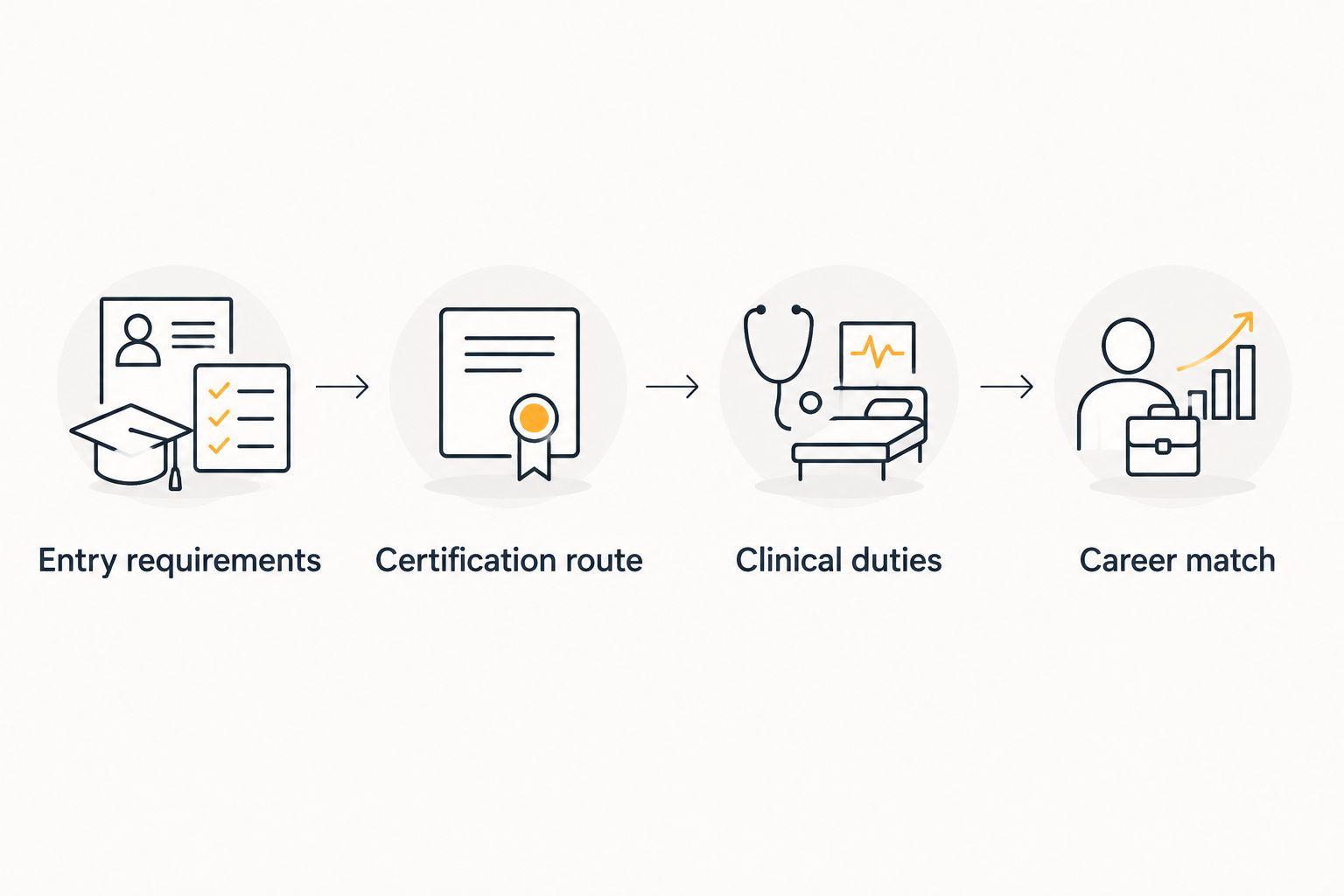
Use this sequence for every program in your 2026 search. Resolve eligibility first; compare educational detail second.
- Entry requirements: Send your training history to the program and request confirmation that it meets the appointment requirements.
- Certification route: Confirm the relevant board pathway directly with the American Board of Radiology or American Board of Nuclear Medicine, as applicable.
- Clinical duties: Obtain the rotation schedule and clarify interpretation, consultation, call, and therapy responsibilities.
- Career match: Compare the training with the duties and credentials requested in jobs you would actually accept.
A standard nuclear radiology fellowship is generally 12 months after diagnostic radiology residency. Nuclear medicine training follows different routes depending on prior education; do not assume that every program described as a fellowship has identical duration or certification consequences.
Certification also differs from authorization to use radioactive materials. The Nuclear Regulatory Commission or the relevant Agreement State governs applicable authorized-user requirements. Ask how the program documents training and experience, and verify the requirements for your intended work.
Questions that separate a curriculum from a department brochure
Use the same questions across programs so that your comparison rests on equivalent information:
- Which clinical responsibilities belong to the fellow rather than another trainee?
- How are PET/CT, SPECT/CT, general nuclear medicine, and therapy distributed across rotations?
- Does therapy participation include consultation and follow-up?
- Who reviews progress, and how is feedback delivered?
- Which research activities fit within the actual clinical schedule?
- What documentation does the program provide at completion?
Ask for examples rather than assurances. A representative schedule, a description of a completed fellow project, and an explanation of responsibility on a therapy service are more useful than an unqualified statement that training is broad.
Keep a written comparison. If a program cannot answer a question during the interview, request clarification before making your decision rather than filling the gap with institutional reputation.
How these programs were ranked
The order prioritizes three distinct career directions: broad clinical practice, cancer-focused practice, and imaging research. It does not imply that Mayo Clinic outperforms Memorial Sloan Kettering or Stanford University across all dimensions.
No numerical score is assigned because comparable program-level outcomes are not established here. The meaningful ranking is the one you produce after checking pathway fit, clinical responsibility, teaching, research access, and intended employment.
Which nuclear medicine fellowship should you choose?
Start with Mayo Clinic if you are undecided and want to investigate broad clinical training. Put Memorial Sloan Kettering first if your intended career centers on cancer imaging and therapy. Put Stanford University first if you have a specific academic research direction and can establish mentor fit.
Do not select any program until its entry requirements and certification route fit your training history. A prestigious appointment that does not support your intended work is the wrong choice.
Use RadBoard’s radiology job search to compare the duties employers request, then take those requirements into fellowship interviews. The platform’s 5,000+ positions across 20 sources provide career-search context, not evidence that a particular fellowship produces better outcomes.
FAQ
What are the best nuclear medicine fellowship programs in 2026?
Mayo Clinic, Memorial Sloan Kettering Cancer Center, and Stanford University form a useful shortlist for broad clinical training, cancer-focused training, and imaging research, respectively. These are career-fit recommendations, not a ranking based on comparative graduate outcomes.
Is nuclear radiology fellowship the same as nuclear medicine training?
No. Nuclear radiology fellowship and nuclear medicine training have different entry and certification pathways. Confirm your route with the program and the relevant certifying board before applying.
How long is a nuclear radiology fellowship?
A standard nuclear radiology fellowship is generally 12 months after diagnostic radiology residency. Other nuclear medicine training routes depend on prior education and must be assessed separately.
Which program should I consider for cancer imaging?
Memorial Sloan Kettering Cancer Center belongs on a cancer-imaging shortlist because it is a dedicated cancer center. Confirm the specific curriculum, fellow responsibilities, and exposure outside oncology before choosing.
Does a theranostics service guarantee hands-on fellowship training?
No. An institution providing radiopharmaceutical therapy does not establish what fellows do on that service. Ask about patient selection, treatment planning, administration, follow-up, and supervision.
Does fellowship completion automatically make me an authorized user?
No. Authorized-user status depends on applicable regulatory requirements, not the fellowship title alone. Confirm training documentation and requirements with the relevant Nuclear Regulatory Commission or Agreement State framework.
How can I connect fellowship choice with my job search?
Compare your target jobs with each fellowship’s actual curriculum. RadBoard supports radiology job searches across multiple sources, while programs and certifying boards establish training and eligibility requirements.
One last thing
Ask each program to describe a task you will be trusted to perform near graduation that you cannot perform confidently today. Then ask how supervision, feedback, and documentation build toward that responsibility.
That question tests the educational value of the appointment. Choose the program that can explain the progression—not just name the equipment or services in its department.