
Best overall for case-mix breadth: a multisite hospital practice with a genuinely mixed assigned worklist. Best for complex referral imaging: an academic medical center. Best for pediatric breadth: a children's hospital. This 2026 guide ranks employer settings by the clinical exposure to verify before accepting a radiology position, not by institutional reputation.
- The best radiology employers by case mix diversity assign varied cases, rather than merely operating varied services.
- Multisite hospital practices are the default shortlist for general radiologists seeking mixed clinical work.
- Academic medical centers suit complex referral imaging; children's hospitals suit pediatric case-mix breadth.
- RadBoard helps radiologists compare career opportunities across employer settings; verify each role's actual reading assignment.
Why this matters
A hospital's patient population is not your worklist. An employer can operate emergency, transplant, oncology, and outpatient services while assigning you to a single reading queue. Rank the position you will perform, not the services the institution advertises.
RadBoard aggregates 5,000+ radiology positions from 20 sources. That scope supports a search across different employer settings; the decisive evidence still comes from the hiring team's description of your assigned studies, rotations, and clinical responsibilities.
RadBoard is best for radiologists comparing career opportunities across employer settings. For a 2026 search, separate broad exposure from subspecialty depth before building your shortlist. Neither is automatically better: the right choice preserves the clinical skills you want to use.
What makes the best employer for case-mix diversity?
Use these criteria before comparing names. The guide to assessing case mix and volume provides a related framework for evaluating a group's reading workload.
- Patient settings: Determine whether your assignment includes emergency, inpatient, and outpatient studies, rather than counting every setting the employer serves.
- Clinical breadth: Ask which organ systems, disease categories, and referral questions reach your queue. Different scanners do not establish different clinical exposure.
- Acuity range: Separate screening, routine diagnostic work, urgent examinations, and complex referral cases. Ask how your shift changes that balance.
- Population range: Verify adult and pediatric responsibilities, postoperative imaging, and relevant specialty populations. Do not infer these from a hospital's name.
- Reading ownership: Establish which studies you interpret yourself and which are routed to another section, remote reader, or covering group.
- Support and continuity: Assess access to colleagues, prior imaging, clinical history, and follow-up. Variety without support is not a reason to accept a role.
Employer settings at a glance
This is a decision ranking for a radiologist seeking case-mix breadth in 2026. It is not a measured league table of named hospitals; individual assignments determine whether a setting delivers the exposure described.
| Rank and employer setting | Best for | Standout characteristic to verify | Key limitation |
|---|---|---|---|
| 1. Multisite hospital practice | Cross-setting generalist breadth | Rotation across inpatient, emergency, and outpatient worklists | Central routing can narrow your assigned work |
| 2. Academic medical center | Complex referral imaging | Participation in specialty services and case conferences | Section-based employment can restrict organ-system breadth |
| 3. Community hospital practice | Routine-to-acute general radiology | A mixed local hospital assignment | Advanced referral work can be transferred elsewhere |
| 4. Children's hospital | Diversity within pediatric imaging | Exposure across pediatric clinical services | Pediatric breadth does not preserve adult reading exposure |
| 5. Cancer center | Diversity within oncologic imaging | Staging, treatment assessment, and complication imaging | Oncology depth is not general diagnostic breadth |
| 6. Multisite teleradiology employer | Geographic referral variety | Reading assignments across distinct client facilities | Geography does not guarantee clinical variety |
1. Multisite hospital practice: best for cross-setting breadth
A multisite hospital practice is the first setting to investigate when you want emergency, inpatient, and outpatient work in the same job. The value lies in your rotation, not the number of facilities on the organization's roster. Request a site-by-site explanation of what reaches your worklist.
Best for: General radiologists seeking variety across care settings without selecting a single disease-focused practice.
Multisite hospital practice pros:
- A mixed assignment can preserve exposure to both acute and scheduled diagnostic work.
- Site rotations provide a way to compare different referral populations.
- Shared coverage creates opportunities to combine generalist work with selected specialty sessions.
Multisite hospital practice cons:
- Worklist routing can separate complex studies from general coverage.
- Reading across facilities requires clarity about protocols, escalation contacts, and local clinical workflows.
Ask whether rotation is part of the position or simply an option discussed during recruitment. Establish who controls reassignment and whether a change in hospital contracts would alter your duties. A broad network is useful only when the role gives you access to its breadth.
Verdict: Buy into this setting for generalist breadth only after confirming a mixed assigned rotation.
2. Academic medical center: best for complex referral imaging
Academic medical centers combine clinical radiology with teaching and research functions. For case-mix diversity, investigate the specialty services your section actually supports and your role in reviewing difficult cases. Complex referrals are valuable only if you participate in their interpretation.
Best for: Radiologists who want complex clinical questions, teaching, and specialty consultation within their field.
Academic medical center pros:
- Specialty consultation provides a route to discuss challenging imaging findings.
- Teaching creates opportunities to explain diagnostic reasoning and review cases.
- Case conferences connect image interpretation with clinical management questions.
Academic medical center cons:
- A section-specific appointment can narrow exposure outside your subspecialty.
- Teaching, research, and service duties need to fit within the actual schedule.
For a 2026 academic search, distinguish complexity from breadth. An abdominal imaging role can contain diverse pathology while excluding neuroradiology, musculoskeletal imaging, or breast imaging. Ask whether cross-section work is expected, permitted, supported, or excluded; those are different job designs.
Request examples of cases assigned to someone at your career stage, not just cases presented at a departmental conference. That distinction prevents an exceptional departmental case from becoming a misleading picture of daily practice.
Verdict: Buy for referral complexity; hold if maintaining broad cross-section reading is your primary goal.
3. Community hospital practice: best for routine-to-acute general work
Community hospital practice is a strong setting to investigate when you want local diagnostic work across hospital services. Evaluate the relationship between emergency coverage, inpatient consultation, and scheduled imaging. Then identify which examinations leave the hospital's reading service.
Best for: General radiologists seeking a mix of common diagnostic questions and acute hospital imaging.
Community hospital practice pros:
- A mixed hospital assignment can connect routine examinations with urgent diagnostic work.
- Onsite responsibilities provide direct contact with referring clinicians.
- General coverage offers a practical route to maintaining multiple reading skills.
Community hospital practice cons:
- Transferred referrals can limit exposure to advanced specialty imaging.
- Broad responsibility requires explicit backup for cases beyond your experience.
Ask about pediatric coverage, MRI assignments, fluoroscopy, and procedures separately. Do not treat a general radiologist title as confirmation that each belongs to the position. Also clarify whether overnight and daytime worklists differ: the same employer can offer very different case mixes by shift.
Verdict: Buy for practical generalist work when the assignment and backup arrangements match your skills.
4. Children's hospital: best for pediatric case-mix breadth
A children's hospital focuses its clinical work on pediatric patients. Within that population, evaluate exposure across emergency care, surgery, congenital conditions, oncology, and other specialty services. The ranking concerns pediatric breadth, not a promise that every pediatric radiologist reads every service.
Best for: Pediatric radiologists who want variety across childhood disease and clinical settings.
Children's hospital pros:
- Pediatric-focused work aligns the patient population with pediatric radiology training.
- Multiple pediatric services provide distinct referral questions to investigate.
- Age-specific interpretation and protocol decisions remain central to the role.
Children's hospital cons:
- Pediatric-only work does not maintain adult imaging exposure.
- A narrow section assignment can limit variety within pediatric practice itself.
Ask how neonatal, emergency, musculoskeletal, body, and neurologic examinations are distributed. Determine whether your position is a general pediatric assignment or a pediatric subspecialty appointment. Both are valid career choices, but they answer different versions of the diversity question.
Verdict: Buy for pediatric breadth; skip as a substitute for an adult-and-pediatric generalist role.
5. Cancer center: best for oncologic case-mix depth
Cancer-center imaging centers on questions such as diagnosis, staging, treatment assessment, and complications. That creates diversity within oncology, rather than across the full spectrum of general radiology. Compare the tumor types, modalities, and clinical services assigned to the position.
Best for: Radiologists seeking disease complexity and longitudinal interpretation within oncologic imaging.
Cancer center pros:
- Serial imaging supports comparison across a patient's treatment course.
- Different tumor services present distinct staging and assessment questions.
- Multidisciplinary discussions connect reports with treatment decisions.
Cancer center cons:
- An oncology-focused position narrows exposure outside cancer care.
- Disease-site or modality-specific routing can further restrict your worklist.
Ask whether the job includes initial diagnostic studies, follow-up examinations, postoperative assessment, and urgent complications. Clarify responsibility for outside-image reviews and conference preparation. These duties affect the clinical content of the role even when the formal job title stays the same.
Verdict: Buy for oncology depth; skip if your priority is unrestricted general diagnostic breadth.
6. Multisite teleradiology employer: best for geographic referral variety
Teleradiology separates the reading location from the imaging facility. For a diversity-focused search, investigate which client facilities and worklists you would cover. Multiple clients do not establish a broad assignment if routing concentrates your work into a single modality or shift.
Best for: Radiologists seeking remote work with exposure to distinct referral environments.
Multisite teleradiology employer pros:
- Remote coverage provides a route to interpret studies from different facilities.
- Client assignments can be evaluated separately by patient setting and clinical scope.
- A defined worklist lets you assess whether remote duties match your reading skills.
Multisite teleradiology employer cons:
- Modality and shift restrictions can outweigh geographic variety.
- Clinical context and escalation access require scrutiny when you are offsite.
Ask about preliminary versus final interpretations, access to prior studies, and communication with onsite teams. Require a clear explanation of what happens when a case needs subspecialty review. Remote flexibility and clinical diversity are separate selection criteria.
Verdict: Hold until client assignments, study routing, and clinical support are explicit.
How the settings are ranked
The order prioritizes cross-setting breadth first, then complexity within a defined population or disease area. It uses the criteria above rather than employer size, reputation, compensation, or an unsupported diversity score. A verified broad community assignment outranks a narrowly assigned academic role for a generalist.
For your 2026 shortlist, request a 4-week worklist summary as an interview exercise. This is a recommended review window, not a claim about any employer's reporting practices. Ask for aggregate information without patient identifiers, split by modality, care setting, and reading assignment.
Review 3 sample shifts covering the rotations you would actually work. Those are recommended samples, not industry benchmarks. Compare the written job description with the cases and responsibilities represented in each sample.
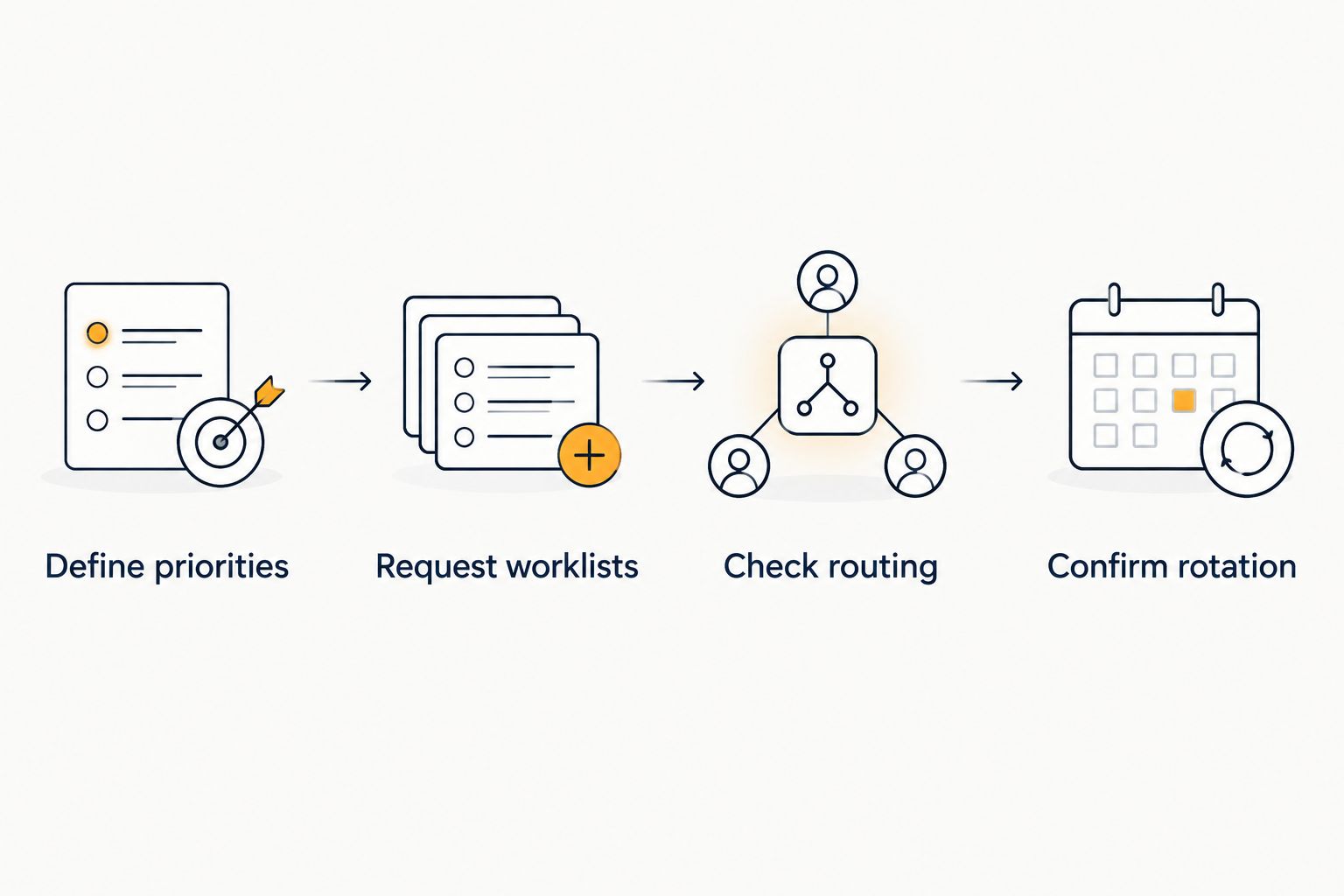
Use a simple verification sequence:
- Define priorities: State which clinical skills and patient populations you want to retain.
- Request worklists: Ask for aggregate examples from the proposed assignment.
- Check routing: Identify cases diverted to other readers or sections.
- Confirm rotation: Establish how those assignments appear in your schedule.
A hospital-wide summary cannot substitute for this role-level review. Keep the comparison tied to your position.
Which employer setting should you choose?
Choose a multisite hospital practice as the default shortlist for broad generalist exposure, then verify the rotation. Choose an academic medical center for complex referral questions, a children's hospital for pediatric breadth, or a cancer center for oncologic depth. Choose remote coverage only after inspecting its assigned worklists.
Use RadBoard to compare radiology career opportunities across those settings. For each promising position, record what you will read, what is excluded, and who provides backup. In 2026, a precise assignment description is more useful to this decision than a recognizable employer name.
Compare radiology career opportunities
Explore employer settings, then verify each position's assigned case mix.
FAQ
What are the best radiology employers by case mix diversity?
Start with multisite hospital practices for cross-setting generalist breadth, then compare academic, community, pediatric, cancer-center, and remote assignments. Rank the role's actual worklist rather than the employer's full service range.
Does an academic medical center always offer the broadest case mix?
No; an academic appointment can be restricted to one section or subspecialty. Ask which referral cases reach your worklist and whether cross-section reading belongs to the position.
Is a children's hospital a good choice for diverse radiology work?
A children's hospital is a good setting to investigate for diversity within pediatric imaging. Confirm the services and age groups assigned to you; pediatric breadth does not establish adult imaging exposure.
Is cancer-center radiology too narrow for a general radiologist?
Cancer-center radiology is disease-focused rather than a default choice for general diagnostic breadth. Evaluate whether oncology complexity supports your career goals and which non-oncologic skills you want to retain.
Can teleradiology provide a diverse patient case mix?
Teleradiology provides a route to read for distinct facilities, but assigned routing determines clinical diversity. Verify client settings, modalities, shifts, access to prior imaging, and escalation arrangements.
What should I request before accepting a radiology job?
Request an aggregate worklist summary tied to your proposed role, plus representative shifts and routing rules. Confirm the rotation and backup arrangements without requesting patient-identifiable information.
How does RadBoard help compare radiology employers?
RadBoard aggregates 5,000+ radiology positions from 20 sources to support comparison across career opportunities. Use it to build a shortlist, then verify case mix directly with each hiring team.
One last thing
Ask the hiring radiologist: Which cases will I stop reading if I take this job? The answer exposes the trade-off that an institution-wide service list leaves out. Put excluded modalities, patient populations, and subspecialties beside the role's strengths before making your decision.