
Best for comparing radiology opportunities: RadBoard. Best for onsite physician-locums inquiries: CompHealth. Best for remote-coverage inquiries: LocumTenens.com. Best for exploring repeat locums blocks: Weatherby Healthcare. RadBoard is a search platform, not a staffing agency; use it to build your shortlist, then assess each agency against your actual schedule.
- RadBoard is best for radiology job discovery, aggregating 5,000+ positions from 20 sources—not arranging placements.
- Searching radiology staffing agencies per diem? Compare physician-specific assignments, not technologist staffing results.
- Consider CompHealth, LocumTenens.com, and Weatherby Healthcare, then verify each assignment’s schedule and clinical scope.
- For recurring part-time work, compare agency assignments with direct practice employment before committing.
Why this matters
Per-diem, part-time, and locum tenens describe different aspects of a job. Per-diem work centers on individual days or shifts; part-time describes a reduced ongoing workload; locum tenens describes temporary physician coverage. An assignment can fit more than one category.
That distinction matters in your 2026 search. A recruiter offering a temporary assignment has not necessarily offered occasional shifts, and a remote position has not necessarily offered control over your hours.
RadBoard is best for radiologists who want to compare opportunities across sources before contacting recruiters. Its 5,000+ radiology positions come from 20 sources; those totals describe the platform overall, not a count of per-diem assignments.
This guide concerns radiologist physicians, not radiologic technologists. Put your physician specialty and subspecialty in every inquiry so the conversation starts with the right clinical role.
What makes the best per-diem radiology staffing option?
Use these criteria before judging an agency by its name or the enthusiasm of its recruiter:
- Schedule fit: Exact dates, shift boundaries, minimum commitments, and expectations for future coverage.
- Clinical fit: Modalities, subspecialty mix, procedures, supervision, and preliminary versus final interpretations.
- Assignment clarity: Named facility, practice relationship, onsite or remote requirements, and a written scope.
- Credentialing readiness: Required licenses, privileges, documents, and the person responsible for each outstanding task.
- Contract protection: Cancellation language, malpractice arrangements, payment terms, and restrictions on future work.
- Working support: Access to prior studies, referring clinicians, technical assistance, and escalation coverage.
A strong match satisfies your nonnegotiable conditions. A recognizable agency name does not compensate for an unsuitable case mix or a schedule that conflicts with your primary job.
At a glance: your 2026 shortlist
These recommendations identify useful starting points, not measured differences in placement speed, recruiter quality, or assignment volume. Confirm the actual engagement terms directly.
| Option | Best for | Distinguishing role | Key limitation |
|---|---|---|---|
| RadBoard | Comparing opportunities across sources | Aggregates 5,000+ radiology positions from 20 sources | A search result is not a confirmed assignment |
| CompHealth | Onsite physician-locums inquiries | Physician staffing route for temporary coverage discussions | Each facility’s dates and clinical requirements need verification |
| LocumTenens.com | Remote radiology coverage inquiries | Locum tenens agency to include in a teleradiology search | Remote work does not establish self-scheduling |
| Weatherby Healthcare | Exploring repeat locums blocks | Physician-locums agency to approach with a repeat-coverage proposal | Repeat work requires agreement beyond an initial assignment |
1. RadBoard: best radiology search option for broad discovery
RadBoard aggregates radiology positions rather than acting as the staffing agency that places you. Its search and swipe-to-save features help you identify opportunities to investigate across multiple sources.
Use the platform before narrowing your search to a single recruiter. Search around your clinical scope and schedule, then distinguish genuinely occasional work from temporary assignments requiring a larger commitment.
RadBoard pros:
- Brings listings from 20 sources into a radiology-focused search.
- Lets you save opportunities while comparing different working arrangements.
- Supports discovery beyond the assignments discussed with one recruiter.
RadBoard cons:
- The platform’s overall listing count is not a per-diem assignment count.
- Finding a listing does not establish credentialing eligibility or contract terms.
- Search and saving features do not replace direct conversations with the hiring party.
Best for: Radiologists defining their options before deciding whether an agency, a practice, or a remote employer fits their needs.
For a useful shortlist, record the source, facility, shift pattern, clinical scope, and contact next to each saved opportunity. Treat advertisements with unclear schedules as questions to resolve, not matches to accept.
Verdict: Buy into this search-first approach if you need a broader view before choosing a recruiter.
2. CompHealth: best agency starting point for onsite locums inquiries
CompHealth is a physician staffing company offering locum tenens services. Include it in your shortlist when you want to discuss temporary onsite radiology coverage rather than search only for permanent employment.
Send a bounded request. State where you can work, what you can read or perform, and which dates you will consider; ask the recruiter to separate individual-shift requests from assignments requiring consecutive coverage.
CompHealth pros:
- Provides a physician-locums route for discussing temporary clinical assignments.
- Gives you an agency contact for questions about a proposed engagement.
- Fits an outreach process organized around named facilities and specific coverage needs.
CompHealth cons:
- The agency’s involvement does not establish that a particular assignment accepts isolated shifts.
- A proposed start date still depends on the facility’s requirements and approvals.
- An onsite assignment adds location and travel considerations to your schedule comparison.
Best for: Radiologists exploring onsite temporary coverage with a clearly defined clinical scope.
Before authorizing submission, ask who receives your information and which facility the submission concerns. Request the written schedule and responsibility list before treating the opportunity as a serious candidate.
Verdict: Hold until CompHealth identifies an assignment that matches your dates, privileges, and clinical scope.
3. LocumTenens.com: best agency inquiry for remote coverage
LocumTenens.com is a locum tenens staffing agency with radiology services. Include it in your outreach when remote coverage is central to your search, while confirming whether each proposed assignment is remote, onsite, or mixed.
For teleradiology, start with the work itself. Establish the interpreting location, patient jurisdictions, report responsibility, shift boundaries, and escalation process before discussing how the assignment fits around your other work.
LocumTenens.com pros:
- Adds a physician-locums agency to your remote radiology search.
- Provides a route to ask about the clinical and scheduling details of proposed coverage.
- Lets you compare an agency-mediated assignment with direct teleradiology employment.
LocumTenens.com cons:
- A remote assignment does not remove licensing or credentialing requirements.
- Working from home does not mean you choose when cases arrive.
- A defined shift still needs clear expectations for unfinished cases and handoffs.
Best for: Radiologists seeking remote supplemental coverage who can evaluate the licensing, technical, and clinical obligations.
Ask whether the work involves preliminary reports, final reports, or both. Also establish who communicates urgent findings and who handles technical interruptions; a remote arrangement needs explicit operational boundaries.
Verdict: Hold until LocumTenens.com confirms the remote arrangement and its complete shift obligations in writing.
4. Weatherby Healthcare: best agency inquiry for repeat locums blocks
Weatherby Healthcare provides physician locum tenens staffing. Approach it with a repeat-coverage proposal if you want temporary assignments that fit a predictable pattern rather than unrelated dates.
That is a screening strategy, not a promise of recurring work. Give the recruiter your preferred pattern and ask whether a proposed facility will agree to it explicitly.
Weatherby Healthcare pros:
- Offers another physician-locums route for comparing temporary coverage proposals.
- Gives you a separate agency conversation rather than relying on one contact.
- Fits an inquiry built around recurring dates and a consistent clinical scope.
Weatherby Healthcare cons:
- An initial assignment does not establish a recurring commitment.
- Returning to the same facility still requires confirmation of current terms and responsibilities.
- A repeat temporary arrangement is not the same as ongoing part-time employment.
Best for: Radiologists who want to explore repeated temporary coverage without assuming a permanent reduced-hours role.
Ask the recruiter to distinguish dates already agreed with the facility from dates merely discussed. If continuity is essential, put the proposed pattern, cancellation provisions, and renewal process into the contract review.
Verdict: Hold until Weatherby Healthcare’s proposed assignment supports your repeat-coverage plan in writing.
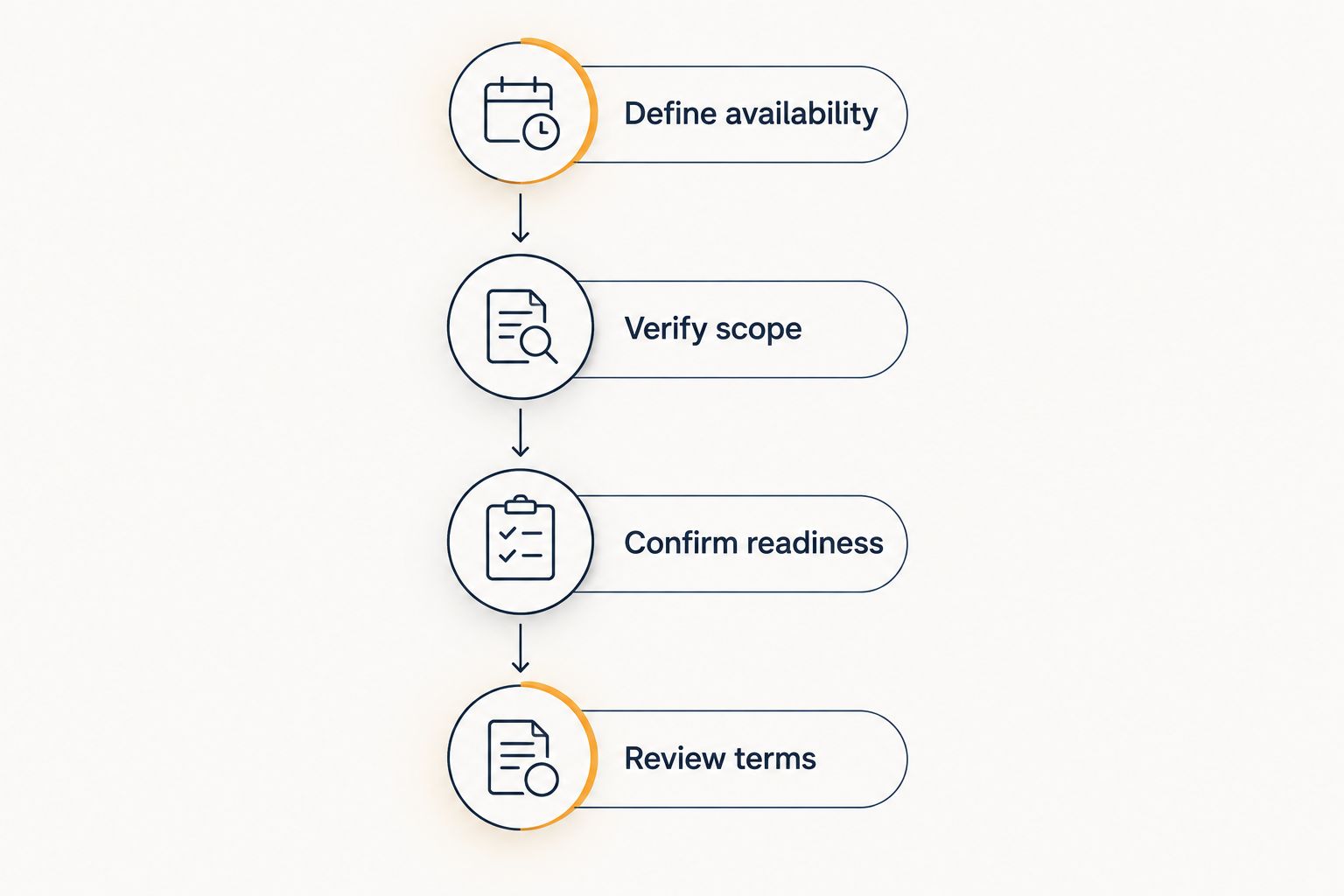
How to screen per-diem proposals in 2026
Move through these checks in order. Reject an assignment when it fails a nonnegotiable requirement instead of spending time comparing details that cannot fix the mismatch.
Define availability
Describe your schedule with dates and boundaries, not just the word flexible. As an example, a request for 2 shifts per month is different from a recurring commitment of 4 shifts per month; neither tells the recruiter whether you accept nights or consecutive days.
For an 8-hour shift, ask whether reporting, consultations, and handoffs must finish inside that window. These are planning examples, not recommended workloads or descriptions of any agency’s assignments.
Verify scope
List what you will interpret, what you will not interpret, and which procedures you are qualified and willing to perform. Confirm whether the assignment includes protocoling, contrast-related responsibilities, resident supervision, or coverage outside your subspecialty.
Ask how workload is described and monitored. A study count without modality and complexity does not adequately describe a radiologist’s clinical day.
Confirm readiness
Establish which licenses and facility privileges the assignment requires. Ask who maintains the outstanding-document list and how you will know that every required approval is complete.
Keep a proposed start date separate from authorization to begin clinical work. Do not make nonrefundable personal arrangements solely because a recruiter has discussed a target date.
Review terms
Confirm the contracting party, payment basis, cancellation provisions, malpractice policy, and responsibility for any required tail coverage. Review your primary employment agreement before accepting outside work; the guide to moonlighting without breaching your contract covers that separate decision.
Use a healthcare attorney for contract interpretation and an insurance professional for coverage questions. A recruiter’s explanation is not a substitute for the written agreement or policy.
Compare agency work with direct part-time employment
Use the same decision criteria for both routes. An agency assignment and a direct practice role should face the same questions about clinical scope, scheduling authority, cancellation, and professional responsibility.
For occasional coverage, ask whether you can accept or decline each proposed date. For ongoing part-time work, ask which hours are obligatory, how leave is handled, and whether the practice can change your schedule.
Direct practice employment pros: A direct arrangement puts your schedule discussion with the organization responsible for the ongoing role. It also gives you a route to negotiate a defined reduced-hours position rather than temporary coverage.
Direct practice employment cons: You handle the employer search directly, and a reduced-hours position still requires a full review of its clinical and contractual obligations. Part-time does not itself establish benefits eligibility or freedom from call.
Best for: Radiologists seeking an ongoing reduced workload rather than individual temporary assignments.
Verdict: Hold until the practice defines the recurring schedule and employment terms.
How this 2026 shortlist is organized
The order follows the decision: discover opportunities, investigate onsite coverage, investigate remote coverage, then explore repeat blocks. It does not rank agencies by unverified placement outcomes.
The same criteria apply throughout: schedule fit, clinical fit, assignment clarity, credentialing readiness, contract protection, and working support. Compare written proposals, not recruiter assurances. Keep a separate record for each facility so similar descriptions do not blur different obligations.
Which option should you choose?
Start with RadBoard for radiology job discovery if you have not yet settled on an agency-based arrangement. Then contact the agency that matches the kind of coverage you want to investigate.
Choose an onsite-locums discussion when location and temporary coverage are central. Choose a remote-coverage discussion when you need to establish reading-location and shift requirements; choose direct practice outreach when a stable reduced-hours role matters more than temporary assignments.
For your 2026 decision, the default is simple: accept the assignment with clear written terms that fit your schedule and competence—not the first recruiter response.
FAQ
What are the best radiology staffing agencies for per-diem work?
CompHealth, LocumTenens.com, and Weatherby Healthcare are physician-locums agencies to include in your search. Select an assignment by its written schedule, clinical scope, credentialing requirements, and contract terms rather than treating the agency name as proof of fit.
Is RadBoard a radiology staffing agency?
RadBoard is a radiology job search platform, not a staffing agency. It aggregates 5,000+ radiology positions from 20 sources and provides search and swipe-to-save features.
Are per-diem and part-time radiology jobs the same?
Per-diem and part-time radiology jobs are not the same. Per-diem describes individual-day or shift-based work, while part-time describes a reduced ongoing workload; confirm the actual commitment in the agreement.
Can I do per-diem radiology remotely?
Remote per-diem radiology is a work arrangement to investigate through teleradiology opportunities. Confirm the schedule, applicable licenses, facility requirements, report responsibility, and technical setup before accepting.
Does a locum tenens assignment let me choose individual shifts?
A locum tenens assignment does not automatically let you choose individual shifts. Ask whether the facility requires consecutive dates, recurring coverage, call, or a minimum commitment.
Can I accept per-diem shifts while employed full-time?
Your employment agreement and professional obligations determine whether outside shifts are permitted. Review outside-work approval, scheduling conflicts, confidentiality, and any applicable restrictions before accepting another engagement.
What should I ask about malpractice coverage for temporary shifts?
Ask for the policy type, covered activities and jurisdictions, coverage dates, and responsibility for any required tail coverage. Have an insurance professional review whether the arrangement covers the work you will actually perform.
One last thing
An advertisement repeated across sources is not necessarily a different opportunity. Before authorizing another submission, match the facility and assignment details against your existing inquiries, then tell each recruiter where you have already been presented.
Your shortlist should count distinct assignments—not repeated advertisements.