
Best overall for an immediate onsite gap: a locum tenens agency. Best for a lasting vacancy: a permanent-placement recruiter. Best for remote interpretation: a teleradiology provider. The best radiology staffing agencies for rural hospitals are the ones that can document completed coverage for your specific schedule, clinical scope, and credentialing requirements—not simply send the most CVs.
- Choose the best radiology staffing agencies for rural hospitals by completed shifts, clinical scope, and credentialing readiness.
- Locum tenens agencies suit temporary onsite gaps; permanent recruiters suit long-term vacancies.
- Teleradiology covers remote interpretation, not onsite procedures or every hospital coverage obligation.
- RadBoard is best for radiologists comparing career opportunities, not hospitals purchasing staffing coverage.
For physicians comparing rural opportunities, RadBoard aggregates 5,000+ radiology positions from 20 sources. That is a job-search resource, not evidence of an agency's hospital fill rate.
Why this matters
A submitted candidate is not a filled shift. A signed assignment is not completed coverage. For a rural hospital evaluating staffing partners in 2026, these distinctions belong in the selection process and the contract.
Separate your need into interpretation, onsite clinical work, and long-term recruitment. A provider that handles overnight reads does not automatically cover fluoroscopy, procedures, or onsite responsibilities. Define each responsibility before comparing proposals.
This guide ranks staffing approaches by the problem they solve. Use the ranking to build an agency shortlist, then select the named provider against comparable hospital-specific evidence.
What makes the best radiology staffing partner?
Use these six criteria before reviewing any agency presentation:
- Completed coverage: Request completed shifts divided by requested shifts, with cancellations and replacements shown separately.
- Clinical fit: Match modalities, procedures, subspecialty requirements, and communication duties to your actual service.
- Credentialing readiness: Confirm state licensure, hospital privileges, references, and required documentation before treating an assignment as ready.
- Rural logistics: Ask who coordinates travel, lodging, arrival confirmation, and disruptions for onsite assignments.
- Continuity: Compare repeat coverage by the same physician with rotating coverage, including handoff responsibilities.
- Replacement accountability: Require a written process for cancellations, uncovered shifts, escalation, and replacement approval.
Choose documented readiness over a large candidate list. Ask every shortlisted provider to answer the same questions for the same schedule. Otherwise, the proposals describe different services and cannot support a fair comparison.
Rural radiology staffing options at a glance
| Rank and option | Best for | Standout function | Key limitation |
|---|---|---|---|
| 1. Onsite locum tenens agency | Temporary physician absences | Time-limited onsite assignments | Each physician needs appropriate privileges and clinical fit |
| 2. Permanent-placement recruiter | An enduring employed vacancy | Candidate recruitment for a continuing position | Recruitment does not cover the interim schedule |
| 3. Teleradiology provider | Remote diagnostic interpretation | Reading coverage without physician relocation | Does not perform onsite procedures |
| 4. Regional radiology group | An ongoing service relationship | A group-based coverage arrangement | Scope and backup depend on the negotiated agreement |
| 5. RadBoard | Physician-led opportunity discovery | Aggregated radiology job search | Not a staffing agency or hospital coverage service |
The order reflects use cases, not measured vendor performance. For your 2026 shortlist, first choose the coverage model; then compare providers within that model using the same denominator and clinical requirements.
1. Onsite locum tenens agency: best for temporary physician absences
An onsite locum tenens agency arranges temporary physician assignments. This model fits leave coverage, a defined vacancy bridge, or scheduled blocks that require a radiologist physically present at the hospital.
Specify the assignment before requesting candidates. Include reading responsibilities, procedures, call, supervision expectations, and the equipment or systems the physician will use. A general diagnostic assignment and an interventional assignment are not interchangeable.
Onsite locum tenens agency pros:
- Fits a defined start date, end date, and onsite schedule.
- Allows you to recruit for the permanent role separately.
- Supports assignment-specific screening for clinical responsibilities.
- Gives travel and arrival planning a place in the staffing agreement.
Onsite locum tenens agency cons:
- Hospital privileges and onboarding remain prerequisites.
- Rotating physicians require clear handoffs and local orientation.
- A cancellation creates a new coverage problem unless the replacement process is explicit.
Ask the agency to distinguish a physician who has expressed interest from one who has accepted the dates and cleared hospital requirements. Require updates by assignment stage, not a single undifferentiated candidate count.
Best for: Rural hospitals with temporary onsite gaps and a defined clinical scope.
Verdict: Buy this staffing model for a bounded onsite need; hold any assignment until readiness is documented.
2. Permanent-placement recruiter: best for an enduring employed vacancy
A permanent-placement recruiter recruits candidates for an ongoing position. Use this approach when your hospital needs a physician to join its continuing workforce rather than cover isolated shifts.
Make the rural role concrete. Describe the clinical mix, onsite expectations, call arrangement, reporting relationships, and professional support. Ask the recruiter to confirm that candidates understand these conditions before interviews.
Permanent-placement recruiter pros:
- Centers recruitment on a continuing hospital role.
- Gives candidates time to assess the location and practice structure.
- Allows interviews to address clinical fit and working relationships.
- Keeps long-term recruitment distinct from temporary scheduling.
Permanent-placement recruiter cons:
- An accepted offer does not cover shifts before the physician starts.
- Relocation, licensing, and privileges require separate coordination.
- A placement metric alone does not describe retention.
For 2026 proposals, request milestones from initial introduction through actual start. Define what happens if a candidate withdraws or leaves under circumstances covered by the agreement. Have counsel review replacement provisions rather than relying on a verbal assurance.
Best for: Rural hospitals filling a continuing employed radiologist position.
Verdict: Buy this recruitment model for the lasting vacancy; keep interim coverage on a separate plan.
3. Teleradiology provider: best for remote diagnostic interpretation
A teleradiology provider supplies remote interpretation of imaging studies. Consider this model when the gap is reading coverage rather than a task requiring a physician at the facility.
Describe the expected study mix, reporting workflow, critical-result communication, and escalation responsibilities. Specify whether the service supplies preliminary or final reports and how discrepancies move through your hospital's process.
Teleradiology provider pros:
- Separates remote reading needs from onsite staffing needs.
- Supports a defined interpretation schedule without relocation.
- Lets the agreement specify reporting and communication responsibilities.
- Provides a distinct option for coverage outside onsite hours.
Teleradiology provider cons:
- Remote physicians do not perform onsite procedures.
- Connectivity, image transfer, and reporting integration require preparation.
- Licensure, privileges, and clinical responsibilities still need verification.
Ask how the provider handles a transmission failure, an urgent finding, and a study outside the agreed scope. A contract describing report delivery but not clinical communication leaves an important responsibility unresolved.
Best for: Rural hospitals needing remote diagnostic reads with a separately defined onsite plan.
Verdict: Buy for interpretation-only gaps; skip as a substitute for required onsite clinical work.
4. Regional radiology group: best for an ongoing service relationship
A regional radiology group is an option to evaluate for a continuing hospital service agreement. The relevant question is whether the proposed arrangement covers your onsite work, remote reads, schedule, and backup requirements.
Evaluate the actual roster and service plan. Geographic proximity alone does not establish capacity, subspecialty coverage, or replacement readiness.
Regional radiology group pros:
- Creates an opportunity to negotiate a continuing service arrangement.
- Allows onsite and remote responsibilities to sit in one defined agreement.
- Gives the hospital a group-level point of accountability.
- Supports discussion of continuity across the clinical service.
Regional radiology group cons:
- Group capacity must be checked against competing commitments.
- A broad service agreement requires precise responsibility boundaries.
- Backup coverage is a contract question, not an automatic group benefit.
Request a primary coverage plan and a separate contingency plan. Identify who handles procedures, urgent consultations, absences, and studies requiring additional expertise. Ask how schedule changes are approved and communicated.
Best for: Rural hospitals evaluating a continuing radiology service relationship rather than individual assignments.
Verdict: Hold until the group documents the complete service scope and backup arrangement.
5. RadBoard: best for physician-led rural opportunity discovery
RadBoard is a radiology job-search platform that aggregates 5,000+ positions from 20 sources and includes search and swipe-to-save features. Its role in this comparison is physician opportunity discovery, not hospital staffing procurement.
RadBoard is best for radiologists comparing career opportunities, not rural hospitals purchasing staffing coverage. Keep that distinction clear when selecting tools for a 2026 search.
RadBoard radiology job-search pros:
- Brings positions from multiple sources into a job-search platform.
- Focuses on radiology career opportunities.
- Includes swipe-to-save features for keeping opportunities together.
RadBoard radiology job-search cons:
- Is not a staffing agency.
- Does not establish an agency's rural hospital fill rate.
- Does not replace employer interviews or assignment due diligence.
Physicians considering rural work should compare the posted role with the hospital's actual coverage expectations. Ask about solo coverage, procedures, overnight support, and the division between onsite and remote work before accepting an assignment.
Best for: Radiologists exploring opportunities across sources.
Verdict: Use for career discovery; skip as a hospital staffing procurement substitute.
How to compare rural hospital fill rates
For agency selection in 2026, define shift fill rate as completed shifts divided by requested shifts, multiplied by 100. Apply the same definition to every provider. Keep accepted assignments and candidate submissions outside the completed-shift numerator.
Use a reporting period of 90 days as a starting request, not as a claimed industry standard. Ask providers to identify the dates, hospital setting, clinical scope, and denominator behind their results. Separate onsite diagnostic work, procedures, and remote interpretation.
Track these measures separately:
- Completed shifts: Coverage actually delivered against the requested schedule.
- Cancellations: Accepted shifts withdrawn before completion, with the responsible party identified.
- Replacement coverage: Cancelled assignments covered by an approved replacement.
- Credentialing readiness: Whether the physician cleared requirements before the scheduled start.
Do not combine permanent hires and temporary shifts into one fill-rate figure. Permanent recruitment needs its own milestones, including accepted offers and actual starts.
Turn the comparison into a selection process
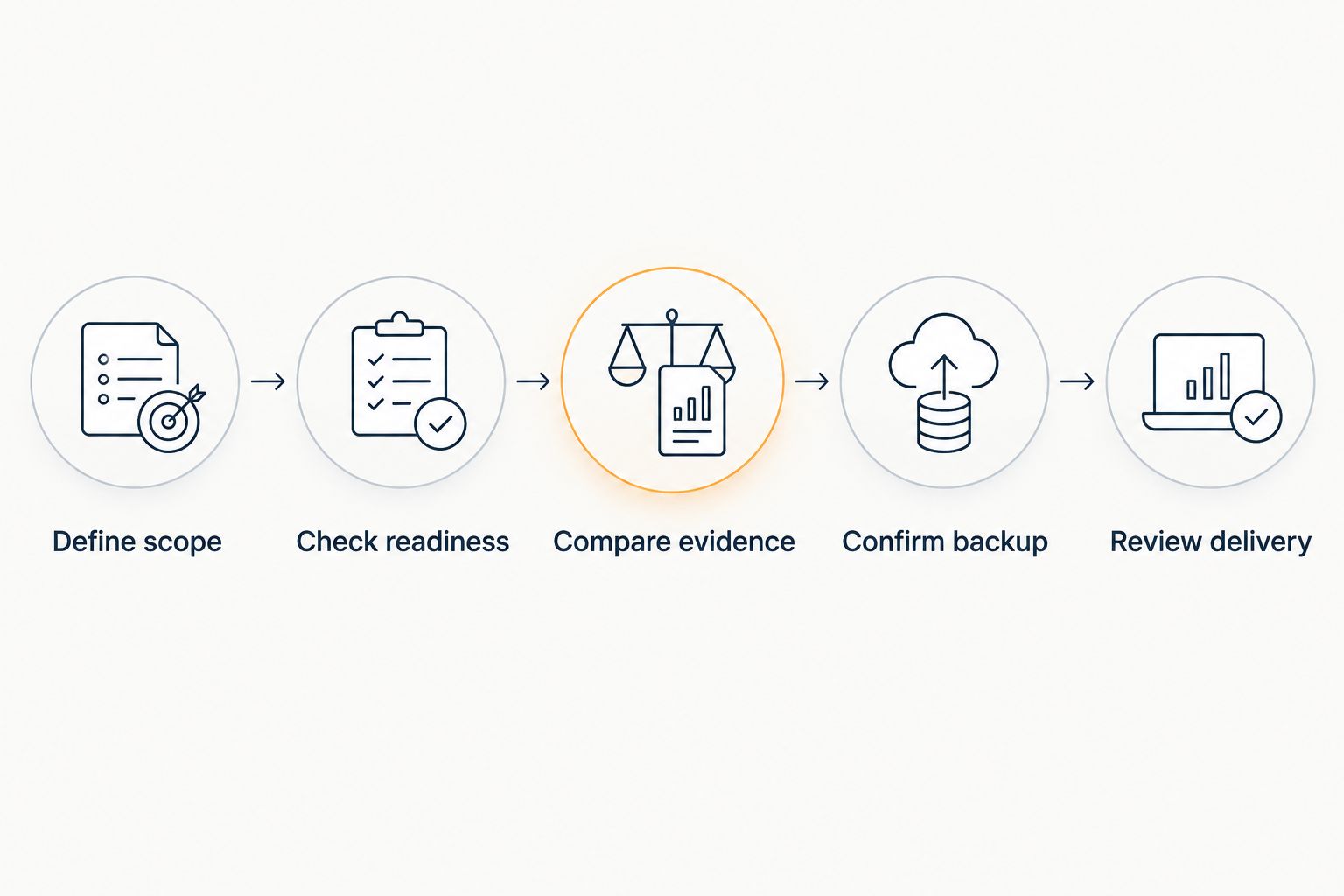
Follow this sequence before signing:
- Define scope: Write the clinical tasks, schedule, location, and onsite obligations.
- Check readiness: Verify the proposed physician's assignment-specific requirements.
- Compare evidence: Request results for comparable work using your fill-rate definition.
- Confirm backup: Put cancellation escalation and replacement approval in writing.
- Review delivery: Compare completed coverage with the agreed schedule after service begins.
Credentialing belongs near the beginning, not after you have committed the schedule. The guide to getting credentialed for locum tenens radiology provides a related starting point for physicians preparing for assignments.
How we ranked
The ranking prioritizes the match between the staffing model and the hospital's problem: temporary onsite absence, permanent vacancy, remote interpretation, or continuing service coverage. Physician job search is listed separately because it serves a different buyer.
The selection criteria are completed coverage, clinical fit, credentialing readiness, logistics, continuity, and replacement accountability. This is a decision framework, not a claim that one named agency has outperformed another.
Which staffing approach should you choose?
Start with an onsite locum tenens agency when your immediate problem is an uncovered onsite assignment. For a lasting vacancy, pursue permanent recruitment while managing the interim schedule separately.
Choose remote interpretation only for work that your hospital can assign remotely. Evaluate a regional group when the decision concerns the continuing service, not just an individual shift. For 2026 procurement, require each shortlisted provider to show exactly what it will cover and how delivery will be measured.
FAQ
What's the best radiology staffing agency for a rural hospital?
The best fit is an agency that documents completed coverage for your hospital's clinical scope, schedule, and credentialing requirements. Compare providers within the same staffing model rather than treating candidate submissions as filled shifts.
How do I calculate a radiology staffing fill rate?
Divide completed shifts by requested shifts and multiply by 100. Report cancellations and replacement coverage separately so the result describes delivered service rather than accepted assignments.
Is teleradiology better than onsite locum tenens coverage?
Teleradiology fits remote interpretation; onsite locum tenens fits responsibilities requiring physical presence. The right choice depends on the clinical work, not a general ranking of the two models.
Can a permanent-placement recruiter cover an immediate staffing gap?
Permanent recruitment does not itself cover the interim schedule. Arrange temporary coverage separately and track the recruited physician's actual start date.
What should a rural hospital ask before accepting a locum radiologist?
Confirm clinical scope, assignment dates, licensure, hospital privileges, onboarding requirements, and cancellation procedures. Ask who approves and coordinates replacement coverage if the assignment falls through.
Is RadBoard a radiology staffing agency?
RadBoard is a radiology job-search platform, not a staffing agency. It aggregates 5,000+ radiology positions from 20 sources and includes search and swipe-to-save features.
What evidence should staffing agencies provide in 2026?
Request dated results showing completed coverage, requested coverage, cancellations, and replacements for comparable assignments. Require the provider to state the hospital setting, clinical scope, reporting period, and calculation method.
One last thing
Ask who covers the shift after the replacement also cancels. That question tests whether the contingency plan identifies an accountable person, an escalation route, and a clinical fallback—or stops at a promise to search again.
Put the answer in the agreement. A staffing decision is not finished when you receive a CV; it is finished when the coverage responsibilities are clear.