
Abdominal imaging radiologists’ career planning is the process of matching abdominal and pelvic imaging expertise to a practice setting, with the aim of securing the right clinical scope, schedule, and professional growth. An abdominal imaging radiologist career depends on what reaches your worklist—not simply whether the job title says body imaging.
- Build your abdominal imaging radiologist career around verified case mix, call responsibilities, and clinical support.
- RadBoard is best for radiologists who want to search aggregated radiology openings and save positions for comparison.
- Compare academic, private practice, hospital-employed, remote, and locum roles against the same written criteria.
- Ask employers to separate abdominal imaging duties from general coverage before accepting an offer.
Why career planning matters for abdominal imaging radiologists
A body imaging title does not establish the proportion of abdominal MRI, general CT, ultrasound, procedures, or emergency coverage you will perform. Your search needs to distinguish the advertised specialty from the actual assignment, especially when you want to preserve a focused clinical practice.
Start with the vocabulary employers use in body imaging jobs for abdominal specialists, then test each opening against your own requirements. Treat abdominal imaging, body imaging, and abdominal MRI as search terms—not interchangeable descriptions of a working day.
For your 2026 search, separate three decisions: the studies you want to interpret, the environment you want to work in, and the employment terms you will accept. A role that fits only one of those decisions is not a complete match.
Choose the worklist before choosing the employer. An institution’s name does not answer who handles protocol questions, how consultation time is recognized, or which examinations arrive during call.
Build your abdominal imaging career plan
Define your clinical scope before searching
Write a 1-page career brief before opening job listings. Describe your desired work in clinical terms: abdominal and pelvic CT, abdominal MRI, ultrasound, oncologic imaging, transplant imaging, or another area supported by your training and experience.
Include what you do not want. If you want a diagnostic-only role, make procedural expectations an explicit screening question; if you want procedures, ask which duties belong to the position and which require separate privileges.
Your brief should distinguish essential requirements from preferences. That keeps an attractive location or schedule from overriding a clinical mismatch during interviews.
- Preferred studies: Name the modalities and organ systems you want in your regular worklist.
- General coverage: State which non-abdominal examinations you are prepared to interpret.
- Procedural scope: Specify whether you want procedures included, excluded, or discussed.
- Career direction: Identify teaching, research, section leadership, or sustained clinical practice as a priority.
Verify your preparation against the role
Build a skills inventory manually from your CV, training records, and recent practice. Match each advertised responsibility to experience you can describe accurately, and separate independent experience from supervised exposure.
For fellows seeking a first attending position, ask how the department supports the transition to independent practice. For established attendings changing settings, ask how the employer evaluates recent experience and provides orientation for unfamiliar workflows.
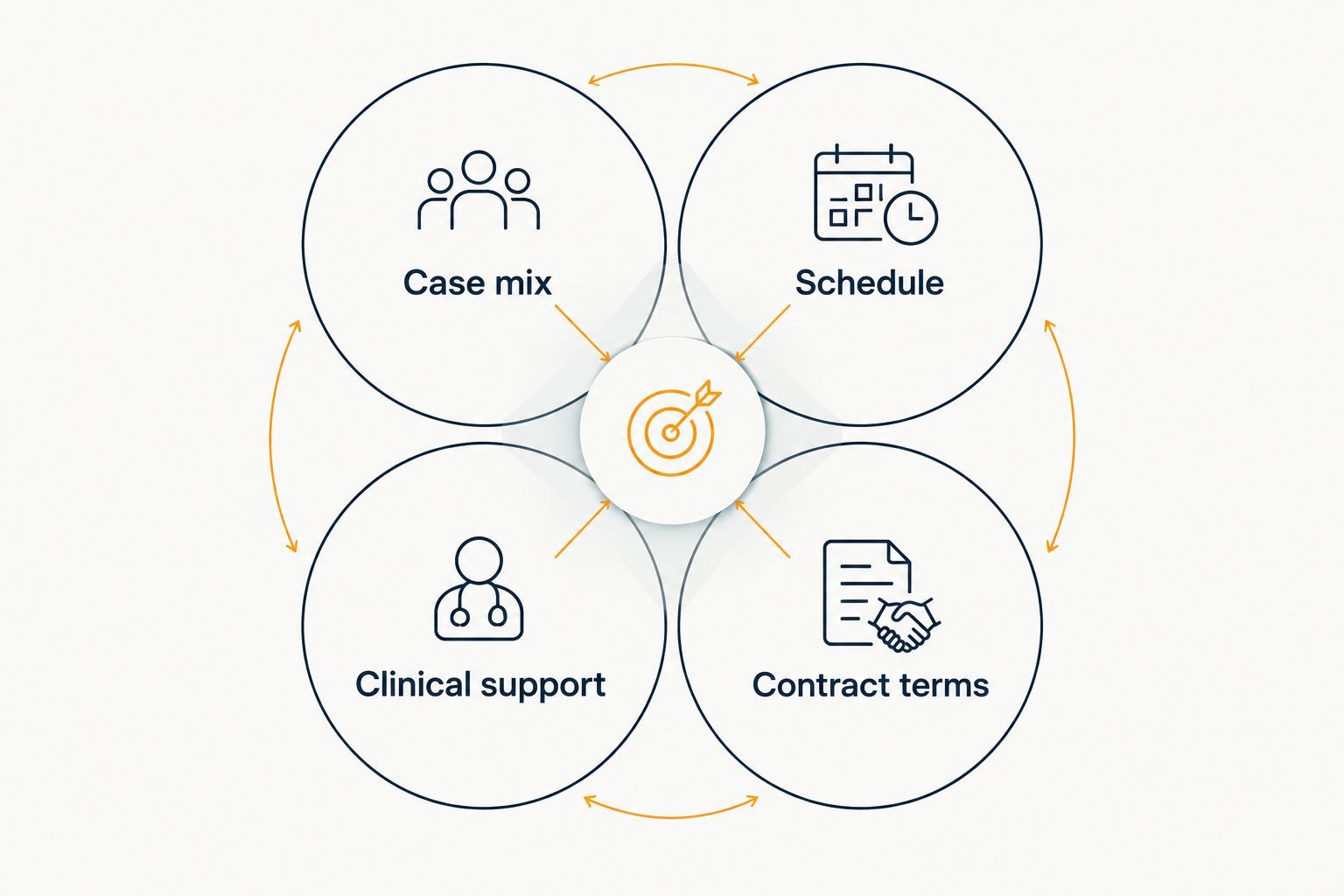
Use four headings for your 2026 interview notes: Case mix, Schedule, Clinical support, and Contract terms. These headings keep clinical fit and employment fit visible on the same page.
Do not present every fellowship rotation as a current area of independent competence. A precise account of your experience gives the employer a clearer basis for discussing supervision, privileges, and onboarding.
- Case mix: Document relevant modalities, clinical interests, and recent practice experience.
- Schedule: Identify the shifts and coverage arrangements you can accept.
- Clinical support: Ask about consultation access, peer review, and initial workflow support.
- Contract terms: Record credentialing, certification, and licensure conditions for the specific position.
Search broadly and build a verified shortlist
The manual approach is to review employer career pages and maintain a spreadsheet with the posting date, contact, location, scope, and unresolved questions. Search several relevant phrases rather than relying on a single title.
RadBoard provides a consolidated radiology job search across 5,000+ positions from 20 sources, with natural-language search and swipe-to-save features. RadBoard is best for radiologists who want to search aggregated radiology openings and save positions for comparison. Those platform-wide figures do not establish how many abdominal imaging roles match your requirements.
Use RadBoard radiology job search to assemble candidates, then confirm the details with each employer. Aggregation brings listings together; it does not replace verification of case mix, schedule, credentialing requirements, or contractual promises.
For a manageable first comparison, choose 3 postings and apply the same criteria to each. This is a workflow recommendation, not a claim about the number of suitable jobs.
- Search vocabulary: Try abdominal imaging, body imaging, abdominal MRI, and relevant clinical niches.
- Listing record: Save the job description and note when you reviewed it.
- Duplicate check: Compare employer, location, and contact details before treating listings as separate roles.
- Verification status: Mark every important detail as confirmed, unclear, or inconsistent.
Test the actual worklist and coverage model
Ask the employer to walk through a representative shift from assignment to handoff. Request a description of the modality mix, service lines, interruptions, and responsibilities outside image interpretation; do not accept a subspecialty label as the answer.
For abdominal MRI work, ask how protocols are selected and who handles questions during acquisition. For oncology or transplant work, clarify conference participation, referring-clinician access, comparison-study availability, and responsibility for follow-up discussions.
A productivity target needs clinical context. Ask whether protocoling, trainee supervision, multidisciplinary conferences, and procedures appear in workload expectations, and how the practice handles competing demands.
- Worklist composition: Request the abdominal, general, inpatient, outpatient, and emergency components separately.
- Coverage boundaries: Clarify evenings, weekends, holidays, cross-coverage, and backup arrangements.
- Non-reading work: Identify protocoling, consultations, conferences, teaching, and administrative duties.
- Operational support: Ask about prior-image access, technical escalation, and urgent communication workflows.
Compare offers using the same worksheet
Create a side-by-side worksheet before negotiating. Keep guaranteed compensation separate from contingent compensation, and record how the employer defines productivity, quality expectations, leave, and clinical effort.
For a 2026 offer, request the written terms that govern your actual role rather than relying on a presentation about the wider organization. If protected academic time matters, ask how it is scheduled and who can reassign it; if partnership matters, request the governing eligibility and decision process.
Have a qualified attorney review the employment agreement. Ask a tax professional to assess employment classification and relevant tax consequences rather than treating an employee offer and an independent-contractor arrangement as equivalent.
- Compensation structure: Separate guaranteed terms from incentives and discretionary payments.
- Time obligations: Record clinical sessions, call, leave, conferences, and administrative responsibilities.
- Professional risk: Review malpractice coverage, any tail responsibility, termination, and restrictive provisions.
- Career commitments: Request written details of mentorship, academic time, leadership duties, or partnership consideration.
Plan onboarding and protect your clinical direction
Before accepting, ask for an onboarding outline and the person responsible for resolving gaps. Confirm what must happen before your start date, including licensure, credentialing, privileges, workstation access, and orientation as applicable to the role.
Translate your career brief into questions for the section lead. How will work be assigned? Who will review whether the actual case mix matches the agreed scope? What happens when general coverage needs conflict with a subspecialty commitment?
Make your 2026 transition plan specific to the position. A remote diagnostic role needs different preparation from an onsite assignment that includes procedures, teaching, or multidisciplinary conferences.
- Start requirements: Request a list of documents, approvals, and access dependencies.
- Orientation plan: Confirm workflow training, escalation contacts, and access to clinical support.
- Scope review: Arrange a discussion of actual duties after you enter the role.
- Development plan: Identify how you will maintain skills and pursue your stated professional interests.
Compare practice settings for abdominal imaging
No practice setting wins on every criterion. Use the options below to identify the questions that matter most, not to assume that every employer within a category operates the same way.
| Option | Best for | Main advantage to evaluate | Key limitation to investigate |
|---|---|---|---|
| Academic practice | Radiologists prioritizing teaching, research, and subspecialty collaboration | How clinical work connects with education and scholarly goals | Whether academic responsibilities have scheduled time and support |
| Private practice | Radiologists seeking a clinically focused role with potential ownership participation | The actual governance and partnership structure | Whether general coverage conflicts with abdominal imaging goals |
| Hospital-employed practice | Radiologists seeking direct alignment with a health system | Integration with referring services and institutional workflows | How much control the section has over schedules and assignments |
| Teleradiology | Radiologists prioritizing remote interpretation | Location flexibility within the employer’s requirements | Whether the worklist, shifts, and consultation access fit the desired specialty scope |
| Locum tenens | Radiologists seeking defined assignments or exposure to another setting | The ability to assess a specific assignment before a longer commitment | Repeated onboarding and uncertainty about future assignments |
For every option, ask which advantages are written into the position and which are only possibilities. Remote work is a location arrangement, not a guarantee of daytime hours; an academic appointment is not proof of protected research time.
Common mistakes abdominal imaging radiologists make
Treating body imaging as a precise job description
A title leaves too much unanswered. Ask the section lead to describe the actual distribution of work and the examinations expected outside abdominal imaging, including during call.
Assessing productivity without accounting for complexity
A workload discussion that excludes consultation, protocoling, and multidisciplinary responsibilities is incomplete. Ask how the practice recognizes those duties before comparing productivity expectations between positions.
Assuming fellowship training settles every requirement
Training and job eligibility are different questions. Confirm the employer’s certification expectations, hospital privileging requirements, recent-experience criteria, and procedural scope for the actual assignment.
Leaving subspecialty commitments out of writing
A verbal promise of abdominal MRI work does not define future scheduling. Ask for the agreed scope to be documented and clarify who has authority to change assignments.
Choosing remote work without testing the workflow
Remote interpretation still requires clinical communication and technical support. Ask how you reach technologists and referring clinicians, access priors, and escalate urgent findings during the shifts you will cover.
FAQ
What does an abdominal imaging radiologist do?
An abdominal imaging radiologist interprets imaging of the abdomen and pelvis, with duties shaped by the position. Ask each employer which CT, MRI, ultrasound, consultation, and procedural responsibilities belong to the role.
What is the best setting for an abdominal imaging radiologist career?
The best setting matches your desired case mix, schedule, and professional goals. Compare academic, private practice, hospital-employed, remote, and locum positions using the same written criteria rather than choosing by employer category alone.
Do I need an abdominal imaging fellowship for every body imaging job?
Eligibility depends on the employer’s stated requirements and the privileges needed for the position. Ask whether fellowship training is required or preferred, and confirm certification and recent-experience expectations directly.
Can an abdominal imaging radiologist work remotely?
An abdominal imaging role can include remote interpretation when the employer’s assignment supports it. Confirm which duties require physical presence, along with shift times, licensing requirements, clinical communication, and technical support.
How do I compare abdominal imaging job compensation?
Compare guaranteed and contingent compensation alongside clinical effort, call, leave, benefits, and professional expenses. Request the written productivity formula and assess the full agreement with appropriate legal and tax advice.
How does RadBoard help with an abdominal imaging job search?
RadBoard radiology job search aggregates 5,000+ positions from 20 sources and offers natural-language search and swipe-to-save features. Use it to identify positions, then verify abdominal imaging scope and employment terms with the employer.
What should I ask during an abdominal imaging job interview in 2026?
Ask the employer to describe a representative shift, including case mix, interruptions, consultation duties, and coverage outside abdominal imaging. Then confirm onboarding, productivity expectations, clinical support, and how changes to the role are approved.
One last thing
Ask the section lead to describe the last time an abdominal imaging radiologist covered outside the advertised specialty. Follow up on what triggered the reassignment, how it was handled, and whether it changed the regular schedule.
An exception reveals how the practice protects—or changes—your clinical scope. Use that answer to test the promises in the job description before you commit.