
A cardiothoracic radiologist career is a diagnostic imaging career focused on the chest and heart, with the aim of guiding patient care through image interpretation and clinical consultation. This 2026 guide explains how to compare training, cardiac CT and MRI responsibilities, practice settings, call duties, and employment terms before choosing a position.
- Build your cardiothoracic radiologist career around verified case mix, not the position title.
- RadBoard brings radiology job search across 20 sources into one platform; confirm role details directly with employers.
- Separate chest imaging, cardiac CT, and cardiac MRI responsibilities before comparing offers.
- Choose academic, private practice, hospital-employed, or remote work according to clinical scope and career goals.
Why career planning matters for cardiothoracic radiologists
The title does not establish the work. A cardiothoracic position needs a closer look at its chest imaging responsibilities, cardiac service structure, general coverage, and consultation expectations. Use the guide to cardiothoracic radiology jobs for chest and cardiac imaging to frame your search, then verify each employer's actual assignment.
For your 2026 search, separate professional identity from scheduled duties. Wanting to practice cardiac MRI does not establish that a particular department will assign you cardiac MRI sessions or provide the necessary support.
Your decision should connect three things: what you are qualified to do, what the employer needs you to do, and what the schedule actually protects. A mismatch between them is a reason to clarify the role before proceeding, not something to resolve after signing.
How to build your cardiothoracic radiologist career
Define your clinical scope before searching
Start with a written description of your preferred working week. Distinguish pulmonary and thoracic imaging from cardiac CT, cardiac MRI, and general diagnostic coverage rather than treating cardiothoracic imaging as a single assignment.
Specify which activities you want to retain as your career develops. Lung cancer conferences, interstitial lung disease discussions, cardiac imaging consultation, and teaching each require time beyond producing reports. Ask where those duties sit in the schedule.
Create a one-page role specification that separates requirements from preferences. This becomes your screening document for recruiters, section chiefs, and interviews.
- Chest imaging: Identify the examinations and clinical services you want to cover.
- Cardiac imaging: State your desired cardiac CT and MRI responsibilities separately.
- General coverage: Define which non-cardiothoracic studies you will read.
- Clinical consultation: List the conferences and referring teams you want to support.
- Career direction: Choose your priorities among clinical practice, teaching, research, and leadership.
Match your training to the intended assignment
For a US clinical career, confirm the applicable medical licensure, diagnostic radiology training, board status, and institutional privileging requirements. Cardiothoracic fellowship training is relevant preparation, but its title alone does not describe your experience with every cardiac or thoracic examination.
Build an accurate record of your supervised experience, independent work, and current scope. A physician whose experience centers on thoracic oncology needs to describe that differently from a physician with extensive cardiac MRI responsibilities.
If you are choosing further training in 2026, evaluate the curriculum against your intended job. Ask who performs the work, who supervises it, and what responsibility fellows actually receive.
- Document cardiac CT, cardiac MRI, and thoracic imaging experience separately.
- Ask employers for their specific privileging criteria.
- Identify gaps between your experience and the proposed assignment.
- Confirm whether mentorship includes scheduled review and named supervisors.
- Keep patient information out of application materials and illustrative cases.
Search across titles and record the differences
The manual approach is to search employer career pages, review professional job postings, and contact departments directly. Keep a spreadsheet with the employer, location, clinical scope, schedule, application status, and unresolved questions; consolidate repeated postings for the same role.
Search beyond the exact phrase cardiothoracic radiologist. Relevant terms include chest imaging, thoracic radiology, cardiac CT, and cardiac MRI, but each result still needs review for actual clinical fit.
RadBoard is best for radiologists who want a single radiology job search across 20 sources. RadBoard aggregates 5,000+ radiology positions and provides search and swipe-to-save features. That breadth supports discovery; it does not establish how many positions match your subspecialty or verify an employer's promises.
- Run separate searches for chest imaging, cardiac CT, and cardiac MRI.
- Record the employer rather than counting every posting as a different opportunity.
- Save promising positions alongside unanswered clinical questions.
- Check whether the advertised work includes general diagnostic shifts.
- Confirm application instructions and role details with the hiring organization.
Verify the workload behind the position
Request a representative schedule and a description of the work assigned during recent shifts. Ask the section leader to distinguish examination counts, complexity, protocoling, consultations, and administrative duties instead of offering a single productivity figure.
For cardiac work, establish who owns acquisition protocols, image postprocessing, interpretation, and communication with referring clinicians. For thoracic work, ask how cancer staging, complex lung disease, screening studies, and urgent examinations enter the worklist.
A workload description is incomplete without its support model. Your 2026 offer evaluation should account for reading assistance, technologist access, specialist backup, and what happens when demand exceeds scheduled capacity.
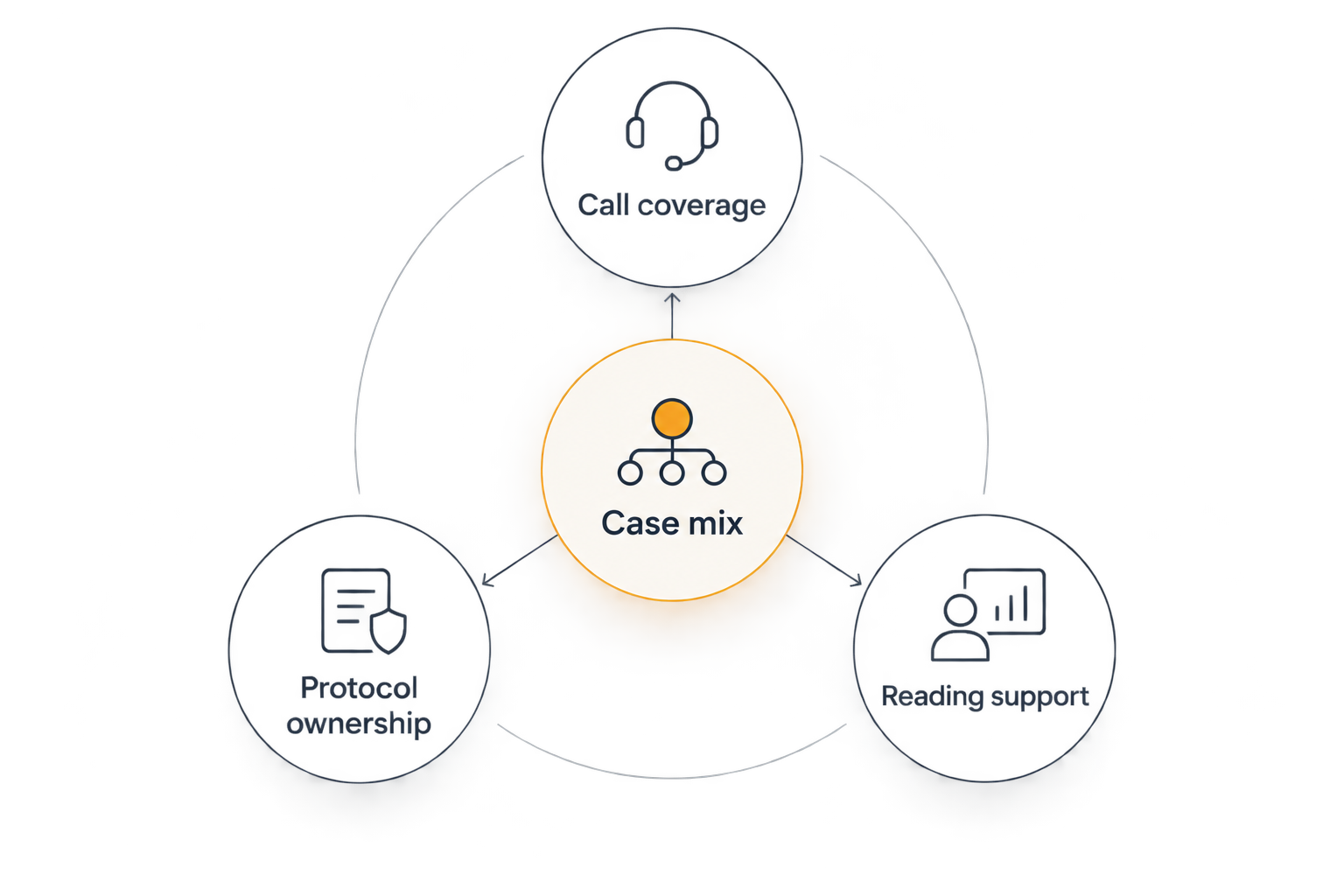
- Case mix: Request a breakdown by examination type and clinical complexity.
- Call coverage: Separate general call from cardiac or thoracic specialist backup.
- Protocol ownership: Identify who handles protocol questions and acquisition problems.
- Reading support: Confirm postprocessing, comparison retrieval, and technical assistance.
- Non-reading duties: Ask how conferences, teaching, and quality work are scheduled.
Test the practice setting against your goals
Begin by interviewing physicians doing the proposed work, not just the hiring manager. Ask what their last working week looked like and compare it with the recruiting description. Request clarity when clinical and administrative accounts differ.
For an academic role, examine how teaching, scholarship, and promotion expectations fit alongside clinical assignments. For private practice, establish governance, ownership eligibility, coverage obligations, and how subspecialty work is allocated.
For remote or hybrid work, separate reading location from clinical responsibility. A remote arrangement does not answer questions about scanner supervision, contrast coverage, consultation, or which examinations you will interpret.
- Ask a current colleague to describe a representative working week.
- Verify how cardiac and thoracic assignments are distributed.
- Identify who changes schedules and resolves coverage gaps.
- Request written expectations for teaching, research, or leadership.
- Confirm onsite duties before treating a position as location-independent.
Compare compensation mechanics and contract obligations
Start with a side-by-side worksheet using the actual offers. Compare guaranteed compensation, productivity calculations, scheduled hours, call, leave, benefits, and professional expenses without assuming that the highest headline figure represents the strongest offer.
Ask how the practice credits cardiac postprocessing, consultation, conferences, and protocol work. A productivity system deserves particular attention when your proposed schedule includes substantial duties outside direct interpretation.
For 2026 contracts, have a physician employment attorney review the agreement under the relevant state law. Get individual tax advice when comparing employee and independent-contractor arrangements; the employment label alone does not establish their net value.
- Obtain the productivity formula and worked examples from the employer.
- Confirm how leave changes productivity expectations.
- Identify malpractice coverage and responsibility for any required tail coverage.
- Review termination, repayment, restrictive covenant, and outside-work provisions.
- Put agreed clinical scope and schedule commitments into the written agreement.
Build an application around demonstrated fit
Tailor your CV and cover letter to the work you can substantiate. Name the relevant modalities, clinical services, teaching responsibilities, and leadership activities without presenting planned experience as completed experience.
Prepare examples that explain your judgment and collaboration. A discussion of resolving a protocol problem or communicating an important finding is more useful than an unsupported claim that you are an excellent team member.
For a first attending position, ask how onboarding supports the transition to independent practice. For an established radiologist, focus on whether the move preserves the skills and responsibilities you intend to retain.
- Match your opening application paragraph to the employer's stated clinical needs.
- Describe your cardiac and thoracic experience distinctly.
- Prepare de-identified examples of consultation and quality improvement.
- Ask references to address relevant clinical responsibilities.
- Confirm onboarding, backup, and initial assignment expectations before accepting.
Compare cardiothoracic career settings
Choose the setting that supports your intended work, not the label with the strongest appeal. The options below describe career-fit criteria rather than guarantees about individual employers. An academic appointment still needs documented teaching expectations; a private practice role still needs a clear ownership agreement.
| Option | Best for | Main advantage to verify | Key limitation to investigate |
|---|---|---|---|
| Academic practice | Radiologists prioritizing teaching and scholarship | Scheduled educational work and access to relevant clinical services | Clinical demands competing with academic responsibilities |
| Private practice | Radiologists seeking group participation and an ownership path | Defined governance and a written route to ownership, if offered | General coverage and ownership terms differing from expectations |
| Hospital employment | Radiologists seeking a role within an integrated clinical service | Direct coordination with hospital-based teams | Limited control over staffing or service changes |
| Remote or hybrid practice | Radiologists prioritizing reading-location flexibility | A documented remote schedule and suitable technical support | Onsite duties or modality restrictions limiting the arrangement |
| Locum tenens work | Radiologists seeking defined temporary assignments | A written assignment scope and coverage schedule | Repeated onboarding and uncertain continuity of subspecialty work |
Treat these categories as interview starting points. Compare the actual assignment, reporting structure, and contract before deciding which option fits your cardiothoracic radiologist career.
Common mistakes cardiothoracic radiologists make
Accepting a subspecialty title without a subspecialty schedule
Ask which scheduled sessions contain cardiac or thoracic work and who controls reassignment. A verbal statement about the department's long-term plans is not the same as an agreed clinical assignment.
Treating cardiac CT and cardiac MRI as interchangeable
Review the required experience, workflow, and support for each modality independently. Strength in one area does not establish readiness or privileges for every responsibility in the other.
Leaving consultation work outside the workload discussion
Ask how protocoling, multidisciplinary conferences, and referring-clinician discussions affect your available reporting time. Include these duties when comparing schedules rather than assessing the position on examination counts alone.
Assuming remote work removes onsite dependencies
Confirm who handles the responsibilities that remain at the imaging site. Your reading location and the service's onsite coverage plan are separate questions, and both need answers before you commit.
Deferring clinical scope until after signing
Resolve material differences between the posting, interview, and agreement before acceptance. Ask for written clarification when cardiac assignments, general call, mentorship, or protected time affect your decision.
FAQ
What does a cardiothoracic radiologist do?
A cardiothoracic radiologist interprets imaging of the chest and heart and provides related clinical consultation. The actual assignment depends on the role, so verify chest imaging, cardiac CT, cardiac MRI, and general coverage separately.
Do I need a fellowship for a cardiothoracic radiologist career?
Check the employer's training and privileging requirements rather than assuming a universal hiring rule. Cardiothoracic fellowship training is relevant preparation, but the employer must assess your documented experience against the intended responsibilities.
What's the best practice setting for a cardiothoracic radiologist?
The best practice setting is the one that supports your intended case mix, schedule, and professional goals. Compare academic expectations, ownership terms, hospital service duties, or remote responsibilities using the actual offer.
Can a cardiothoracic radiologist work remotely?
Remote suitability depends on the examinations, clinical duties, technical setup, and employer requirements. Confirm onsite coverage, protocol support, consultation access, licensing, and privileges before accepting a remote assignment.
How should I compare cardiothoracic radiology compensation?
Compare the full compensation structure with the workload and contractual obligations. Review productivity calculations, call, leave, benefits, professional expenses, and duties that do not generate interpretation credit.
Where should I start searching for cardiothoracic radiology jobs?
Start with employer career pages, professional postings, department contacts, and a specialty search platform such as RadBoard. Search chest imaging, thoracic radiology, cardiac CT, and cardiac MRI separately, then verify each position with the employer.
What should I ask during a cardiothoracic radiology interview?
Ask for a representative schedule, modality-specific responsibilities, general call duties, and the support available for complex work. Also confirm who controls assignments and how consultation, teaching, and protocoling enter workload expectations.
One last thing
Before accepting a 2026 position, ask: Who receives the next cardiac MRI examination, and why? Then ask the same question about a complex chest CT and a general overnight examination. Those answers test how the department actually distributes work.
Use RadBoard for radiology job search and shortlist building, then verify the assignment directly. A search result starts the evaluation; the documented clinical role determines the fit.