Correctional facility radiology jobs run almost entirely on teleradiology contracts and third-party staffing vendors, not standard hospital employment, and evaluating one in 2026 means checking the coverage model, the employer structure, and the liability protection before you sign anything.
- Correctional facility radiology jobs in 2026 run mostly on remote teleradiology contracts, not on-site attending roles.
- Federal Bureau of Prisons and VA-adjacent facilities offer federal benefits; private vendors like Centurion or Wellpath pay RVU-based rates instead.
- Malpractice tail coverage and multi-state licensing matter more here than in typical hospital radiology jobs.
- Nighthawk shifts and short-term locum tenens contracts are the fastest entry points into correctional radiology work.
Why this matters
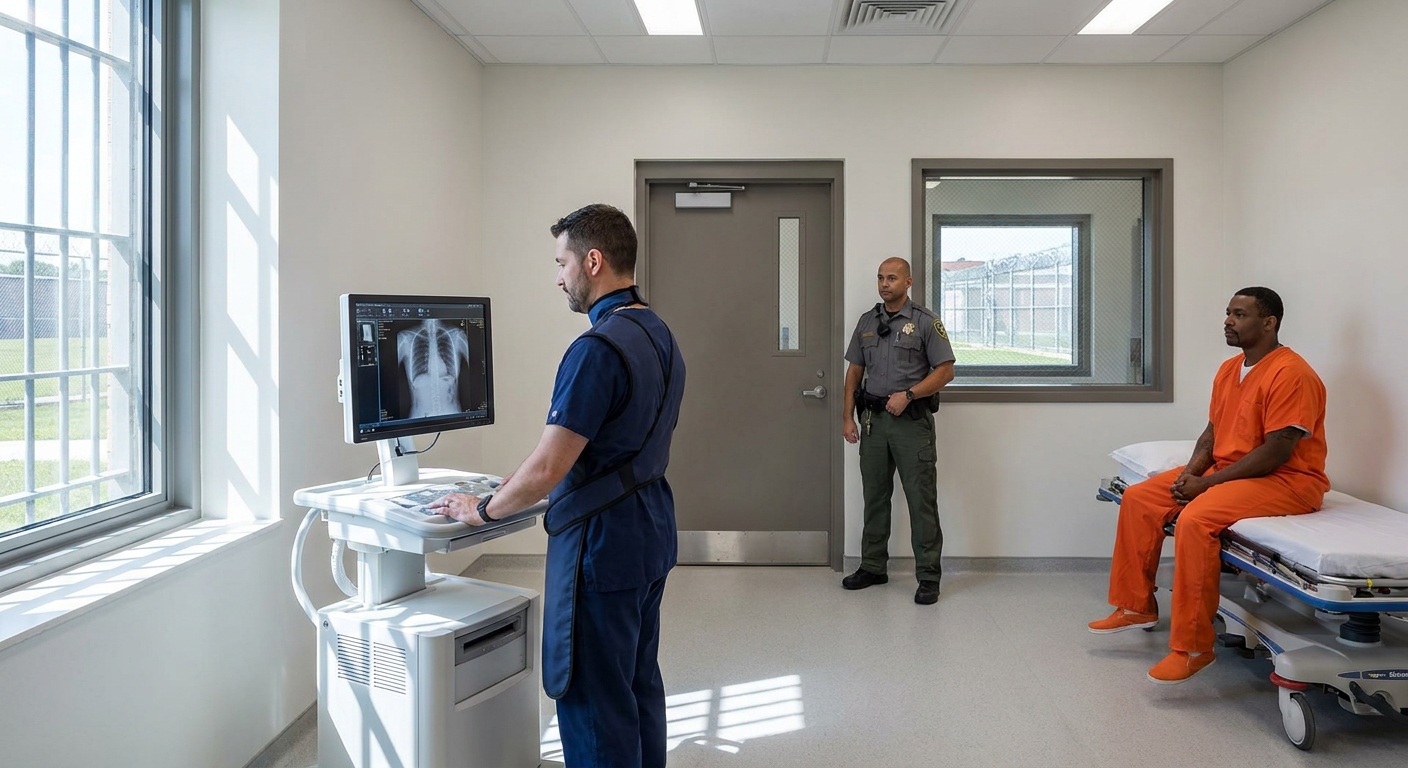
Most state and federal correctional systems do not staff full-time, on-site radiologists. Imaging equipment inside a prison infirmary is usually limited to portable X-ray, and studies get routed off-site or read remotely by a contracted radiologist. That structure means correctional facility radiology jobs look less like a hospital posting and more like a teleradiology or locum tenens contract wearing a different label.
The employer sitting behind the contract also varies more than in most radiology hiring. You might be reading for a state Department of Corrections, a federal Bureau of Prisons site, or a private correctional healthcare vendor that holds the actual imaging contract. Each path carries a different pay structure, a different credentialing timeline, and a different liability exposure in 2026's litigation environment around inmate care.
Who this is for
This guide is for a radiologist with general, body, or musculoskeletal training who is comfortable reading trauma and assault-related studies remotely, doesn't need to be on-site, and wants either the federal benefits attached to Bureau of Prisons and VA-adjacent work or the flexible income of a locum tenens or teleradiology contract. It's a fit if you already read overnight or nighthawk shifts and want to add correctional coverage into that rotation rather than start a new full-time role.
What to look for in correctional facility radiology jobs
Coverage model: teleradiology vs. on-site
Almost every correctional facility radiology job in 2026 is a remote read, not a physical presence contract. Confirm whether the posting expects you to review portable X-rays and occasional CT studies transmitted from the facility, because "on-site" language in a job title can still mean a single infirmary visit per week with remote coverage the rest of the time.
Employer structure: federal, state, or private contractor
A federal Bureau of Prisons contract behaves like a VA-adjacent federal job, complete with federal benefits and loan repayment eligibility in some cases. A state Department of Corrections contract usually routes through a private correctional healthcare vendor such as Centurion Health, YesCare, or Wellpath, and pay there is closer to RVU or per-study rates than a fixed salary.
Licensing and multi-state credentialing
If the contract covers more than one facility across state lines, you need active licenses in each state before you read a single study. Correctional teleradiology vendors that route reads across a regional network often require two or three state licenses simultaneously, and credentialing can add 60 to 90 days before your start date.
Turnaround SLAs and call schedule
Correctional facilities frequently need fast turnaround on trauma and self-harm cases, which pushes some contracts into nighthawk-style overnight coverage. Ask for the contracted turnaround time in writing, not verbally, because a 30-minute SLA on trauma reads changes the actual workload compared to a routine 24-hour read window.
Malpractice tail coverage
Inmate litigation is a real and recurring exposure in correctional healthcare, and tail coverage gaps show up more often in these contracts than in standard hospital-employed radiology jobs. A contract that doesn't explicitly name tail coverage, or that leaves it as your responsibility after termination, is a red flag regardless of the pay rate.
Compensation structure
Federal correctional and VA-adjacent roles tend to run on a government pay scale with predictable benefits. Private contractor and teleradiology-based correctional work usually pays per study or per RVU, which means your effective hourly rate depends entirely on read volume, not a flat salary.
Find correctional radiology openings faster
Search 5,000+ radiology jobs from 20 sources with AI-powered filters.
Top picks for correctional facility radiology jobs
Teleradiology contracts covering correctional systems — the default entry point. Most correctional imaging in 2026 is read this way, with turnaround SLAs often set at 30 minutes for trauma studies. If you already read remotely and want to add correctional volume without relocating, teleradiology jobs for radiologists who want remote flexibility is the category to search first. Buy.
Federal Bureau of Prisons and VA-adjacent roles — the benefits play. These positions carry federal pay scales and benefits structures similar to other federal medicine, and eligibility can include loan repayment programs depending on the posting. Radiologists prioritizing stability over top-line RVU pay should look at radiology jobs at VA hospitals for federal benefits as the closest comparable federal pathway. Consider.
Nighthawk overnight coverage for correctional trauma reads — the overnight route. Correctional facilities generate a disproportionate share of after-hours trauma and self-harm studies, which is exactly the workload nighthawk contracts are built around. If your schedule already skews overnight, nighthawk radiology jobs for physicians who prefer overnight shifts is worth cross-referencing against correctional vendor postings. Consider.
Short-term locum tenens diagnostic contracts — the test-drive. A locum tenens diagnostic radiology contract lets you cover a correctional system's imaging for a few weeks or months before committing to a longer arrangement, which matters given how much variation exists between individual state DOC contracts. This route is a good way to evaluate turnaround expectations and vendor reliability before signing anything longer. Buy.
What to avoid
- Contracts without an explicit tail coverage clause. If malpractice tail coverage isn't named in writing, assume you're responsible for it after the contract ends.
- "On-site" postings that are actually single-visit infirmary reads. Confirm the real cadence before assuming the job means daily physical presence.
- Per-study pay with no minimum volume guarantee. RVU-based correctional contracts can swing hard month to month; ask for historical volume, not projections.
Verdict comparison
| Path | Coverage model | Employer type | Verdict |
|---|---|---|---|
| Teleradiology contracts | Remote | Private vendor | Buy |
| Federal BOP / VA-adjacent | Mixed | Federal | Consider |
| Nighthawk overnight | Remote | Private vendor | Consider |
| Locum tenens diagnostic | Remote or on-site | Staffing agency | Buy |
FAQ
What are correctional facility radiology jobs?
Correctional facility radiology jobs involve reading imaging studies for state, federal, or privately contracted prison healthcare systems, usually through remote teleradiology rather than on-site attending roles in 2026.
Do correctional radiology jobs pay more than hospital jobs?
Pay varies by employer type: federal Bureau of Prisons roles run on government pay scales, while private contractor and teleradiology-based correctional work usually pays per study or per RVU, which can exceed or trail hospital salaries depending on volume.
Is correctional facility radiology work remote?
Most of it is. Correctional facilities typically lack on-site radiologists and route portable X-ray and CT studies to remote teleradiology contractors for reads, often under tight turnaround SLAs for trauma cases.
Who employs radiologists for correctional healthcare?
Employers include state Departments of Corrections working through private correctional healthcare vendors such as Centurion Health, YesCare, or Wellpath, and the federal Bureau of Prisons for federal facilities.
Is malpractice tail coverage included in correctional radiology contracts?
It depends on the contract, and it should always be confirmed in writing. Correctional healthcare carries elevated litigation exposure, making tail coverage gaps a common and costly oversight.
Do correctional radiology jobs require multiple state licenses?
Yes, if the contract covers facilities across state lines, which is common with regional teleradiology vendors. Expect 60 to 90 days of credentialing lead time per additional state.
How fast is turnaround for correctional radiology reads?
Trauma and self-harm studies often carry SLAs as tight as 30 minutes, while routine studies may allow up to 24 hours. The exact number should be written into the contract, not left verbal.
Can locum tenens radiologists work correctional facility contracts?
Yes, short-term locum tenens diagnostic radiology contracts are a common way to cover correctional imaging before committing to a longer-term arrangement with a specific vendor or state system.
One last thing
The overnight nighthawk shift you already work for a rural ER contract may include correctional facility studies without the vendor ever labeling them that way. Teleradiology companies frequently bundle correctional reads into general overnight coverage pools, so the fastest way into this niche in 2026 isn't a dedicated "correctional radiologist" posting, it's asking your current teleradiology group what's already in the queue.