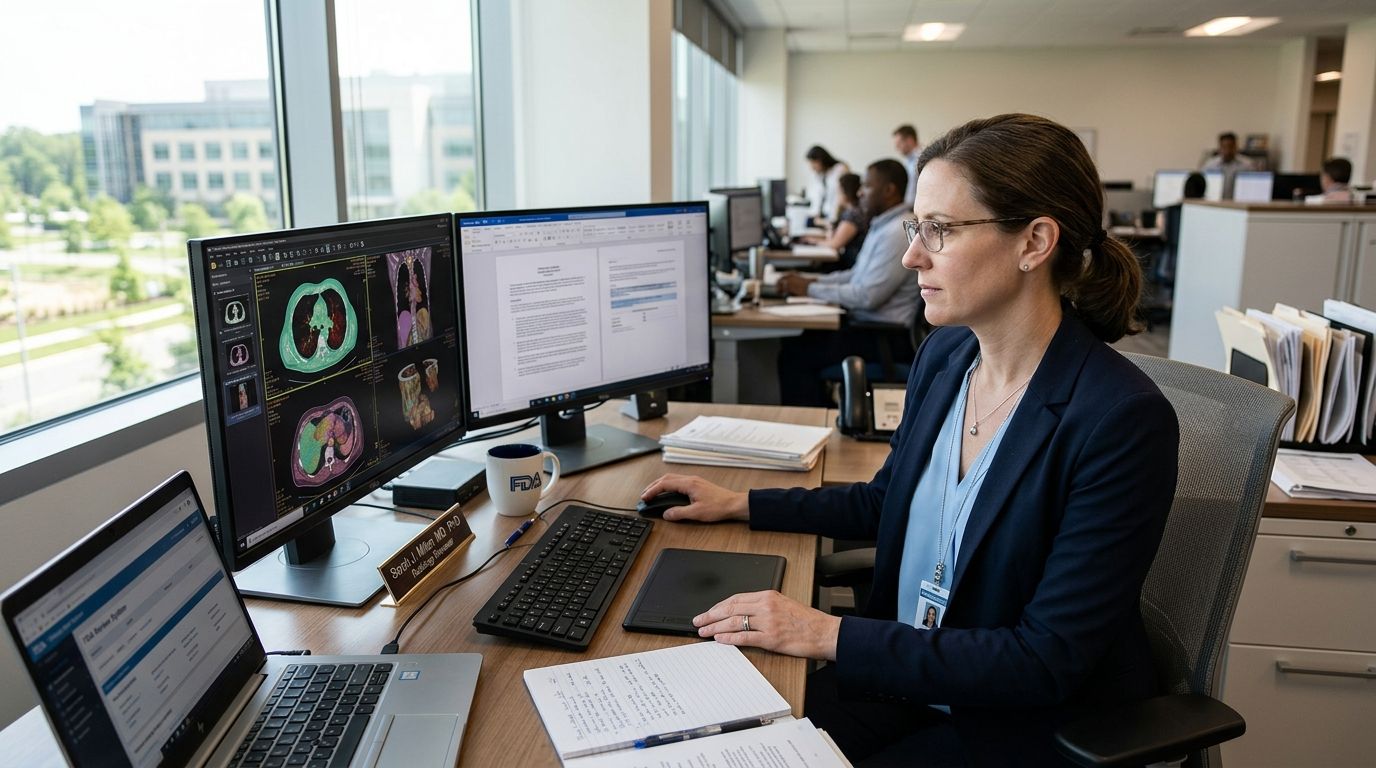
FDA radiology reviewer jobs are federal positions inside the Center for Devices and Radiological Health (CDRH) where board-certified radiologists evaluate imaging device submissions instead of reading patient scans. The work centers on 510(k) clearances, premarket approval (PMA) applications, and post-market surveillance for MRI, CT, ultrasound, and AI-based imaging software — a different skill set from clinical volume, but one that draws directly on subspecialty reading experience.
This segment differs from most radiology career searches because the buyer isn't a hospital or practice group — it's a federal agency, and the hiring process runs through USAJOBS, not a recruiter or a practice's HR office.
- FDA radiology reviewer jobs are federal CDRH roles evaluating imaging device submissions, not patient scans.
- Best fit: board-certified radiologists with device, informatics, or regulatory exposure who want off-call, non-clinical work.
- CDRH is headquartered in the Silver Spring, MD metro area, and pay follows the federal General Schedule with locality adjustment.
- RadBoard indexes non-clinical and industry-adjacent radiology postings alongside 5,000+ clinical openings from 20 sources in 2026.
Why FDA radiology reviewer jobs matter for device and imaging regulation
Radiologists searching for FDA reviewer roles in 2026 are almost always coming from one of two places: burnout with call schedules, or a specific interest in device regulation after working with new imaging hardware or AI-assisted software in daily practice. Neither group searches the way a typical hospital-track radiologist does — they're not filtering by subspecialty read volume, they're filtering by non-clinical, federal, and device.
That search behavior matters because most radiology job boards are built around clinical postings — call schedules, RVU comp, subspecialty mix. FDA reviewer roles rarely show up in that inventory because they're civil service positions, not practice hires. Anyone chasing this path has to know to look at USAJOBS directly, and to treat adjacent non-clinical and industry roles as the bridge while a federal opening comes open. You can browse the broader radiology career platform RadBoard maintains to see which non-clinical and industry-adjacent postings are active right now, even though direct CDRH listings sit outside its 5,000+ aggregated jobs.
Update your understanding of what CDRH reviewers actually do
- Review 510(k) submissions for imaging hardware and software, checking substantial equivalence claims against predicate devices
- Evaluate PMA applications for higher-risk imaging devices, including clinical data packages
- Participate in post-market surveillance when adverse event reports involve imaging equipment
- Contribute to guidance documents on AI/ML-based imaging software, an active CDRH priority in 2026
- Sit on advisory panels reviewing new imaging modalities before clearance decisions
Map your clinical background to FDA hiring criteria
- List board certification and subspecialty fellowship training first — CDRH reviewer postings weight this heavily
- Highlight any prior work with device manufacturers, clinical trials, or informatics committees
- Note experience reading studies from investigational devices, even informally, since it signals familiarity with pre-clearance imaging
- Flag any publication or peer-review work touching device performance, sensitivity, or specificity data
- Include PACS or radiology informatics exposure — CDRH increasingly reviews AI-driven software, and informatics fluency is a differentiator
Search the right channels, not the usual radiology job boards
- Search USAJOBS directly using radiologist, medical officer, and CDRH as combined terms
- Set alerts for GS-14 and GS-15 medical officer postings, the typical grade range for physician reviewers
- Check the FDA's own careers page for CDRH-specific announcements, which sometimes post before appearing on USAJOBS
- Use a broader non-clinical radiology job search to catch adjacent industry roles that build toward a federal application — RadBoard's non-clinical radiology jobs listings cover imaging tech and AI companies that hire former reviewers and vice versa
- Network through radiology informatics and device-regulation subcommittees at ACR and RSNA, where CDRH staff frequently present
Build a CV federal reviewers will recognize
- Lead with board certification, licensure, and any FDA-adjacent committee work
- Use plain, specific language for device and imaging experience — avoid clinical shorthand a non-radiologist HR reviewer won't parse
- Quantify review volume where you can: studies read per week, years in a subspecialty, any device-related case series
- Include any regulatory writing — protocol review, clinical study design feedback, or grant reviews touching imaging endpoints
- Keep the format federal-resume style if applying through USAJOBS, which expects more narrative detail than a typical two-page clinical CV
Prepare for the federal interview and clearance process
- Expect a structured, competency-based interview format common across federal medical officer hiring
- Budget for the additional timeline: federal background checks and security processing routinely add weeks to months versus a private practice offer
- Prepare to discuss specific device submissions or imaging modalities you've worked with, since panels test technical depth
- Ask directly about telework policy — CDRH has allowed hybrid schedules for reviewers, but this varies by division
Keep a paid bridge role while the federal process runs
- Take device consulting or clinical-trials imaging work to keep device exposure current on your resume
- Consider utilization review or claims adjudication work for steady part-time non-clinical hours
- Use per-diem or locum clinical shifts to hold income steady without a full-time call schedule
- Stay licensed and board-current — a lapse during a multi-month federal process kills the application
Search non-clinical radiology openings now
Browse industry, informatics, and device-adjacent roles while a federal opening comes open.
Comparison: FDA reviewer roles vs. adjacent non-clinical paths in 2026
| Option | Best for | Typical entry path | Key limitation |
|---|---|---|---|
| CDRH staff radiologist (FDA) | Radiologists wanting fully non-clinical, federal, off-call work | USAJOBS application, GS-14/15 medical officer postings | Long hiring and clearance timeline; pay follows GS scale, not RVU comp |
| Medical device consulting | Radiologists who want project-based device review without leaving practice entirely | Direct outreach to device manufacturers or consulting firms | Inconsistent volume; requires building a client base |
| Expert witness / IME consulting | Radiologists wanting flexible, case-based non-clinical income | Referral networks, legal consulting platforms | Irregular scheduling; requires deposition and testimony comfort |
| Insurance claims review | Radiologists wanting steady part-time non-clinical hours | Direct hire by payers or utilization review vendors | Work is adjudication-focused, not device or regulation-focused |
| Clinical trials imaging (pharma) | Radiologists interested in device and drug development pipelines | Pharma or CRO imaging core lab postings | Requires comfort with sponsor timelines and protocol-driven reads |
Radiologists moving away from full-time clinical reading toward regulatory or industry work should read the broader breakdown on leaving clinical radiology for industry and consulting before picking a specific path — CDRH is one option among several, and the right one depends on how much clinical work you want to keep.
For radiologists weighing legal and consulting income against a federal reviewer role, the case-based flexibility of expert witness and IME consulting work is worth comparing directly against CDRH's fixed schedule and slower hiring timeline.
Verdict: FDA radiology reviewer jobs are the right fit for board-certified radiologists who want fully non-clinical, off-call federal work and are willing to accept GS-scale pay and a multi-month hiring process in exchange. Radiologists who need faster income or want to keep one foot in clinical reading are better served by device consulting or clinical trials imaging in the near term.
“If you need the job to start in 60 days, FDA reviewer work is the wrong target in 2026 — federal clearance does not compress.”
Common mistakes radiologists make chasing FDA reviewer roles
- Applying without a federal-style resume. A clinical CV formatted for a hospital job gets passed over on USAJOBS, where narrative detail and quantified duties matter more.
- Skipping the clearance timeline math. Radiologists used to a fast hospital hiring process underestimate the months a federal background check can take, then push for an answer that nobody at CDRH can give.
- Treating device experience as irrelevant. Radiologists discount informal exposure to investigational devices or AI software pilots, when that's exactly the experience CDRH panels ask about.
- Ignoring the non-clinical bridge roles. Waiting for a CDRH opening with no interim plan leaves a resume gap; industry consulting or clinical trials imaging work keeps the transition visible and paid.
- Assuming FDA work replaces subspecialty private practice income at parity. Federal GS pay follows a published scale with locality adjustment — radiologists comparing it directly to RVU-driven practice comp are often surprised by the structure, even when the trade-off of no call and no weekend reads is the whole point.
FAQ
What does an FDA radiology reviewer do?
An FDA radiology reviewer evaluates imaging device submissions inside CDRH, including 510(k) clearances and PMA applications for MRI, CT, ultrasound, and AI-based imaging software. The role is regulatory, not clinical, so reviewers assess device safety and equivalence data rather than interpreting patient studies.
Is FDA radiology reviewer work clinical or non-clinical?
It is fully non-clinical. Reviewers spend their time on submission review, guidance documents, and post-market surveillance rather than diagnostic imaging interpretation.
How much does an FDA radiology reviewer earn in 2026?
Federal medical officer pay follows the General Schedule scale with locality adjustment, since CDRH is headquartered in the Silver Spring, MD metro area. That is a different structure than RVU-based practice compensation, so check the current GS tables rather than assuming parity with clinical pay.
Do you need board certification to work at FDA as a radiology reviewer?
Yes, board certification and an active medical license are standard requirements for CDRH medical officer postings. Subspecialty fellowship training in imaging or device-adjacent work strengthens an application further.
Is FDA reviewer work a good exit from clinical radiology?
It is a strong option for radiologists who want off-call, fully non-clinical work and can absorb a slower federal hiring timeline. It is a poor fit for anyone who wants to keep reading studies part-time or needs a fast transition.
How do I apply for FDA radiology reviewer jobs?
Apply directly through USAJOBS using terms like radiologist, medical officer, and CDRH, and check the FDA careers page for CDRH-specific postings that sometimes appear before reaching USAJOBS.
What is the difference between FDA reviewer work and expert witness consulting?
FDA reviewer work is a fixed-schedule federal job reviewing device submissions. Expert witness and IME consulting is case-based and flexible, centered on legal testimony or independent medical evaluations rather than regulatory review.
Can teleradiologists transition into FDA reviewer roles?
Yes, though the transition benefits from added device or informatics exposure. Teleradiologists with PACS or AI-software reading experience have a stronger technical match for CDRH's growing AI/ML imaging device workload.
One last thing
CDRH's workload on AI/ML-based imaging software has grown as more device makers submit algorithm-driven products for clearance. Radiologists with hands-on exposure to AI-assisted reads in 2026 hold a technical edge that most CVs still bury under generic clinical language — put it on page one, not in a bullet at the bottom.