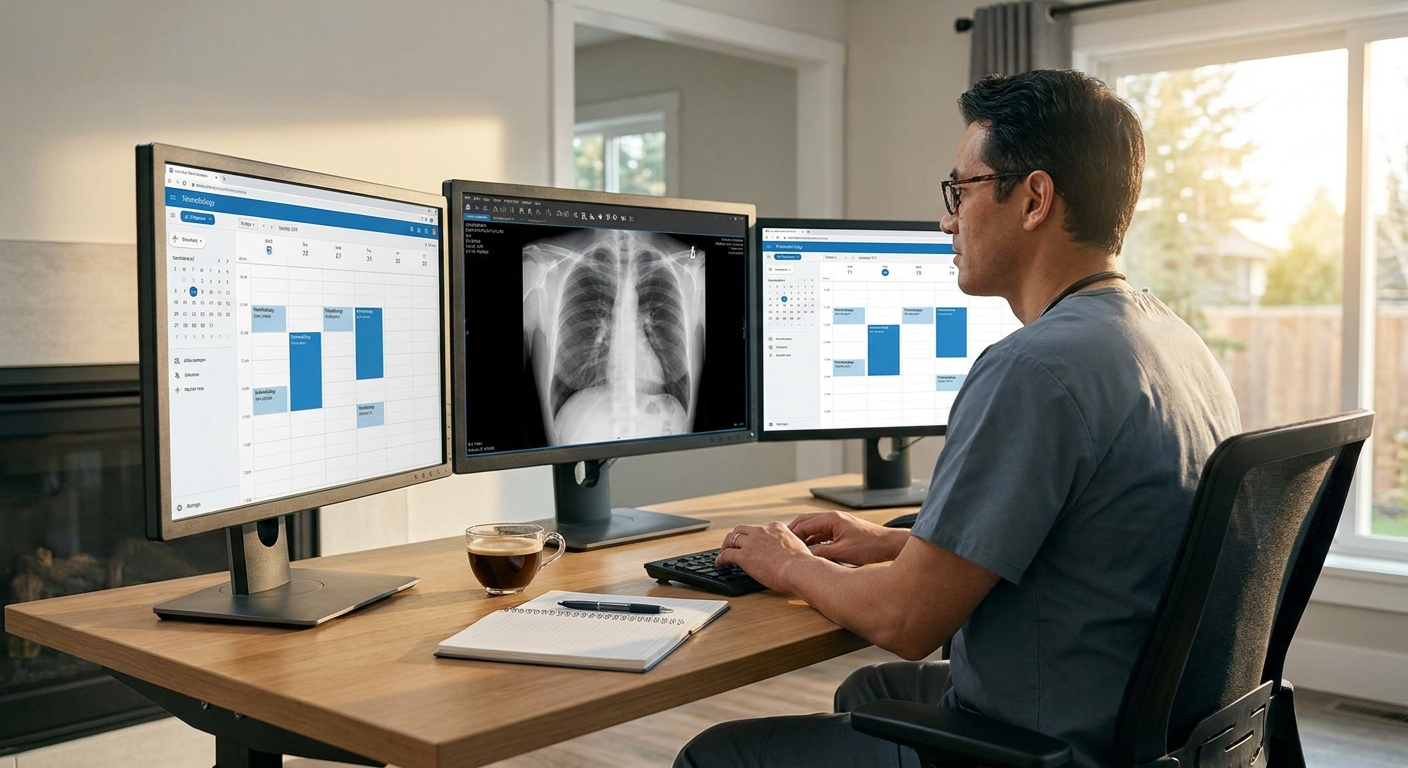
A teleradiology side income schedule only works if you build it around fixed reading blocks and a real rate floor, not whatever hours are left over after your full-time job. This walks through the steps, the contract checks, and the tracking system that keeps a side schedule from eating your primary job or your weekends in 2026.
- Structure a teleradiology side income schedule around fixed reading blocks, not leftover hours — buy the block model over open availability.
- Check your primary contract's moonlighting clause before signing any teleradiology side income schedule in 2026.
- Track true hourly rate, not per-study rate, or you won't know if the schedule pays.
- Multi-state licensing lag is the top delay — start applications 60 to 90 days before your first shift.
- Cap side volume in 90-day increments to avoid burnout stacking on top of full-time reads.
Why this matters
Most radiologists who add a teleradiology side income schedule fail at one of two points: they never checked whether their primary contract allows outside reads, or they never calculated what the extra hours actually pay after licensing costs, malpractice tail exposure, and tax withholding.
A side schedule that isn't structured with fixed blocks and a rate floor turns into unpaid overtime with extra paperwork. The fix isn't finding more shifts — it's building the schedule correctly before you accept the first one.
What you'll need
- A copy of your primary employment contract, specifically the moonlighting and non-compete clauses
- An active license in every state where you'll read remotely, or a plan to get one
- A calendar system you actually use — shared or personal, doesn't matter, as it must be checked before every commitment
- A spreadsheet or app to log hours, RVUs, and per-study or per-hour pay
- Malpractice tail awareness for the secondary engagement, separate from your primary coverage
- A realistic view of your open evening, weekend, or early-morning hours over a rolling 90-day window
If you're evaluating whether teleradiology side income fits your situation at all, confirm the fit before you touch licensing paperwork — it's the cheapest step to reverse.
The steps
1. Audit your primary employment contract first
This step protects the job you already have. Most academic and hospital-employed contracts include a moonlighting clause that either requires disclosure, caps outside hours, or bans it outright for anyone covered by the employer's malpractice policy.
Read the non-compete language too — some contracts restrict remote reads for competing health systems within a defined radius, and "remote" doesn't always exempt you from a geographic non-compete written before telehealth became common. If the language is ambiguous, get it clarified in writing before you sign anything with a teleradiology group. Evaluate a teleradiology contract against your primary agreement side by side, not in isolation.
Expected outcome: you know exactly what's disclosed, capped, or off-limits before you commit hours. Common mistake: assuming a moonlighting clause only applies to in-person shifts — many 2026 contracts now name remote and asynchronous reads specifically.
2. Secure licensure in your target read states
This step determines how much of the market you can actually serve. A teleradiology side income schedule is only as flexible as your license portfolio — one state license means one client pool, multiple licenses mean you can pick up coverage gaps across time zones.
Apply through the Interstate Medical Licensure Compact where your home state participates; it typically cuts processing time versus a standalone application in each state. Budget 60 to 90 days for a new state license even with the compact, longer without it.
Expected outcome: you can accept assignments in 2-4 states within a quarter instead of one. Common mistake: waiting until a specific offer requires the license, which stalls your start date by months.
3. Pick an engagement model that fits your calendar
This step decides whether you're reading asynchronously (batch studies, submit on your own timeline within an SLA) or live (scheduled real-time shifts, often overnight or weekend). Asynchronous work fits unpredictable free time; live shift work fits people who can commit to the same block every week.
Most radiologists running a side schedule alongside a full-time job do better with asynchronous or short fixed blocks rather than open-ended per diem availability — it prevents the "always on call" trap. Per-diem shift flexibility platforms list which vendors support each model.
Expected outcome: a model that matches your actual free hours instead of one you have to bend your life around. Common mistake: signing up for live overnight shifts without testing whether your sleep schedule tolerates it first.
4. Block fixed reading windows, not "whenever free" time
This step is what separates a sustainable side schedule from a burnout schedule. Open-ended availability sounds flexible but creates constant low-grade decision fatigue — every evening becomes a negotiation with yourself about whether to log in.
Pick two or three fixed windows per week (for example, Tuesday and Thursday 7-10pm, Saturday 8am-noon) and treat them as immovable. Put them on the same calendar as your primary job's call schedule so conflicts show up before they become double-bookings.
Expected outcome: predictable weekly volume you can actually plan around. Common mistake: agreeing to "as available" arrangements that quietly expand into a second full-time job.
5. Set a rate floor using true hourly math
This step tells you whether the schedule is worth running at all. Per-study or per-RVU rates look attractive in isolation, but they don't account for report turnaround pressure, license maintenance costs, or the malpractice tail on the secondary work.
Calculate true hourly pay by dividing total compensation for a block by every hour spent on it, including report review and any callback time — not just the reading itself. Calculate true hourly rate for locum work before you accept a recurring arrangement, then set a personal floor below which you decline shifts.
Expected outcome: a number you can compare across offers instead of guessing. Common mistake: comparing headline per-study rates across companies without normalizing for study complexity or turnaround requirements.
6. Track everything for 1099 tax season
This step keeps the extra income from turning into a tax surprise. Most teleradiology side work pays on a 1099 basis, which means no withholding and a self-employment tax obligation on top of your regular return.
Log every payment, mileage or home-office deduction, license renewal fee, and malpractice tail cost in the same spreadsheet you use for hours. Set aside 25-30% of side income for quarterly estimated taxes rather than waiting until April.
Expected outcome: no scramble in Q1 of 2027 when the 1099s arrive. Common mistake: treating 1099 income like a paycheck and spending it before the tax set-aside happens.
7. Ramp volume in 90-day increments
This step prevents the schedule from silently expanding past what you agreed to. Start with one fixed block per week for the first 90 days, then reassess: is your primary job performance steady, is sleep intact, is the true hourly rate holding up?
Only add a second block after that checkpoint, not before. Radiologists who stack volume too fast in year one of a side schedule are the ones most likely to drop it entirely within 12 months.
Expected outcome: a side schedule still running smoothly a year in, not one you quietly abandoned in month four. Common mistake: doubling volume the moment the first paycheck looks good.
Compare Teleradiology Openings Now
Search 5,000+ radiology listings from 20 sources to find side-income-friendly roles.
Troubleshooting
Problem: your primary employer flags the outside work. Fix: go back to the contract language you audited in step one, disclose proactively if required, and get any exception approved in writing before continuing.
Problem: license approval is taking longer than expected. Fix: check compact status versus standalone application status — some states process compact letters faster than direct applications, and a status call to the board often surfaces a stuck document.
Problem: the per-study rate looked good but true hourly is low. Fix: revisit the math from step five — report complexity, turnaround SLAs, and callback frequency usually explain the gap, and it's a reason to renegotiate or drop the contract.
Problem: fixed blocks keep getting bumped by primary-job call. Fix: put both schedules on one calendar and treat the side blocks as fixed appointments, not optional ones — recurring conflicts mean the block needs to move permanently.
Problem: burnout symptoms show up by month three. Fix: drop to one block per week immediately rather than pushing through — the 90-day ramp in step seven exists specifically to catch this before it compounds.
“A teleradiology side income schedule that requires willpower every week isn't a schedule — it's a countdown to quitting.”
Tools and resources
- Interstate Medical Licensure Compact application portal for multi-state licensing
- A shared calendar app that syncs your primary call schedule with side blocks
- A spreadsheet template tracking hours, RVUs, per-study pay, and true hourly rate
- Per-diem shift flexibility platforms for comparing engagement models before you sign
- A quarterly estimated tax calculator for 1099 income
What to do next
Once the schedule is running, the next decision is which company or platform to route the extra volume through — not every teleradiology vendor pays or structures shifts the same way. Compare vendors on turnaround SLA, per-study versus per-hour pay, and license support before renewing past the first 90-day block.
FAQ
How much can a radiologist earn from a teleradiology side income schedule in 2026?
Earnings depend on volume, study mix, and rate structure, and vary widely by contract in 2026. Calculate true hourly rate rather than headline per-study pay before comparing offers.
Is teleradiology side work worth it for a full-time attending?
It's worth it when the true hourly rate clears your personal floor and the schedule fits fixed weekly blocks. It stops being worth it once it interferes with sleep, primary-job performance, or call coverage.
Do I need a license in every state to do teleradiology side work?
You need an active license in whichever state the patient is physically located during the study, not where you're sitting. The Interstate Medical Licensure Compact speeds up getting additional state licenses.
Can my employer stop me from taking teleradiology side income work?
Yes, if your primary contract has a moonlighting clause or a non-compete that names remote or telehealth reads. Review the contract language before accepting any outside work.
How many hours per week is reasonable for a teleradiology side schedule?
Most radiologists start with one fixed block of 3-4 hours per week and reassess every 90 days. Stacking volume faster than that is the most common cause of dropping the schedule within a year.
Is teleradiology side income paid as 1099 or W-2?
Most teleradiology side work pays on a 1099 basis with no tax withholding. Set aside 25-30% of that income for quarterly estimated taxes.
What's the biggest mistake radiologists make setting up a side schedule?
Accepting open-ended availability instead of fixed reading blocks, which turns a side schedule into an always-on obligation. Fixed blocks protect both the primary job and personal time.
How long does it take to get licensed for teleradiology side work?
Expect 60 to 90 days through the Interstate Medical Licensure Compact, longer through a standalone state application. Start the process before you have a specific offer, not after.
One last thing
The radiologists who keep a teleradiology side income schedule running past year one almost always started with one fixed block, not two. Adding the second block only after a 90-day check on sleep, primary-job performance, and true hourly rate is the difference between a schedule that lasts and one that quietly disappears by month six.