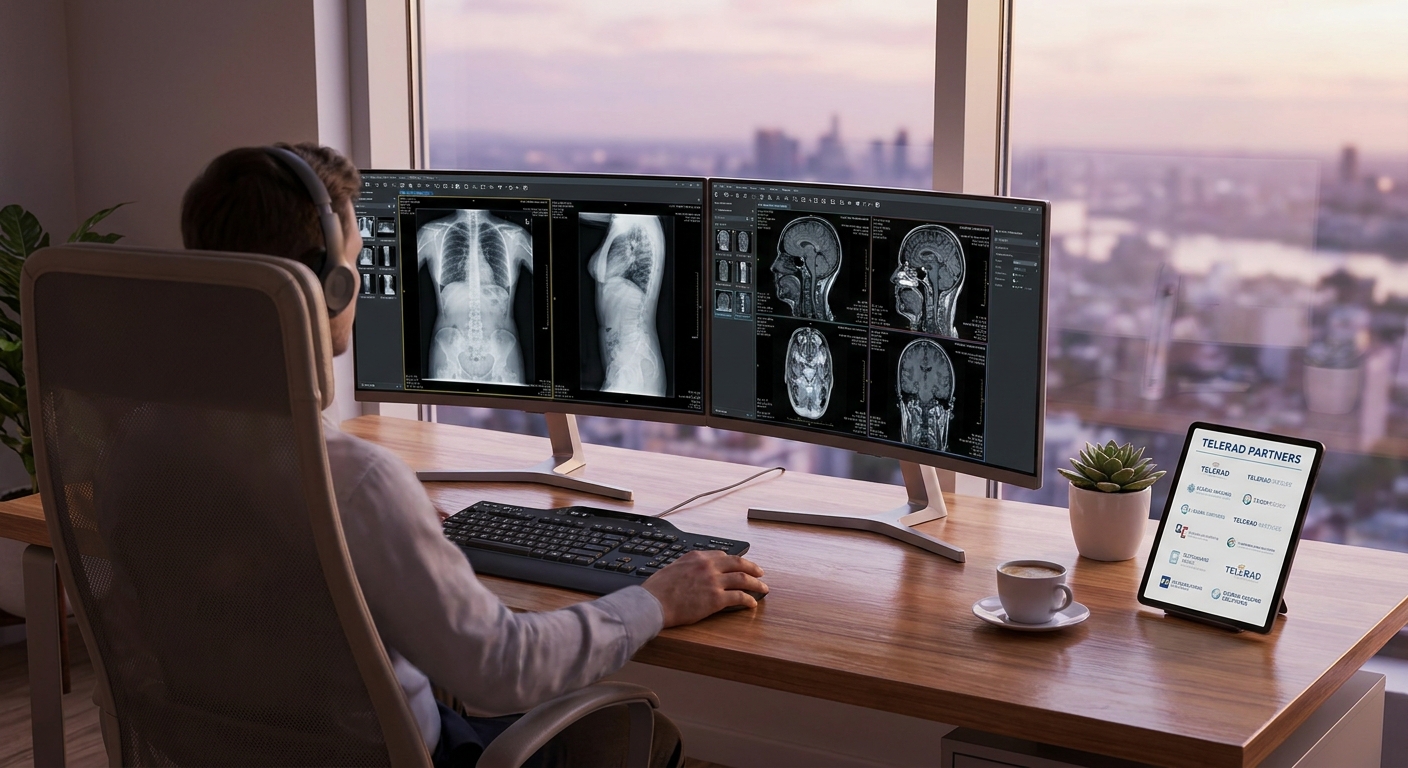
Teleradiology hiring in 2026 splits into a handful of distinct models, and picking the wrong one costs radiologists more in lost autonomy and licensing headaches than a bad RVU rate ever will. This guide ranks the structures worth targeting and names the shops that fit each one.
- National teleradiology groups win on case volume and subspecialty rotation in 2026 — Buy for high-throughput readers.
- Nighthawk-focused shops pay a premium for overnight coverage but demand a real schedule shift — evaluate before signing.
- Federal telehealth radiology through the VA trades top-dollar RVU pay for loan forgiveness and benefits — Buy for stability seekers.
- Best teleradiology companies vary by subspecialty: neuro and MSK readers do better at specialty-only shops than generalist mills.
- Licensing burden, not salary, is the real differentiator between teleradiology employers in 2026.
Why this matters
Teleradiology stopped being a side gig years ago. It's now a primary career track, and the teleradiology jobs landscape in 2026 includes national consolidators, subspecialty-only shops, nighthawk specialists, and federal telehealth programs — each with a different pay structure, licensing requirement, and lifestyle trade-off.
The mistake most radiologists make is comparing offers on hourly rate alone. Two teleradiology contracts can pay the same per RVU and still be completely different jobs once you factor in state licensing count, case mix, and whether you're on call for every modality or just the ones you trained on.
How we ranked these
Each category below is scored on four factors that actually change a radiologist's day-to-day: case volume and subspecialty mix, licensing burden (how many states you need to carry credentials in), schedule control, and compensation structure. This isn't a popularity ranking — it's a fit ranking. A shop that's a Buy for a night-shift MSK reader can be a Skip for a daytime neuroradiologist, and the list below flags that explicitly instead of pretending one model fits everyone.
The ranked list
1. National teleradiology groups — the volume play
Large national teleradiology employers built through consolidation over the past decade run the widest case mix in the industry: general X-ray, CT, MRI, and cross-coverage across dozens of hospital contracts. That breadth means more RVU-earning potential per shift, but it also means less specialization control — you read what comes through the queue.
Verdict: Buy for radiologists who want maximum volume and don't mind a generalist rotation.
2. Subspecialty-only remote practices — the specialist's lane
Boutique teleradiology shops built around a single subspecialty (neuro, MSK, body) route only matched cases to fellowship-trained readers. Pay per study tends to run higher than generalist queues because the client hospital is paying for expertise, not throughput.
Verdict: Buy for fellowship-trained radiologists who don't want general call mixed into their week.
3. Hybrid hospital-embedded remote programs — the anchor-site hybrid
Some teleradiology employers pair remote reading with a requirement to appear on-site periodically — usually for tumor boards, procedure days, or quarterly meetings. It's a middle ground between full remote and traditional employment, and it often comes with better benefits than pure-play remote shops.
Verdict: Hold unless the on-site cadence (check the contract for exact frequency) fits your travel tolerance.
4. Nighthawk-focused teleradiology shops — the overnight specialist
Overnight and weekend coverage is where the nighthawk radiology jobs market pays its premium. These shops exist specifically to cover the 7pm-to-7am window that hospital-employed radiologists don't want, and the pay differential reflects that.
Verdict: Buy if you're optimizing for pay per hour and can handle a permanent overnight schedule. Skip if you need a conventional sleep pattern.
5. Regional and independent teleradiology groups — the lighter-licensing option
Smaller, regionally concentrated teleradiology groups typically cover fewer states, which cuts the licensing and credentialing burden significantly compared to a national shop reading across 20-plus jurisdictions. The trade-off is a smaller case pool and less negotiating leverage on rate.
Verdict: Hold — evaluate case mix and rate transparency before signing, since smaller shops vary more in pay consistency.
6. Academic-affiliated remote programs — teaching without the commute
Some academic radiology departments now run remote reading tracks for faculty who want to keep a teaching or research appointment without being physically in the reading room every day. These roles show up less often than pure-play teleradiology postings, and access usually requires an existing academic affiliation — the academic radiology jobs track is worth watching if that's your path.
Verdict: Buy if you already hold an academic appointment. Wait if you're trying to break into academics cold — these openings are limited.
7. VA and federal telehealth radiology — the benefits path
Federal telehealth radiology programs pay less per RVU than private national groups but come with benefits private practice rarely matches: federal retirement, loan repayment programs, and predictable schedules. VA hospital radiology jobs are worth a serious look for radiologists prioritizing stability over top-dollar pay in 2026.
Verdict: Buy for radiologists who value benefits and schedule predictability over maximum earnings.
8. Locum tenens teleradiology contracts — the flexible route
Locum contracts let radiologists sample multiple teleradiology employers before committing to one, and they're increasingly used as a bridge between residency and a permanent position or as a way to test a subspecialty shop before signing long-term. Locum tenens radiology jobs rates run higher per shift to compensate for the lack of benefits.
Verdict: Buy for radiologists who want optionality. Skip if you need benefits continuity and contract stability.
“Licensing burden, not salary, is what actually separates a good teleradiology contract from a bad one.”
Comparison table
| Type | Best For | Coverage Model | Licensing Load | Verdict |
|---|---|---|---|---|
| National teleradiology groups | High-volume generalists | Broad, multi-modality | Heavy (many states) | Buy |
| Subspecialty-only shops | Fellowship-trained readers | Narrow, matched cases | Moderate | Buy |
| Hospital-embedded hybrid | Radiologists open to occasional travel | Remote plus periodic on-site | Moderate | Hold |
| Nighthawk-focused shops | Overnight-schedule readers | Overnight/weekend only | Moderate to heavy | Buy/Skip (schedule-dependent) |
| Regional/independent groups | Licensing-conscious radiologists | Regional, smaller pool | Light | Hold |
| Academic-affiliated remote | Faculty with existing appointment | Mixed teaching/reading | Light | Buy/Wait |
| VA/federal telehealth | Benefits-first radiologists | Structured, federal | Light | Buy |
| Locum teleradiology contracts | Radiologists testing employers | Short-term, variable | Varies by assignment | Buy/Skip |
Named teleradiology companies to compare
Use this shortlist as a starting point, then compare licensing support, case mix, schedule, turnaround expectations, compensation structure, and benefits in each current offer.
| Company | What to compare |
|---|---|
| Experity | Urgent-care and outpatient integration, turnaround-time consistency, operational visibility |
| vRad (Virtual Radiologic) | Nationwide coverage, high-volume reading model, modality mix, schedule |
| Nines | Technology and AI tools, quality process, workflow optimization |
| RadNet | Outpatient imaging network, geographic coverage, case mix |
| ONRAD | Hospital and imaging-center workflow customization, service model |
| Direct Radiology | Hospital and health-system support, accessibility, subspecialty coverage |
| StatRad | Acute-care coverage, turnaround expectations, overnight schedule |
| Teleradiology Solutions | Global coverage, subspecialty expertise, licensing and board-certification requirements |
Company names are examples to compare, not a ranking or endorsement; verify current openings and contract terms before applying.
Where to find these openings
- Search across aggregated sources instead of one employer's career page — postings for the same teleradiology role often appear on multiple boards with different pay disclosure.
- Confirm licensing support in writing before accepting any offer; a shop that won't cover multi-state licensing costs is telling you something about its margins.
- Compare RVU rate against case complexity, not just the headline number — a subspecialty shop paying less per study can still out-earn a generalist queue per hour.
Find teleradiology openings by subspecialty
Search 5,000+ radiology positions from 20 sources with AI-powered filters.
FAQ
What are the best teleradiology companies to work for in 2026?
The best fit depends on subspecialty and schedule preference: national teleradiology groups offer the highest case volume, subspecialty-only shops pay a premium for fellowship training, and federal telehealth programs offer the strongest benefits. There is no single best teleradiology company for every radiologist in 2026.
Is teleradiology pay better than in-person radiology pay?
Teleradiology often pays more per RVU for overnight and weekend shifts, but in-person hospital-employed roles typically include stronger benefits and retirement matching. Compare total compensation, not just the hourly or per-study rate.
How many state licenses do teleradiology radiologists need?
It depends on the employer's client hospital footprint. National teleradiology groups often require licensure in ten or more states, while regional shops may only need two or three.
Do teleradiology jobs require board certification in a subspecialty?
General teleradiology queues typically only require ABR certification, but subspecialty-only shops require fellowship training in that specific area, such as neuroradiology or MSK.
Are nighthawk radiology jobs worth the pay premium?
Nighthawk roles pay more per shift specifically because the overnight schedule is hard to staff. It's worth it for radiologists who can adapt to a permanent night schedule, but the premium doesn't offset burnout for those who can't.
Can locum tenens teleradiology lead to a permanent position?
Yes. Locum contracts are commonly used as a trial period by both the radiologist and the employer before either side commits to a permanent role.
Does the VA offer remote radiology jobs?
Yes, federal telehealth radiology programs through the VA offer remote reading positions with federal benefits and loan repayment options, though RVU pay typically runs below private national teleradiology groups.
How do I compare teleradiology company offers?
Compare licensing support, case mix, and total compensation together rather than the headline pay rate alone. A lower per-study rate at a subspecialty shop can outperform a higher generalist rate once case complexity and hours are factored in.
One last thing
The teleradiology employers gaining the most traction in 2026 aren't the ones with the highest advertised pay — they're the ones disclosing licensing support and case mix upfront in the job posting itself. That transparency alone is becoming a filter radiologists use before they even open an application, and it's a better signal of contract quality than the rate line.