
Locum tenens radiology is worth it in 2026 when the assignment improves your total compensation, gives you usable schedule control, and matches your clinical skills. It is not worth accepting on the advertised rate alone: unpaid time, benefit replacement, travel obligations, cancellation terms, and malpractice responsibilities belong in the decision.
- Is locum tenens radiology worth it? Yes, when the written contract supports your financial, scheduling, and clinical priorities.
- Compare guaranteed work and total obligations, not an advertised rate against an employed salary.
- Reject assignments with unresolved clinical scope, cancellation, or malpractice terms.
- RadBoard supports radiology job search across 5,000+ positions from 20 sources; verify assignment details before accepting.
Is locum tenens radiology worth it in 2026?
Choose locum work for a defined objective, not an assumed financial premium. That objective might be filling a career gap, testing a practice, supplementing an existing role, or working selected blocks instead of holding a continuing appointment.
Start with the actual arrangement. The guide to locum tenens radiology jobs for flexible contracts provides a starting point for that search; the assignment agreement determines what you are accepting.
| Work arrangement | Best for | Main advantage to evaluate | Main drawback to evaluate |
|---|---|---|---|
| Locum tenens assignment | Radiologists seeking defined coverage periods | Ability to select individual assignments | Gaps, cancellations, and repeated onboarding |
| Permanent employed position | Radiologists prioritizing continuity | An ongoing role with a defined benefits package | Continuing schedule and employment obligations |
| Locum-to-permanent assignment | Radiologists evaluating a potential long-term practice | Opportunity to assess the workplace during temporary coverage | Permanent employment terms still require separate review |
These are decision categories, not promises about individual openings. A permanent role can offer scheduling flexibility, and a temporary assignment can impose rigid coverage requirements. Read the terms rather than treating the label as the answer.
Why this matters
A radiology assignment combines clinical responsibility with a business agreement. You need both to fit. A preferred schedule does not compensate for an unfamiliar procedural scope, and attractive compensation does not resolve an unsafe escalation process.
For your 2026 search, separate eligibility from desirability. First confirm that you can legally and clinically perform the assignment; then decide whether its financial and personal trade-offs beat your alternatives.
The relevant comparison is the role you would otherwise accept. Do not compare a real locum contract against an imaginary employed position with ideal benefits, no call, and unlimited flexibility.
Locum assignments: best for defined coverage blocks
Locum work fits a radiologist who wants to commit to specified dates rather than an indefinite role. Ask which dates are confirmed, whether additional coverage is optional, and whether the facility can change the schedule after acceptance.
The advantage is assignment-level choice. The limitation is that choosing an assignment does not establish a continuing income stream, and an anticipated extension is not the same as a signed extension.
Accept the block only when its confirmed obligations fit your calendar. Include travel, orientation, call, and administrative work in that calendar, not just reading-room hours.
Permanent employment: best for continuity
A permanent position deserves a place in the comparison when you value an established team, ongoing responsibilities, or employer-sponsored benefits. Check the actual benefits documents, paid leave terms, and eligibility conditions rather than assuming every employed role includes the same package.
The advantage is continuity within a continuing appointment. The trade-off is the commitment: call allocation, outside-work restrictions, notice requirements, and other contractual obligations need the same scrutiny as compensation.
Prefer the employed offer when its complete package better supports your priorities. There is no reason to select temporary work merely because it sounds more flexible.
Locum-to-permanent: best for evaluating a practice
A temporary assignment can help you observe a practice before considering a continuing role. Use that opportunity to evaluate case mix, communication, reading systems, staffing, and the response to clinical questions.
The limitation is the transition itself. Ask whether permanent employment is genuinely under consideration, who makes that decision, and whether any restrictions affect your ability to accept a direct offer.
Treat permanent employment as a separate negotiation. Do not assume that a successful temporary assignment settles compensation, partnership, benefits, or future scheduling.
Why the value of locum radiology varies
The assignment's value depends on what you keep, what you give up, and what you must do to complete it. Evaluate these factors before discussing an extension or leaving another position:
- Guaranteed work: Identify confirmed shifts, minimum commitments, cancellation notice, and payment obligations after a cancellation.
- Employment structure: Establish your classification and who handles withholding, insurance, retirement contributions, and other responsibilities.
- Clinical scope: Confirm modalities, procedures, patient populations, call coverage, and the boundary between subspecialty and general work.
- Unpaid time: Account for credentialing paperwork, orientation, travel, and administrative tasks outside compensated hours.
- Practice support: Confirm PACS access, dictation systems, prior-study availability, technical support, and clinical escalation contacts.
- Exit obligations: Review termination, malpractice arrangements, restrictive provisions, and any responsibilities that continue after the assignment.
Ask for written answers. A recruiter’s summary helps you identify an opportunity, but the signed agreement and applicable coverage documents need to support the promises that matter to your decision.
How do you compare the financial value without guessing?
Compare both offers over the same 12-month planning period. That is a budgeting framework, not a prediction of how much work you will obtain. Include only confirmed work in your committed-income calculation and keep potential extensions separate.
Build a worksheet with compensation received, expenses you personally bear, benefits you must replace, and the total time committed. Keep employer reimbursements distinct from compensation so the comparison does not count the same economic benefit twice.
For a 2026 decision, use your actual offers, current insurance quotations, and applicable tax advice. A general market headline cannot establish the value of your assignment.
Separate paid work from committed time
Record reading shifts, call obligations, orientation, travel, and required administrative work. Identify which activities are compensated under the agreement.
A comparison based only on reading hours misses the rest of the commitment. Keep unpaid hours visible even when the contract does not assign them a monetary value.
Compare benefits explicitly
List the benefits in your employed alternative and determine what happens if you move to temporary work. Review health coverage, retirement arrangements, paid leave, continuing education support, and disability coverage where applicable.
Do not mark a benefit as included because someone says the package is competitive. Request the document that identifies eligibility, responsibility, and exclusions.
Keep taxes separate from the headline comparison
Confirm whether the arrangement is employment or independent contracting. The words “locum tenens” describe temporary coverage; they do not, by themselves, determine your tax classification.
Ask a qualified tax professional to evaluate your actual work locations and classification. Do not apply an assumed take-home percentage to every assignment or treat withholding as the final measure of tax liability.
How do you evaluate an assignment before signing?
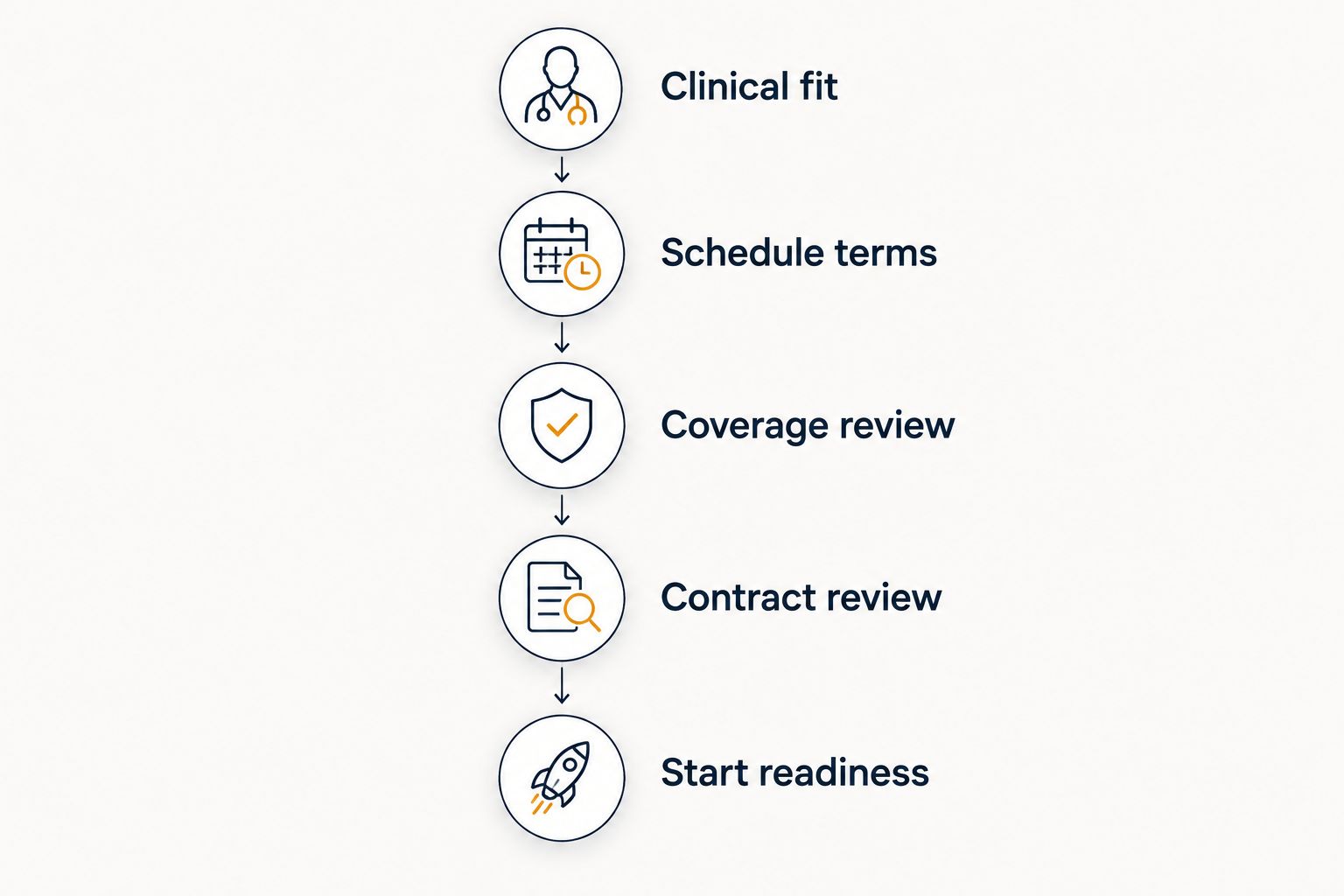
Use the same sequence for every offer in your 2026 shortlist. Resolve clinical fit before investing heavily in paperwork, then confirm the agreement supports the schedule and responsibilities you discussed.
- Clinical fit: Request the expected modalities, patient populations, procedures, coverage locations, and call responsibilities. State any scope limits before accepting.
- Schedule terms: Obtain the proposed dates, shift boundaries, orientation requirements, and cancellation provisions. Distinguish confirmed coverage from tentative requests.
- Coverage review: Identify the malpractice insurer, policy form, covered activities, and responsibility for any required extended reporting coverage. Request clarification from the insurer or a qualified adviser.
- Contract review: Have an appropriate attorney review termination, restrictions, payment terms, and unresolved promises before you sign.
- Start readiness: Confirm licensure, privileges, system access, orientation, and the contact responsible for clearing outstanding requirements.
Do not substitute an expected start date for confirmation that you are authorized and prepared to work. Ask the facility which requirements remain outstanding and who will confirm completion.
Where should you search for comparable radiology assignments?
RadBoard is best for radiologists who want to search positions aggregated from multiple sources. The RadBoard radiology job search platform aggregates 5,000+ positions from 20 sources and includes swipe-to-save features for building a shortlist.
Use RadBoard to identify openings that fit your clinical scope and preferred work arrangement. Compare the resulting opportunities against the same checklist rather than changing your standards for each listing.
The distinction matters: finding a listing is not the same as verifying an assignment. Confirm the current scope, dates, classification, compensation terms, and coverage arrangements with the hiring party before making a commitment.
Compare radiology opportunities
Search 5,000+ radiology positions from 20 sources and save opportunities for closer review.
Is locum radiology better than a permanent job?
Locum radiology is better when defined assignments serve your priorities better than a continuing appointment. Permanent employment is better when its actual benefits, continuity, and career opportunities outweigh the temporary arrangement's advantages.
Compare responsibilities as well as benefits. A locum role with extensive call and travel is not automatically more flexible than a well-matched employed position.
Is locum tenens radiology worth it for a new attending?
Locum tenens radiology is worth considering for a new attending only when the scope and support match the physician's readiness. Ask who provides consultation, how urgent questions escalate, and what orientation covers before accepting independent coverage.
Do not use compensation as a substitute for appropriate support. A first assignment should have clearly understood expectations, not unresolved questions about procedures or backup.
Is remote locum radiology more flexible than onsite work?
Remote locum radiology removes the onsite commute, not the contractual schedule. Verify shift boundaries, reporting expectations, equipment responsibilities, technical support, and the jurisdictions in which you must be authorized to practice.
Choose remote work for an arrangement that fits your circumstances. Do not assume “remote” means asynchronous reading, self-selected hours, or freedom to work from any location.
FAQ
Is locum tenens radiology worth it in 2026?
Locum tenens radiology is worth it in 2026 when the confirmed compensation, schedule, clinical scope, and contract terms beat your realistic alternatives. Include unpaid time, benefit replacement, cancellation exposure, and malpractice responsibilities in the comparison.
Does locum radiology always pay more than an employed job?
Locum radiology does not automatically deliver greater total financial value than employment. Compare confirmed work, personally paid expenses, benefits, and total committed time rather than the advertised rate alone.
Can I do locum radiology while keeping my permanent job?
You need to review your employment agreement and proposed assignment before combining permanent and locum work. Confirm outside-work permissions, scheduling compatibility, malpractice coverage, and any restrictions with the relevant parties.
Are all locum radiologists independent contractors?
Temporary coverage does not by itself establish independent-contractor status. Verify the actual employment arrangement and obtain tax advice appropriate to your classification and work locations.
Who pays for malpractice coverage on a locum assignment?
The agreement and insurance documents must identify who provides malpractice coverage and who bears related obligations. Confirm the covered work, policy form, and responsibility for any required extended reporting coverage before starting.
Can a locum radiology assignment be canceled?
Read the assignment's cancellation and termination provisions before treating its dates as guaranteed. Ask what notice is required and what payment obligations apply if the assignment ends or changes.
What should I check before accepting my first locum assignment?
Check clinical scope, consultation support, privileges, schedule, compensation terms, malpractice coverage, and termination provisions. Resolve gaps in writing before accepting responsibility for coverage.
Should I leave my permanent radiology job for locum work?
Leave only after comparing the actual locum agreement with your current role and preparing for uncommitted periods. Review notice obligations, benefits transitions, insurance, and your household's financial requirements before resigning.
One last thing
Write down your reason for choosing locum work before reviewing another offer. If your goal is schedule control, an assignment that consumes your preferred time off fails that test even when its other terms look attractive.
For your 2026 decision, keep that objective beside the contract checklist. The right assignment meets both your clinical requirements and the reason you wanted temporary work in the first place.