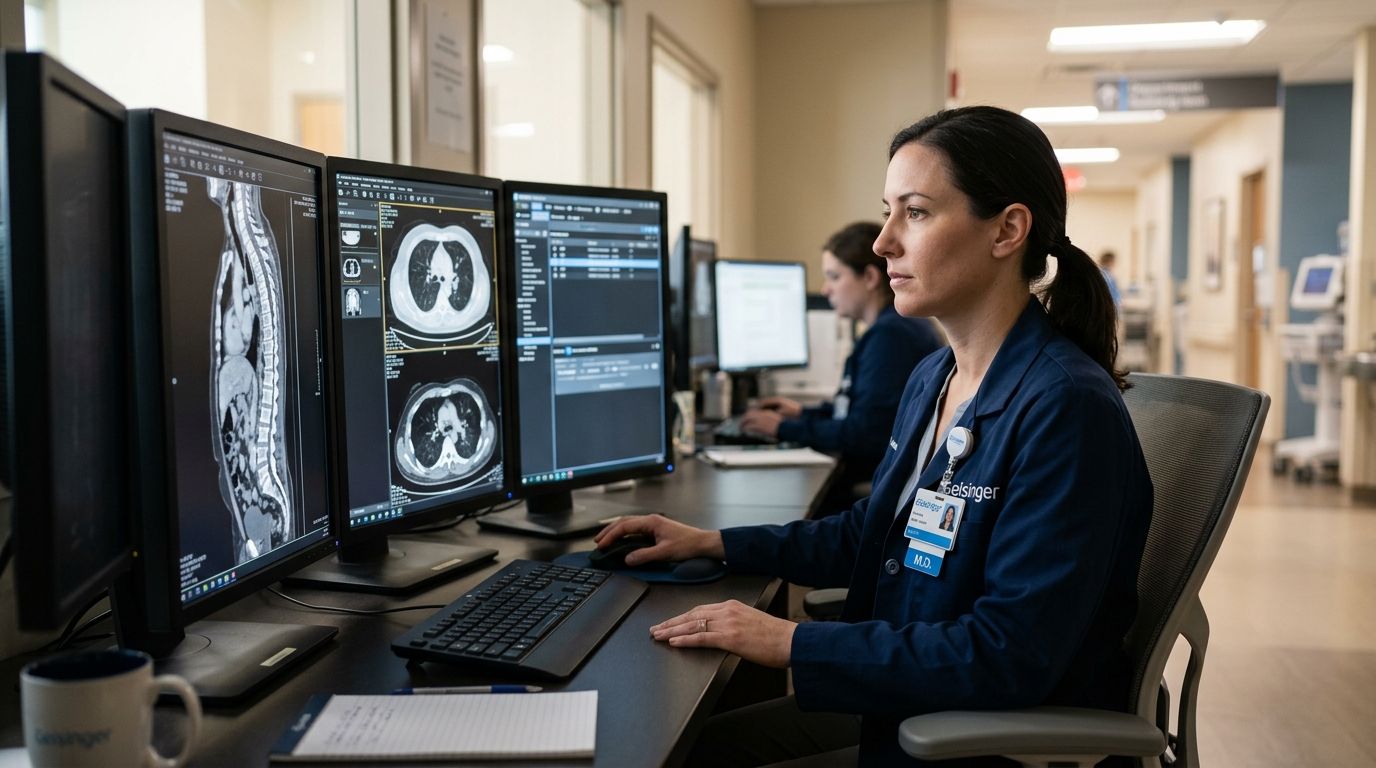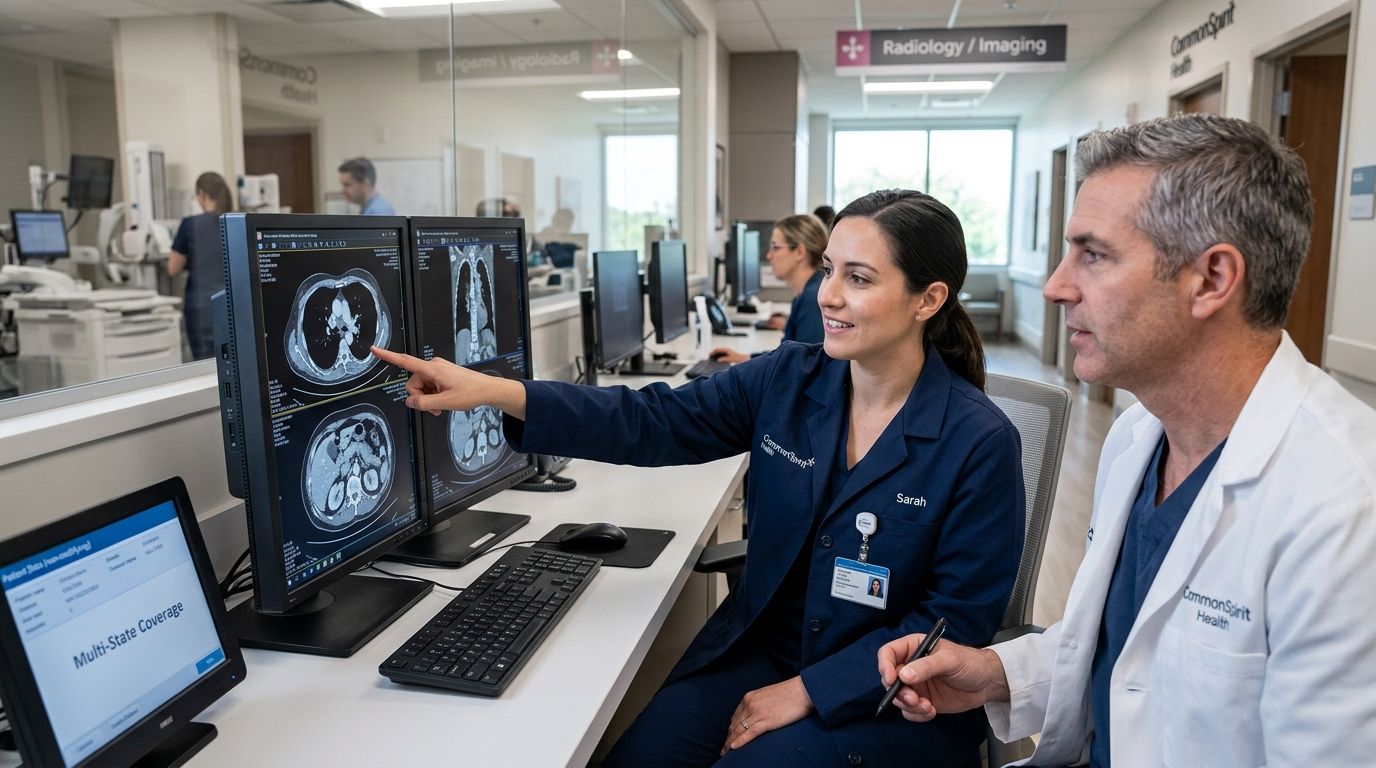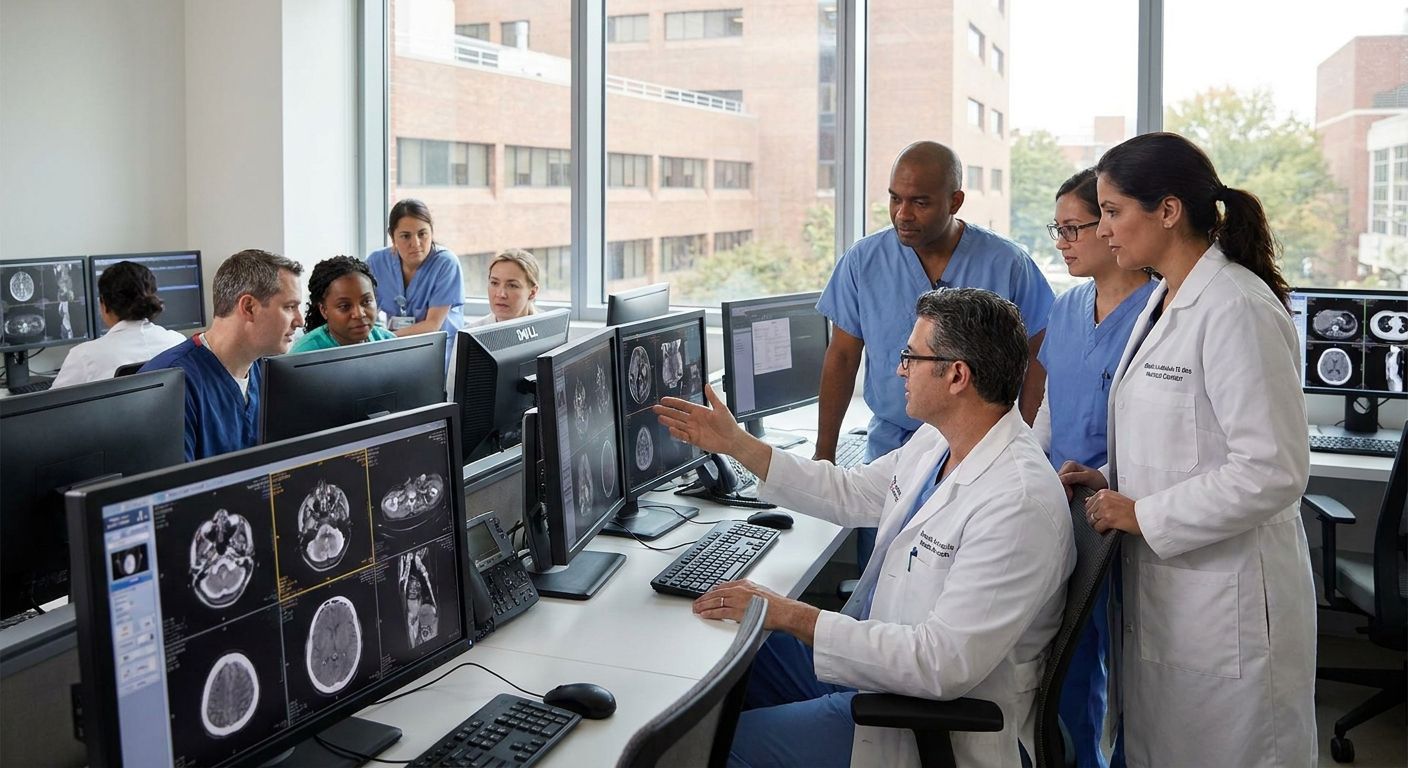
Johns Hopkins radiology jobs for academic attendings sit inside a narrow slice of the radiology market: openings at an academic medical center built around research time, resident supervision, and subspecialty depth rather than pure RVU throughput. Academic attending postings differ from private practice or teleradiology listings on pay structure, call burden, and what counts as a successful first year — this guide covers how to search for, evaluate, and land one in 2026.
- Johns Hopkins radiology jobs for academic attendings prioritize research productivity and subspecialty fit over case volume.
- RadBoard aggregates academic and private-practice radiology openings from 20 sources so you're not checking career pages one by one.
- Protected research time and promotion track terms matter more than base salary in academic offers.
- Subspecialty match to the hiring division is the single biggest filter academic recruiters apply.
- Most academic attending searches take longer than private practice searches because openings are fewer and more specific.
Why academic attending searches need a different playbook
An academic medical center like Johns Hopkins hires radiologists into divisions, not just into a department. Neuroradiology, body imaging, musculoskeletal, and breast imaging divisions each run their own hiring cycles tied to grant funding, resident teaching needs, and faculty turnover, which means openings surface unevenly across the year instead of in a steady stream.
That unevenness is the core reason academic attendings can't search the way private practice candidates do. A single institution's career page might show one or two radiology openings at a time, and the posting rarely states research expectations, protected time, or promotion track details up front. You have to read past the job title to find the actual role.
RadBoard's search platform pulls radiology postings from 20 sources into one searchable feed, which matters more for academic roles than any other segment — academic openings are scattered across institution sites, ACR listings, and recruiter networks, and missing one source often means missing the only opening in your subspecialty that quarter.
Steps to land an academic attending role at a center like Johns Hopkins
Define your academic track before you search
Academic radiology jobs split into tracks with different expectations for publication output, teaching load, and clinical volume. Decide which track fits before you apply, because a research-heavy track and a clinician-educator track look identical in a job title but are entirely different jobs.
- Clarify whether you want a research-intensive track (grant-funded, lower clinical volume) or a clinician-educator track (higher reads, teaching-focused)
- Estimate how much protected non-clinical time you need to sustain your research agenda
- Decide if you want a tenure-track appointment or a non-tenure clinical faculty line
- Check whether the division expects extramural funding within a set timeframe
- Rule out tracks that require lab space or wet-bench research if that's not your background
Audit your CV against academic promotion benchmarks
Academic hiring committees read CVs differently than private practice recruiters. Publication count, first-author papers, national society involvement, and prior teaching evaluations carry more weight than case volume ever will.
- List peer-reviewed publications with your authorship position clearly marked
- Add teaching evaluations or resident feedback scores if you have them
- Include national society committee work (ACR, ASNR, SIR, RSNA)
- Quantify grant history, even pilot or internal funding
- Add invited talks, visiting professorships, or guest lectures
- Update your CV format to match the academic (not clinical) CV standard your target institution uses
A competitive radiology CV built for your first attending job reads differently for an academic search than for a private group — academic committees want to see a trajectory, not just a job history.
Match your subspecialty to the division's stated need
Academic divisions hire to fill a specific gap, not to add general coverage. A neuroradiology division short one attending after a retirement will not consider a body imaging candidate, regardless of overall qualifications.
- Identify which subspecialty divisions at your target institutions have had recent faculty departures
- Cross-reference your fellowship training against the division's current faculty roster gaps
- Ask contacts inside the department which subspecialty is actively recruiting
- Avoid applying broadly across divisions at one institution — it reads as unfocused to hiring committees
Search aggregated listings instead of one institution's career page
Checking a single institution's career site misses academic postings that appear on ACR's career center, recruiter databases, or state medical board job boards before they hit the institution's own site.
- Set search alerts across multiple job boards, not just one institution
- Filter by academic medical center and subspecialty simultaneously
- Save postings that mention research time or teaching load explicitly — that phrasing signals a real academic role, not a relabeled clinical job
- Use AI-powered job matching to surface academic listings across sources faster than manually checking each institution's site
Build direct relationships inside academic radiology
Many academic openings never get widely posted because a division chair already has a candidate in mind from a conference conversation or a fellowship connection. Cold applications compete against candidates who were introduced first.
- Attend RSNA, ASNR, or subspecialty society meetings where academic faculty present
- Reach out to former fellowship program directors for warm introductions
- Ask current academic attendings at target institutions about unposted openings
- Follow division chairs' recent publications to identify active research areas before reaching out
Prepare for the academic interview format
Academic interviews run longer and cover more ground than private practice interviews. Expect a research talk or grand rounds presentation, meetings with the chair, division chief, and often a resident representative.
- Prepare a 20-30 minute research or clinical talk tailored to the department's interests
- Review the division's recent publications so your talk connects to their work
- Prepare specific questions about protected time, mentorship structure, and promotion timelines
- Ask what percentage of recent hires were promoted on schedule
Negotiate protected time and promotion terms, not just base pay
Academic radiology salaries typically run below private practice and teleradiology compensation, and that gap is offset by protected research time, benefits, and career stability — not by base pay alone. Negotiating only on salary misses where the real value sits.
- Get protected non-clinical hours per week in writing, not verbally promised
- Confirm startup funds or seed grant support if the role involves research
- Clarify the promotion timeline and criteria in writing before signing
- Ask about moonlighting rules if you want supplemental income
- Confirm CME allowance and conference travel support separately from salary
“If a posting doesn't state protected research time in hours per week, treat it as a private-practice-pace job wearing an academic label.”
Where academic radiology job seekers actually find these openings
| Option | Best for | Cost to job seeker | Key limitation |
|---|---|---|---|
| Institution career pages | Candidates targeting one specific center | Free | Rarely states research time or track details |
| Academic radiology recruiting firms | Candidates who want a recruiter to vet fit | Free | Firm's academic pipeline may be narrow |
| Professional society career centers (ACR, ASNR) | Subspecialists wanting vetted academic listings | Free | Smaller volume than general job aggregators |
| RadBoard aggregated search | Candidates comparing academic openings across many institutions at once | Free | Postings still require direct outreach to confirm track details |
| Word-of-mouth and conference networking | Unposted or soon-to-open faculty lines | Free | Requires existing academic connections |
Common mistakes academic attendings make chasing these roles
- Applying to a division without checking its actual faculty gap — a strong CV in the wrong subspecialty gets filtered out immediately
- Negotiating salary before confirming protected research time — the time commitment shapes whether the salary is competitive at all
- Submitting a clinical CV instead of an academic CV — hiring committees expect publication and teaching sections formatted their way
- Skipping the research talk preparation — a weak grand rounds presentation can override a strong application
- Assuming one institution's timeline applies everywhere — academic hiring cycles vary widely by division and fiscal year
Search academic radiology openings now
Compare academic and private practice radiology jobs from 20 sources in one place.
FAQ
Are Johns Hopkins radiology jobs harder to find than private practice jobs?
Academic openings at centers like Johns Hopkins are fewer and tied to specific division needs, so they surface less often than private practice or teleradiology postings. Checking aggregated listings across multiple sources catches openings that don't appear on a single institution's career page.
What makes an academic radiology attending job different from private practice?
Academic roles include protected research or teaching time, resident supervision, and a promotion track, while private practice roles focus on clinical volume and RVU-based pay. The tradeoff is typically lower base salary in exchange for research support and career stability.
Do academic radiology jobs pay less than private practice?
Academic radiology salaries generally run below private practice and teleradiology compensation, offset by protected non-clinical time, benefits, and institutional stability. Candidates should compare total compensation including startup funds and CME support, not base salary alone.
How important is fellowship training for an academic attending role?
Fellowship subspecialty training is the primary filter academic divisions apply when hiring, since openings are tied to a specific gap in a division's faculty roster. A general diagnostic radiologist without subspecialty training will rarely be considered for a subspecialty academic line.
How long does an academic radiology job search typically take?
Academic searches generally take longer than private practice searches because openings are fewer, tied to fiscal-year hiring cycles, and often filled through existing networks before wide posting. Starting the search 12 or more months ahead of your target start date is common practice.
Should I use a recruiter or search directly for academic radiology jobs?
Academic recruiting firms can surface unposted openings, but direct search across aggregated job platforms and professional society career centers covers more of the market. Using both approaches together covers postings a single recruiter's pipeline might miss.
What should I negotiate besides salary in an academic radiology offer?
Protected research or teaching hours per week, promotion criteria and timeline, startup or seed funding, CME allowance, and moonlighting rules all matter more than base salary in an academic offer. Get each of these in writing before signing.
One last thing
The fastest signal that a posting is a real academic role rather than a relabeled clinical job: check whether it names a specific division and states a research or teaching expectation in the first paragraph. Postings that lead with call schedule and RVU targets are private practice roles wearing an academic institution's name, regardless of which center is listed.