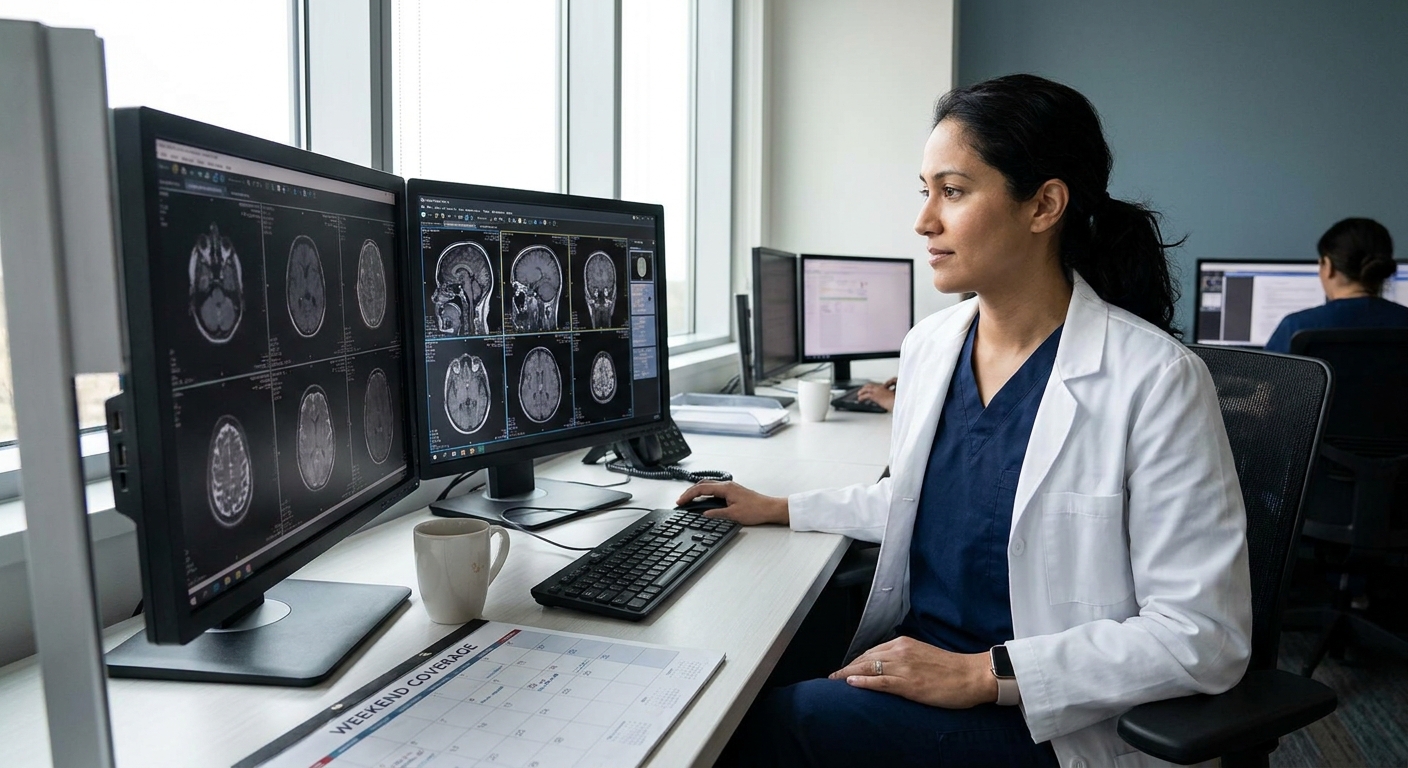
Weekend call is where per diem neuroradiology jobs live or die — either you get clean stroke and trauma reads with a real per-shift rate, or you get dumped on a mixed body-and-neuro queue that pays like general call. This guide breaks down what separates a real per diem neuroradiology job from a bait-and-switch weekend slot in 2026.
- Hospital-based weekend call pools pay flat per-shift or per-RVU with no cross-state licensing wait — the steady pick for 2026.
- Teleradiology per diem platforms fit remote schedules but require credentialing verified in every state you read for.
- Locum tenens neuro bridge assignments pay per-RVU and work best filling gaps between full-time contracts, not as a permanent side gig.
- Academic weekend moonlighting builds CV weight but usually pays below market per diem neuroradiology jobs rates.
- Multi-site 1099 weekend pools scale income fastest but carry the heaviest credentialing overhead of any per diem neuroradiology jobs option.
Who this is for
This guide is for fellowship-trained neuroradiologists who already hold a full-time position — academic, private practice, or teleradiology — and want extra weekend shifts for added income, without committing to a second full-time contract. It's also useful for neuroradiologists between contracts who need bridge income while they interview, and for radiologists building a case for RVU-based negotiation using outside per diem rates as leverage. A radiology job search platform like RadBoard aggregates these listings from 20 sources so you're not chasing five separate staffing agency portals to find weekend neuro coverage.
What to look for in per diem neuroradiology jobs
Subspecialty read purity
A posting labeled "neuro per diem" that actually queues mixed body, MSK, and neuro studies isn't a neuro job — it's general call with a neuro label. Ask for a sample worklist or a 30-day study mix breakdown before accepting; anything under 70% neuro/head-and-spine studies isn't worth the subspecialty rate you're expecting.
Credentialing and licensing timeline
Weekend-only work still requires full state licensing, hospital privileges, and often a separate teleradiology credentialing packet — a process that can take 60-120 days depending on the state medical board. If the recruiter can't tell you a realistic start date within the first call, the timeline is going to eat your first quarter of expected income.
Malpractice coverage and tail structure
Per diem work still needs occurrence or claims-made coverage with tail included, and this detail gets glossed over more in per diem contracts than in full-time offers. Confirm in writing whether the facility or staffing agency covers the tail — an uncovered tail on a short-term weekend gig can cost more than the gig paid.
Compensation structure
Weekend neuro shifts get paid three ways in 2026: flat per-shift rate, per-RVU, or hourly with a minimum guarantee. Flat per-shift rates are easiest to budget around; per-RVU pays more if the weekend volume is heavy but swings with census, so ask for trailing 90-day volume numbers before you commit to a per-RVU structure.
Turnaround time expectations
Weekend neuro coverage usually means stroke protocol reads with 20-minute STAT turnaround requirements, sometimes tighter. Confirm the expected TAT and whether it's contractually enforced with penalties — a 20-minute stroke TAT on a solo weekend shift with no backup reader is a different job than one with a second neuro reader on call.
Top picks for per diem neuroradiology jobs
Hospital-based weekend call pools — the steady pick. These are W-2 or 1099 arrangements directly with a hospital system, usually paying $180-$250 per hour or a flat per-shift rate in the $2,500-$4,000 range for a 12-hour Saturday or Sunday shift, based on aggregated 2026 job board data. Setup time runs 60-90 days for full credentialing. Best fit for neuroradiologists who already hold privileges at the facility or a sister system. Read more on part-time weekend radiology jobs structured around fewer, higher-value shifts. Verdict: Buy.
Teleradiology per diem platforms — the flexible pick. These platforms route studies from multiple client hospitals to a remote reading queue, and the better ones let you pick specific weekend blocks rather than committing to a recurring schedule. Pay is almost always per-RVU or per-study, and the trade-off is credentialing overhead — expect to hold active licenses in 3-5 states minimum to see enough weekend volume. Details on per diem shift flexibility on teleradiology platforms cover which platforms actually let you set a true per diem schedule versus a disguised part-time contract. Verdict: Buy if you already hold multi-state licenses; Consider if you don't.
Locum tenens neuro bridge assignments — the gap filler. Staffing agencies place fellowship-trained neuroradiologists into short-term coverage, typically 2-8 week blocks, when a hospital's neuro reader is out or a contract hasn't started yet. Pay runs per-RVU with agency-covered malpractice in most 2026 postings. This works well as bridge income between jobs, not as an ongoing weekend side gig, because the assignments aren't guaranteed to recur. See the full breakdown of locum tenens neuroradiology jobs for subspecialists between contracts. Verdict: Consider for bridge income; Skip as a long-term weekend plan.
Academic weekend moonlighting — the resume builder. Academic medical centers sometimes open weekend attending slots to outside fellowship-trained radiologists for teaching-hospital coverage. Pay typically runs 15-25% below private per diem neuroradiology jobs rates, but the CV line and complex-case exposure carry value for radiologists still building a subspecialty reputation. Verdict: Consider if you're early-career; Skip if pure income is the goal.
Multi-site 1099 weekend pools — the wildcard. These are staffing-agency-run pools that place you across multiple facilities in rotation, sometimes reading for three or four different hospital systems in a single month. Income potential is the highest of any option here, but so is the credentialing load — expect to maintain active privileges at every site simultaneously. Verdict: Consider only if you already hold broad multi-state credentialing; Skip if you're managing this alongside a full-time job.
Find open per diem neuroradiology jobs now
Search 5,000+ radiology listings from 20 sources with AI-powered filters.
What to avoid
- "Neuro-friendly" general call. Postings that say a job is "neuro-friendly" instead of "neuro-only" usually mean you'll read whatever hits the queue on a slow Saturday night, body and MSK included.
- No minimum shift guarantee. A per diem contract with zero guaranteed shifts per month leaves you exposed to census swings you can't control — ask for a minimum before signing.
- Credentialing at five facilities for one weekend a month. If the ratio of credentialing burden to actual paid shifts doesn't pencil out inside 90 days, the job isn't worth the paperwork.
Why this matters
Per diem neuroradiology jobs in 2026 pay well precisely because stroke and trauma coverage is the hardest weekend slot to staff — hospitals and teleradiology groups are willing to pay a premium for a fellowship-trained reader who can hit a 20-minute STAT turnaround on a Sunday. But the same scarcity that drives up the rate also drives sloppy job postings that blur "neuro" with "general call." Knowing the difference before you sign is what separates a $200-per-hour weekend from a $140-per-hour general shift with a neuro label slapped on it.
Verdict comparison
| Pathway | Read Purity | Pay Structure | Setup Time | Verdict |
|---|---|---|---|---|
| Hospital weekend call pool | High (single site) | Flat per-shift / hourly | 60-90 days | Buy |
| Teleradiology per diem platform | Moderate-high | Per-RVU / per-study | 90-120 days (multi-state) | Buy / Consider |
| Locum tenens neuro bridge | High | Per-RVU | 30-60 days | Consider |
| Academic weekend moonlighting | High | Below-market flat rate | 60-90 days | Consider |
| Multi-site 1099 pool | Variable | Per-RVU, highest volume | 90-150 days | Consider |
FAQ
What is the best per diem neuroradiology job for weekend coverage in 2026?
Hospital-based weekend call pools are the most reliable per diem neuroradiology jobs in 2026, paying $2,500-$4,000 per 12-hour shift with clean read purity. Teleradiology platforms come close on flexibility but require multi-state licensing to see comparable volume.
How much do per diem neuroradiology jobs pay?
Per diem neuroradiology jobs pay roughly $180-$250 per hour or $2,500-$4,000 per 12-hour weekend shift based on aggregated 2026 job board data. Per-RVU structures can exceed this on high-volume weekends but swing lower on slow census.
Is teleradiology better than on-site call for per diem neuro coverage?
Teleradiology per diem platforms offer more schedule flexibility since you're not tied to one facility's physical location. On-site hospital call pools usually offer simpler credentialing since you only need privileges at one system instead of the multiple states teleradiology platforms require.
How fast can I start a per diem neuroradiology job?
Most per diem neuroradiology jobs take 60-120 days from application to first shift due to state licensing and hospital credentialing. Locum tenens bridge assignments through staffing agencies move fastest, sometimes closing in 30-60 days.
Do per diem neuroradiology jobs require malpractice tail coverage?
Yes, per diem neuroradiology jobs still require occurrence or claims-made malpractice coverage with tail included, and this should be confirmed in writing before the first shift. Staffing agencies typically cover the tail on locum tenens assignments, but hospital-direct contracts vary.
Can fellowship-trained neuroradiologists do per diem work part-time alongside a full-time job?
Yes, weekend-only per diem neuroradiology jobs are structured specifically for radiologists holding a separate full-time position elsewhere. The limiting factor is usually credentialing bandwidth, not employer restrictions, since most full-time contracts allow outside per diem work.
What credentialing do I need for multi-state per diem neuro reads?
Multi-state per diem neuroradiology jobs, especially teleradiology roles, require an active medical license in every state where studies originate. Expect 60-120 days per state license and separate hospital privileging at each site in a multi-site pool.
One last thing
The fastest-moving 2026 per diem neuroradiology jobs postings aren't the ones with the highest advertised rate — they're the ones with a guaranteed minimum shift count, because that's the detail that tells you the hospital actually has recurring weekend volume instead of a one-off staffing gap they're testing out.