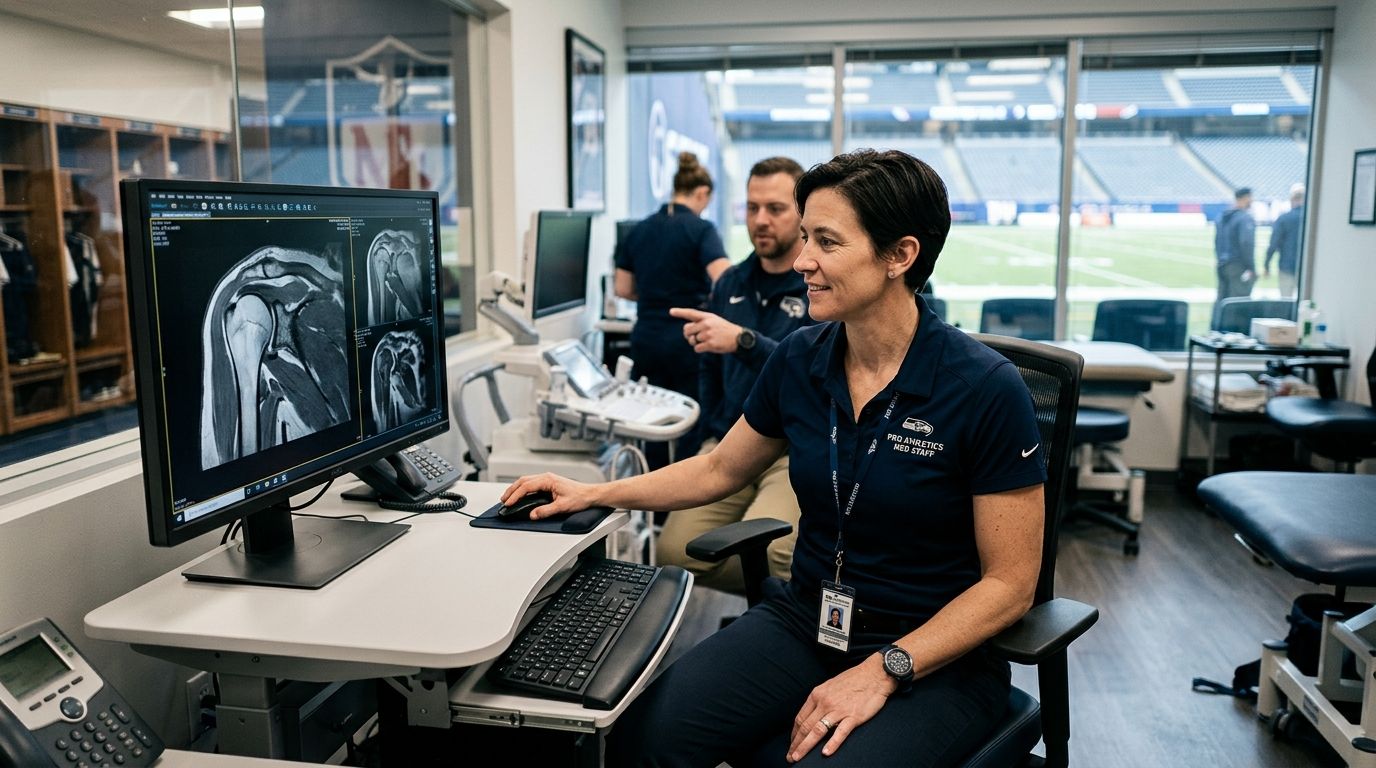
Sports team radiologist jobs are specialized musculoskeletal imaging roles that combine diagnostic radiology with the pace and stakes of professional athletics, reading MRIs, ultrasounds, and stress radiographs for franchises, athletic departments, or Olympic training centers. These positions demand fast turnaround on acute injuries, close coordination with team physicians and athletic trainers, and a working vocabulary in sports-specific pathology like UCL tears, Lisfranc injuries, and stress reactions that a general MSK read might miss. Sports team radiologist jobs in 2026 sit at the intersection of subspecialty MSK training and a niche employer network — most roles run through hospital-affiliated sports medicine centers rather than direct team payrolls.
- Sports team radiologist jobs in 2026 mostly route through hospital sports medicine centers, not direct franchise contracts.
- MSK fellowship training is the baseline credential; general diagnostic radiologists rarely get considered.
- RadBoard aggregates 5,000+ radiology positions from 20 sources, including MSK and sports imaging listings updated across 2026.
- Locum tenens sports imaging coverage is the fastest entry point for radiologists without an existing team relationship.
- Verdict: build an MSK niche first, then target academic medical centers with team affiliations second.
Why sports team radiology matters for this segment
Professional and collegiate teams don't typically employ radiologists directly. They contract with a hospital system or private MSK group that holds the team's official imaging relationship, and the radiologist reading those scans usually splits time between general MSK reads and the small subset tied to athletes. That structure changes how you search: the job title on a posting rarely says "team radiologist" — it says "musculoskeletal radiologist" or "sports medicine imaging" at a health system known for a team affiliation.
This segment also skews toward radiologists who already read a high volume of MSK MRI and ultrasound. A general diagnostic radiologist applying cold, without fellowship-level MSK reps, competes poorly against candidates who've spent two to three years reading nothing but joints, tendons, and cartilage. The path in is narrower than most subspecialties, and it rewards a documented niche over a broad CV.
Update your subspecialty positioning
Your CV and cover letter need to signal MSK depth immediately, not bury it on page two.
- Lead with fellowship training in musculoskeletal radiology, not general diagnostic background
- Quantify MSK volume: MRIs read per week, ultrasound-guided procedures performed
- List any prior work with athletic populations, even at the collegiate or high school level
- Name specific pathology expertise: UCL, meniscus, labral tears, stress fracture grading
- Include any prior coverage of an athletic department imaging contract
Target hospital systems with known team affiliations
Most NFL, NBA, MLB, and NHL teams publicize their official hospital imaging partner. That partner's radiology department is where the actual job posting lives.
- Search hospital sports medicine center staff pages for MSK radiologist roles
- Check academic medical centers near franchise cities — team contracts often route through university hospitals
- Cross-reference musculoskeletal radiology jobs for sports medicine imaging postings against known team-affiliated systems
- Note that Olympic training centers and university athletic departments post separately from pro franchises
Build procedural volume in image-guided injections
Sports imaging roles increasingly bundle diagnostic reads with therapeutic procedures.
- Get comfortable with ultrasound-guided joint and tendon injections
- Document experience with corticosteroid and PRP injection support
- Review arthrogram and joint injection jobs for MSK procedure rads to see how procedural volume gets framed in postings
- Practice arthrography protocols specific to shoulder, hip, and wrist imaging
Search with the right platform and filters
Generic job boards rarely tag "sports team" as a category, so the search itself has to be deliberate.
- Filter by musculoskeletal subspecialty rather than "sports" as a keyword alone
- Set alerts for hospital systems in cities with professional franchises
- Use AI-powered job matching to surface MSK openings across aggregated sources faster than manual searching across 20 individual job boards
- Cross-check postings against RadBoard's aggregated feed of 5,000+ positions, which pulls from 20 sources including hospital career pages that rarely rank in general search
Get locum tenens exposure first if you're new to the niche
Direct team affiliation is hard to land without a track record. Locum coverage builds it.
- Take short-term MSK imaging assignments at sports medicine centers to build documented volume
- Review locum tenens musculoskeletal radiology jobs for sports imaging for assignment structure and typical scope
- Use locum stints to network directly with team physicians and athletic trainers
- Convert strong locum performance into a standing referral relationship with the hospital's sports medicine department
Negotiate the imaging relationship, not just salary
Once you're in front of an offer tied to a team contract, the terms differ from a standard hospital role.
- Clarify who owns the reads — the hospital or the team directly — since this affects liability and reporting lines
- Ask about game-day and travel expectations, including away-game imaging support
- Confirm turnaround time requirements for acute in-season injuries versus routine reads
- Get any media or public-facing commentary expectations in writing before accepting
Track your case volume and pathology mix over time
Sports team affiliations get reviewed and re-bid by hospital systems. Radiologists who can show sustained MSK volume keep the relationship or win the next one.
- Log annual MRI and ultrasound volume by joint and pathology type
- Track procedural counts for image-guided injections separately from diagnostic reads
- Keep documentation of any conference or CME work tied to sports imaging
- Use that record when the hospital renegotiates its team imaging contract
Comparison: paths into sports team radiology
| Path | Best for | Key limitation |
|---|---|---|
| Hospital-affiliated MSK staff role | Radiologists wanting a stable, salaried position with a known team affiliation | Team-specific work is usually a fraction of total caseload, not the whole job |
| Locum tenens MSK/sports coverage | Radiologists building a niche without an existing team relationship | Short-term, no guarantee of conversion to permanent affiliation |
| Private MSK group with team contract | Radiologists who want partnership-track stability plus sports imaging exposure | Fewer openings; contracts concentrated in major metro areas |
| Academic sports medicine imaging | Radiologists interested in research alongside clinical sports reads | Slower path to direct team-facing work; teaching load competes for time |
| Independent telerad MSK coverage | Radiologists wanting flexibility while maintaining MSK volume | Rarely includes direct athlete-facing procedural work |
Verdict: hospital-affiliated MSK staff roles are the strongest entry point in 2026 for radiologists who want both stability and a documented team relationship, with locum tenens sports imaging coverage as the fastest way in for those still building the niche.
Search sports team radiology openings now
Filter 5,000+ radiology jobs from 20 sources by MSK subspecialty and location.
Common mistakes in this segment
- Applying with a general diagnostic CV. Sports team-affiliated roles filter hard for MSK fellowship training; a broad diagnostic background gets passed over before the interview stage.
- Assuming the team pays directly. Most radiologists work through the hospital system's contract with the team, not a direct athlete-facing employment relationship, which changes who negotiates terms.
- Skipping procedural training. Diagnostic-only MSK radiologists lose ground to candidates who also perform image-guided injections, since sports imaging roles increasingly bundle both.
- Ignoring locum tenens as a stepping stone. Radiologists waiting for a direct staff opening often lose years that a locum assignment could have used to build documented sports imaging volume.
- Underestimating turnaround expectations. In-season acute injury reads carry tighter timelines than routine MSK caseloads, and candidates who don't ask about this upfront get surprised after signing.
FAQ
What is a sports team radiologist job?
A sports team radiologist job is a musculoskeletal imaging role, usually held through a hospital or private MSK group with a contracted relationship to a professional or collegiate team. The radiologist reads MRIs, ultrasounds, and radiographs for athletes as part of a broader MSK caseload, not as a standalone team employee.
Do NFL, NBA, or MLB teams hire radiologists directly?
Rarely. Most professional teams contract with a hospital system or private imaging group for their official medical imaging partnership, and radiologists are employed by that system, not the franchise itself.
What fellowship training do you need for sports team radiology?
Musculoskeletal (MSK) radiology fellowship training is the standard credential for these roles in 2026. General diagnostic radiologists without MSK fellowship training are rarely considered competitive candidates.
Is locum tenens a good way to break into sports imaging?
Yes. Locum tenens MSK and sports imaging assignments let radiologists build documented case volume and network with team physicians without needing an existing team relationship first.
How do I find sports team radiology job postings?
Search hospital sports medicine center career pages directly, since most postings list "musculoskeletal radiologist" rather than "team radiologist." Aggregated platforms pulling from multiple hospital career pages surface these faster than manual searching site by site.
What pathology expertise matters most for sports imaging roles?
UCL tears, meniscus and labral injuries, stress fractures, and tendon pathology come up most often in athlete-facing MSK imaging. Candidates who can quantify volume in these specific areas stand out over generalist MSK reads.
Do sports team radiology jobs include procedures, or just diagnostic reads?
Many roles now bundle diagnostic MRI and ultrasound reads with image-guided injection procedures, including corticosteroid and PRP support. Procedural experience increasingly separates competitive candidates from diagnostic-only applicants.
Are academic medical centers a good path into sports team radiology?
Yes, particularly in cities with university hospitals holding official team imaging contracts. The tradeoff is a slower path to direct athlete-facing work, since teaching and research responsibilities compete for time.
One last thing
Most radiologists searching for "sports team radiologist jobs" search the wrong term entirely — the postings that lead to real team-affiliated work are almost always titled "musculoskeletal radiologist" or "sports medicine imaging" at a hospital system, not anything mentioning a franchise by name. Searching by subspecialty and hospital affiliation in 2026 surfaces far more of these roles than searching the team name directly.