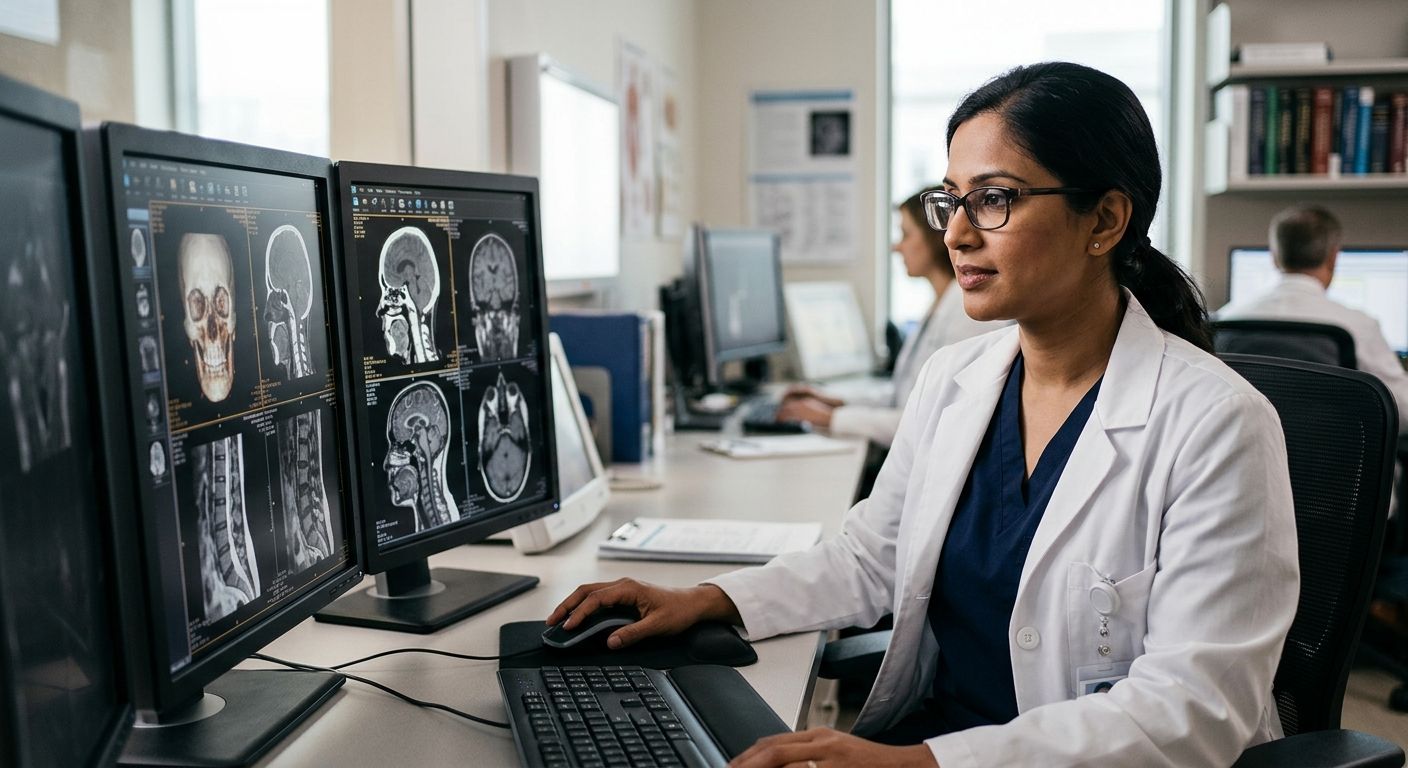
Clinical trials imaging radiologist jobs put diagnostic and interventional radiologists inside pharmaceutical and device trial infrastructure, reading against fixed endpoints like RECIST 1.1 or running quality control for a central imaging lab instead of working a routine clinical worklist. The work rewards radiologists who want structured, deadline-driven reads and criteria discipline over bedside variety, and it pays through contracted scopes of work rather than a standard RVU model.
- Core imaging lab and central-read roles pay per contracted SOW, not standard RVU compensation.
- RECIST 1.1, PI-RADS, and lesion-tracking experience matter more than general diagnostic volume here.
- ACR-accredited sites and CRO-affiliated core labs post clinical trials imaging radiologist jobs most consistently in 2026.
- RadBoard indexes listings across 20 sources, including pharma-adjacent and non-clinical radiology postings, searchable by subspecialty.
Why clinical trials imaging matters for radiologists switching lanes
Sponsors and contract research organizations need radiologists who apply one measurement standard across hundreds of scans without clinical drift, which is a different skill from routine diagnostic variety. RadBoard aggregates radiology postings from 20 sources, and clinical trials imaging roles show up scattered across CRO, academic, and non-clinical categories rather than under one job title, which is why searching by title alone misses most of the actual openings.
Demand for this segment tracks two forces in 2026: oncology drug pipelines that need RECIST-trained readers, and imaging AI companies that need physicians to validate algorithm output against ground truth. Neither of those buyers writes "clinical trials radiologist" on a job board — they write "central read," "imaging core lab," or "biomarker imaging physician," and radiologists who only search the obvious phrase never see the listing.
Step 1: Identify where these jobs actually get posted
Most clinical trials imaging jobs never reach the general hospital job board circuit. Check these channels directly before assuming supply is thin:
- CRO career pages for imaging core lab divisions
- Academic medical center clinical trials or research imaging offices
- Radiology group subsidiaries that run sponsor-facing imaging cores
- Imaging AI and biotech companies hiring reader physicians for algorithm validation
- ACR-accredited outpatient centers that host multi-site trial imaging
Step 2: Build the reading criteria fluency sponsors require
A CV heavy on general diagnostic volume does not move a core lab hiring manager. What moves them is documented fluency in the specific criteria their trials use:
- RECIST 1.1 for solid tumor measurement
- iRECIST for immunotherapy response assessment
- PI-RADS for prostate MRI trials
- Lugano criteria for lymphoma staging
- mRECIST for hepatocellular carcinoma studies
Step 3: Confirm the site or lab carries real trial-grade infrastructure
Sponsors and CROs audit imaging sites before routing trial volume to them, and you should audit the employer the same way before signing. Radiology jobs at ACR-accredited imaging facilities walks through what accreditation actually verifies. Before accepting an offer, confirm:
- Current ACR accreditation status, not a lapsed or pending one
- A documented quality manual covering trial-specific protocols
- History of passing FDA or sponsor audit inspections
- PACS and archive systems compliant with 21 CFR Part 11 for electronic records
Step 4: Separate salaried, per-read, and consulting compensation models
Clinical trials imaging work pays through several structures that don't map cleanly onto a hospital contract, and mixing them up during negotiation costs you leverage:
- Salaried core lab staff radiologist, fixed schedule and benefits
- Per-case or per-image contracted reads tied to a defined SOW
- Hourly consulting for protocol imaging design or endpoint committee work
- Advisory or reader-validation roles at imaging AI companies
Step 5: Check licensure and credentialing scope before signing
Multi-site trials mean your reads may cross state lines even when you're never physically at the site. Confirm before you commit:
- Multi-state licensure requirements for every trial site in scope
- Interstate telehealth compact eligibility if reads are remote
- Malpractice tail coverage that extends to trial-related reads
- Completion of GCP (Good Clinical Practice) training, which most sponsors require
Step 6: Use AI-powered search to surface listings buried in generic titles
Because core lab and central-read postings rarely use the phrase "clinical trial" in the title, keyword search on a generic job board misses them. AI-powered search that matches on protocol language and role description, not just title strings, catches what a manual title search skips:
- Search by criteria terms ("RECIST," "central read," "biomarker imaging") instead of job titles
- Filter results by employer type: CRO, academic, hospital, or pharma
- Swipe-save listings that mention core lab or endpoint committee work for later comparison
- Set alerts for recurring CRO postings, since core labs rehire in cycles tied to trial phases
Step 7: Negotiate contract terms unique to trial work
A standard clinical employment contract template doesn't cover the clauses that matter for trial-facing reads. Push for clarity on:
- Data and intellectual property ownership over your read output
- Publication and authorship rights if the trial produces papers
- Indemnification language covering protocol deviations you didn't cause
- Termination terms tied to trial phase completion, not just calendar notice
Comparing your options for clinical trials imaging work
| Option | Best For | Work Setting | Key Limitation |
|---|---|---|---|
| CRO-affiliated core imaging lab | Radiologists who want steady central-read volume | Remote or hybrid, contracted hours | Read output tied strictly to sponsor SOW, little diagnostic variety |
| Academic medical center clinical trials office | Radiologists combining trial reads with teaching or research | Onsite, part of a larger academic radiology group | Trial volume fluctuates with grant and sponsor funding cycles |
| Pharma or imaging-AI company staff radiologist | Radiologists moving toward protocol design or algorithm validation | Fully remote, corporate schedule | Away from direct patient care and clinical call entirely |
| Independent second-opinion or central-read platform | Radiologists wanting per-contract flexibility across multiple trials | Remote, project-based | Income depends on active trial pipeline, not guaranteed volume |
Verdict: radiologists with documented RECIST or PI-RADS reading experience move fastest into CRO-affiliated core lab roles, since that's where sponsors need immediate volume in 2026.
Search clinical trials imaging listings
Filter RadBoard's aggregated postings by subspecialty and employer type.
Common mistakes radiologists make chasing this segment
- Assuming central-read hours count toward clinical FTE or MOC clinical practice requirements without checking with the certifying board first.
- Applying with a general diagnostic CV instead of highlighting specific RECIST, PI-RADS, or lesion-tracking reading experience up front.
- Signing a core lab contract without checking cross-state licensure obligations when the lab reads sites spread across multiple states.
- Underestimating SLA turnaround pressure — central reads often carry contractual deadlines tighter than a routine clinical worklist, not looser.
- Not asking who owns the read data and whether resigning mid-trial triggers a transition obligation on open cases.
FAQ
What is a clinical trials imaging radiologist job?
It's a role reading or overseeing imaging for pharmaceutical or device trials, often applying fixed criteria like RECIST 1.1 rather than making a routine clinical diagnosis. These jobs sit inside CROs, academic trial offices, pharma companies, and imaging AI vendors.
Do clinical trials imaging radiologist jobs require patient contact?
Most do not. Central read and core lab roles are typically image-only work with no direct patient interaction, which is part of why radiologists move into the segment for schedule control.
What subspecialty training helps most for pharma imaging lab jobs?
Oncologic imaging (RECIST, iRECIST), prostate MRI (PI-RADS), and lymphoma imaging (Lugano criteria) are the most requested skill sets in 2026 because oncology trials make up a large share of core lab volume.
Is clinical trials imaging radiology work remote in 2026?
Much of it is. Core lab and central-read positions are frequently structured as remote contracted work, though academic clinical trials office roles are more often onsite or hybrid.
How is compensation structured for core imaging lab radiologists?
Compensation runs through salaried, per-case, or consulting structures rather than standard RVU pay, and the exact terms are set in the scope of work, so read the contract before assuming it maps to a clinical salary model.
What is RECIST and do radiologists need certification in it?
RECIST 1.1 is the standard tumor measurement criteria used in most solid tumor trials. There's no separate board certification for it, but documented experience or CRO-provided training on it is what hiring managers screen for.
Can locum tenens radiologists take clinical trials imaging assignments?
Yes, some CROs and imaging cores contract locum or per-diem readers for surge volume during active enrollment periods, though most core lab positions favor longer-term contracted relationships over single assignments.
How do radiologists find clinical trials imaging job openings?
Search by protocol and role terms like 'central read' or 'imaging core lab' rather than the phrase 'clinical trial,' and check CRO and imaging AI company career pages directly, since these roles rarely surface on general hospital job boards.
One last thing
Core lab and central-read postings almost never use the words "clinical trial" in the job title — search "central read," "imaging core lab," or "biomarker imaging" instead, and set a standing alert rather than relying on one search pass. A single keyword search misses most of what's actually open in 2026.