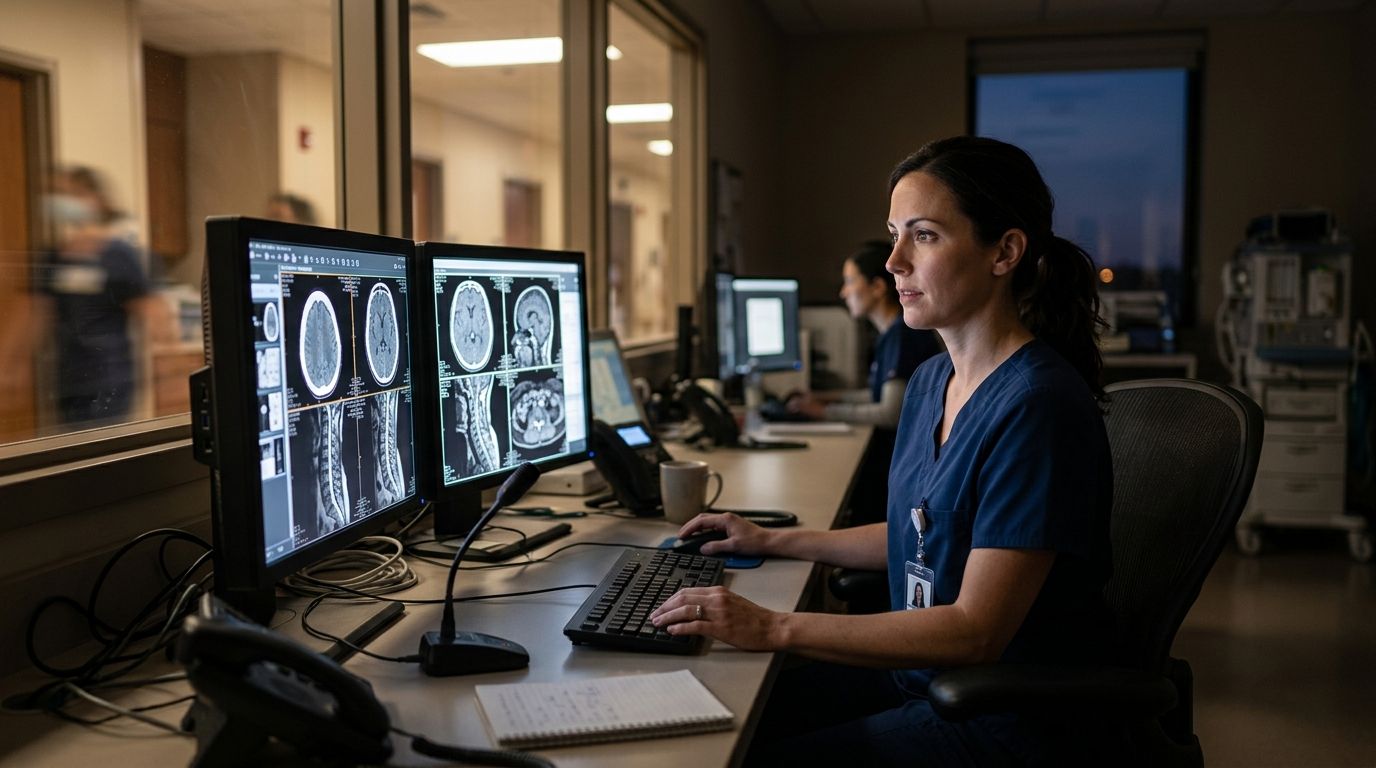
Swing shift radiology jobs cover the evening block between standard day reading and overnight nighthawk coverage, generally somewhere in the 2 PM to midnight range depending on the employer. They exist because emergency departments and inpatient services don't stop generating studies at 5 PM, and most groups can't justify a second full day shift or a dedicated overnight hire to cover that gap alone.
- Swing shift radiology jobs typically run 3 PM to 11 PM and pay a shift differential above standard day rates.
- Teleradiology and hybrid onsite models both offer swing shift radiology jobs in 2026, with teleradiology giving more location flexibility.
- RadBoard aggregates evening coverage and swing shift radiology openings from 20 sources in one search.
- Negotiate the call structure before signing: swing shift alone versus swing shift plus backup call changes the real workload.
Why swing shift radiology jobs matter for evening coverage
The search term itself is inconsistent across job boards. Some postings say "evening shift," some say "second shift," some bury the actual hours in the job description and call it "flexible coverage." Radiologists searching for swing shift radiology jobs in 2026 have to read past the label to the hour range, because a 4 PM to midnight posting and a 6 PM to 2 AM posting solve very different lifestyle problems even when both get marketed as "evening."
Groups schedule swing shifts to smooth a volume curve, not to fill an arbitrary slot. ED throughput and inpatient imaging orders tend to build through the afternoon and stay elevated into the evening before nighthawk services take the true overnight load. A radiologist covering that window reads a case mix weighted toward emergency and inpatient studies, which is worth knowing before comparing RVU targets against a day-shift job.
Define your coverage window
Get the exact hours in writing before comparing anything else about the position.
- Ask whether the shift is 2-10, 3-11, or 4-12, since all three get called "swing" or "evening"
- Confirm whether the schedule rotates weekly or is a fixed permanent block
- Check if weekend swing shifts differ in length or pay from weekday swing shifts
- Ask whether the position stands alone or bridges directly into nighthawk overnight coverage
- Clarify whether onsite presence is required or the group allows remote reading for part of the shift
Compare swing shift pay structures
Pay models for evening coverage vary more than day-shift pay because groups use swing shifts to solve different staffing gaps.
- Base salary with a built-in evening differential versus straight hourly per-shift pay
- RVU-based compensation, where swing shift case volume may or may not count the same as day-shift RVUs
- A flat evening or night stipend paid regardless of case volume that shift
- Overtime triggers tied to a case count threshold rather than clock hours
- Separate differential rates for weekday swing versus weekend swing
Negotiate shift differentials and call responsibilities before signing
The differential percentage matters less than what it's calculated against, and the call structure matters more than most candidates assume going in. Review how to negotiate a radiology call schedule before you sign anything tied to evening hours.
- Get the differential percentage and its calculation base written into the offer letter, not just discussed verbally
- Ask directly whether swing shift radiologists also carry backup phone call after the shift ends
- Find out how many consecutive swing shifts appear in a typical rotation before a stretch of days off
- Confirm whether swing coverage RVU output counts identically toward productivity targets as day-shift output
- Ask whether all radiologists in the group rotate through swing shifts or whether the group hires dedicated swing staff
Decide between onsite, hybrid, and teleradiology swing coverage
The delivery model changes what the shift actually looks like day to day, independent of the hours themselves.
- Onsite swing shifts require physical presence for procedure consults or in-person clinician communication
- Teleradiology swing shifts can be read from a home workstation if the contracting group permits remote access
- Hybrid models pair an onsite swing shift on some days with remote evening reading on others
- Fully remote swing coverage suits radiologists who've already built a compliant home reading setup
- Confirm PACS access works reliably outside the facility before assuming a remote swing option exists at all
Line up licensing and credentialing for multi-site swing coverage
Evening bridge coverage often spans more than one facility, which means licensing gets checked before the offer, not after.
- Confirm your state license covers every site the swing shift is expected to read for
- Start credentialing paperwork 60 to 90 days ahead of a target start date
- Check whether the group requires separate privileges for evening-only cross-coverage roles
- Verify malpractice coverage extends to the specific reading location tied to the swing shift
- Ask locum tenens agencies whether they handle credentialing directly for short-term swing assignments
Evaluate schedule sustainability before signing a multi-year swing contract
A swing shift that looks fine on paper for six months can wear down a household within a year if the rotation never gives real recovery time.
- Count how many swing shifts land per month before a run of consecutive days off
- Check whether the schedule rotates swing/day/night or locks radiologists permanently into evenings
- Ask what backup exists if case volume spikes right before the shift's scheduled end
- Look at whether swing shift radiologists get priority on vacation weeks as a tradeoff for the hours
- Confirm the group tracks RVU output separately for swing shifts so overload gets caught early, not after burnout
Search and apply for swing shift openings efficiently
Job boards don't standardize shift terminology, so the search itself takes more filtering than a straight day-shift search.
- Filter listings using multiple keywords: "swing," "evening," "second shift," and "bridge coverage" all describe the same window
- Check both hospital-employed and teleradiology company listings, since swing coverage appears in both
- Ask recruiters directly whether a posting labeled "night" is actually evening-only hours
- Save postings that use "evening bridge shift" language, a common synonym for swing coverage
- Use AI-powered filtering rather than manually scanning full descriptions for hour ranges
Search swing shift radiology openings
Filter 5,000+ radiology listings from 20 sources by shift type.
Comparing swing shift job models
| Option | Best for | Key limitation |
|---|---|---|
| Hospital-employed swing shift | Radiologists who want W-2 stability and onsite clinician contact | Fixed schedule, little control over which weeks rotate to swing |
| Teleradiology swing shift | Radiologists who want to read evenings from a home workstation | Requires a compliant home setup and licensing in every covered state |
| Locum tenens swing shift | Radiologists filling gaps between permanent positions | Short-term by design, and pay structure varies contract to contract |
| Hybrid split-schedule swing shift | Radiologists mixing onsite days with evening remote reading | Coordinating two schedules across sites adds administrative overhead |
| Nighthawk-adjacent swing shift | Radiologists who prefer non-daytime hours long-term | Swing paired with overnight can compress rest between shifts |
The verdict for most candidates: teleradiology swing shift jobs give the most schedule control in 2026, but only after licensing and a compliant home reading setup are confirmed in writing before the start date.
Common mistakes with swing shift radiology jobs
- Trusting the job title over the hour range. "Evening shift" postings range from 2 PM starts to 6 PM starts, and only the actual hours listed in the description tell you which one you're applying to.
- Assuming swing RVU targets match day-shift targets. Evening case mix skews toward emergency and inpatient studies, which reads differently than a typical outpatient-heavy day shift.
- Underestimating the household cost of rotating irregular evenings. A swing schedule that shifts week to week is harder on a family's routine than a fixed block, and that's worth weighing before a multi-year contract.
- Not confirming backup call responsibilities upfront. Some contracts tack on phone call immediately after an 8-hour evening shift with no built-in recovery window.
- Choosing a fully remote swing role before confirming multi-state licensing. Credentialing delays can eat into the first several weeks of a job that was supposed to start on day one.
FAQ
What's the best swing shift radiology job for someone who wants to stay onsite?
Hospital-employed swing shift roles are the best fit for onsite radiologists in 2026 since they keep in-person clinician consults and procedure coverage as part of the shift. Teleradiology swing jobs remove that in-person component entirely.
Is teleradiology swing shift work better paid than hospital-employed swing shift?
Pay structure differs by model rather than by a fixed rule, since hospital-employed roles often use RVU or salary-plus-differential pay while teleradiology swing jobs may run hourly or per-case. Compare the actual offer terms rather than assuming one model pays more.
How much does a swing shift differential typically add to radiology pay?
The differential is negotiated per contract and calculated against a base rate that varies by employer, so there's no single published figure. Get the calculation method in writing before comparing two offers side by side.
What hours count as swing shift in radiology?
Swing shift generally covers the afternoon-to-late-evening block, commonly somewhere between 2 PM and midnight depending on the employer. The exact window varies enough that you should always check the listed hours rather than the job title.
Can radiologists do swing shift work remotely?
Yes, teleradiology and hybrid models both offer remote swing shift coverage in 2026, provided the radiologist holds the required state licenses and has a compliant home reading setup. Fully onsite groups still require in-person presence for the same hours.
Do swing shift radiology jobs require separate credentialing from day shift jobs?
Credentialing requirements depend on the facility, but multi-site swing coverage often needs separate privileges for the evening-only role. Start that paperwork 60 to 90 days before the expected start date to avoid delays.
How many swing shifts per month is reasonable before burnout risk rises?
There's no universal number, so look instead at how many consecutive swing shifts appear before a stretch of days off and whether the rotation ever locks a radiologist into permanent evenings. A schedule that never varies is a bigger burnout signal than the shift count alone.
What's the difference between swing shift and nighthawk radiology jobs?
Swing shift covers the afternoon-to-evening bridge, typically ending before midnight, while nighthawk coverage handles the true overnight block after that. Some groups combine the two into a single rotation, which compresses rest time between shifts.
One last thing
The single detail that trips up most swing shift candidates isn't pay or hours, it's the label itself: "evening shift," "second shift," and "bridge coverage" all describe the same window radiologists call swing shift, and job boards don't standardize any of it. Read the listed hour range in the actual posting before assuming a title tells you anything, and confirm the call structure in writing before signing a swing shift contract in 2026.