
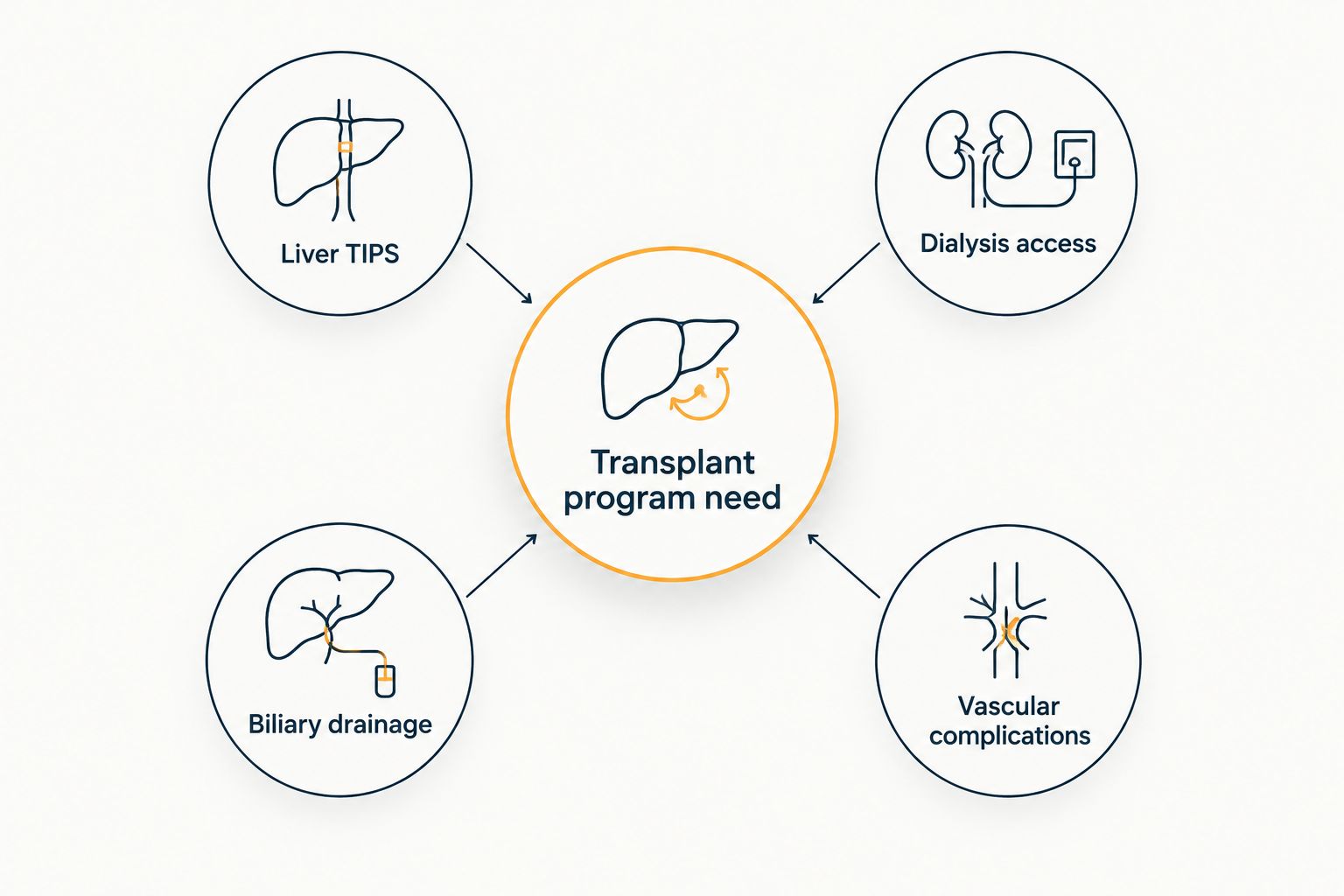
Transplant interventional radiology jobs place IR-trained physicians inside liver, kidney, pancreas, and multi-organ transplant programs, where the core caseload is TIPS, dialysis access maintenance, and biliary intervention rather than general vascular or oncologic IR work. These positions sit closer to transplant surgery and hepatology than a standard IR call pool, and hiring programs screen for organ-specific procedure volume before general case counts.
- Transplant interventional radiology jobs concentrate at academic centers running liver, kidney, or multi-organ transplant programs in 2026.
- TIPS, dialysis access, and biliary drainage volume matter more to transplant IR hiring managers than general IR case counts.
- Locum tenens transplant IR coverage is the fastest way to test a program's call structure before signing a permanent contract.
- RadBoard's AI search filters transplant-specific IR openings out of its 5,000+ aggregated radiology listings from 20 sources.
Why transplant interventional radiology jobs work differently
A general IR opening and a transplant IR opening look similar on a job board and read completely differently once you're on service. Transplant programs need physicians who can manage hepatic artery stenosis, portal vein thrombosis, and biliary strictures in liver recipients, plus arteriovenous fistula and graft maintenance for kidney transplant candidates who are still on dialysis while waiting for an organ.
Most of that volume lives at designated transplant centers, and those centers are concentrated in a small number of academic and large health-system hospitals rather than spread evenly across every hospital that runs an IR suite. A transplant imaging radiologist role at a liver and kidney center sits on the diagnostic side of the same programs this guide covers on the procedural side, and the two roles often work the same multidisciplinary meetings.
Call in these jobs is tied to organ availability, not a fixed rotation, which changes how you evaluate compensation, backup coverage, and malpractice terms before you sign anything.
How to land a transplant interventional radiology job
Confirm the program is a designated transplant center
A hospital with an IR suite and a hospital with a transplant program are not the same thing. Verify this before you spend time on an application.
- Check whether the program is a UNOS-listed transplant center for the organ types the posting mentions
- Ask the recruiter for the prior 12 months of liver, kidney, or pancreas transplant volume
- Confirm whether the multidisciplinary transplant board meets weekly or less often
- Find out if transplant IR call is a dedicated pool or shared with general IR call
- Look for co-located transplant surgery and hepatology practices in the same health system
Build TIPS and biliary intervention volume before applying
Transplant programs verify procedure competency before they verify anything else on a CV.
- Log TIPS case counts separately from your general IR numbers
- Track biliary drainage and stent placements apart from routine GI procedures
- Document portal vein and hepatic vein intervention experience by year
- Get a supervising attending's sign-off on independent TIPS competency
- Pull case logs from your PACS or RIS system instead of relying on memory
Map the organ-specific procedure mix at target programs
Liver, kidney, and multi-organ programs each lean on a different procedure mix, and the job posting rarely spells this out.
- Liver transplant IR skews toward TIPS, hepatic artery work, and biliary intervention
- Kidney transplant IR skews toward dialysis access maintenance and renal artery stenosis
- Multi-organ and pancreas programs need broader vascular coverage across services
- Ask the recruiter for a 12-month procedure breakdown by organ type
- Compare that breakdown against your own training gaps before the interview
Network directly with transplant surgery and hepatology teams
Most transplant IR openings move through internal referrals before they ever post publicly.
- Attend regional transplant society conference tracks, not just general IR meetings
- Request a shadow day with a program's transplant IR call team
- Connect with transplant surgeons through professional societies, not cold outreach
- Ask current transplant IR staff how often they present at tumor board
- Get introduced through a fellowship mentor with transplant program ties
Negotiate call structure around organ availability
Organ-availability call arrives without warning, often overnight, and that changes how a contract should read.
- Ask how urgent overnight transplant-related procedures are staffed and backed up
- Confirm coverage exists for simultaneous transplants at the same site
- Clarify RVU or stipend treatment for organ-availability call specifically
- Review malpractice tail coverage tied to the transplant service line
- Confirm whether transplant call runs separately from general IR call
Search transplant-tagged openings instead of scrolling generic boards
Once your case volume and network are in order, the search itself is the bottleneck. Generic radiology boards mix transplant IR postings in with general IR, neuro IR, and diagnostic listings, which makes filtering by hand slow.
- Filter listings by "transplant," "TIPS," or "dialysis access" as search terms
- Use swipe-to-save to shortlist openings at hospitals running active organ programs
- Cross-check a posting's source against RadBoard's aggregated list of 20 sources rather than trusting one hospital career page
- Save a filtered search so new transplant postings surface as they're added
- Compare hospital-employed and independent-group transplant contracts side by side before applying
RadBoard pulls transplant-tagged IR postings into a single search rather than making you check individual hospital and health-system career pages one at a time.
Prepare a transplant-specific interview package
A general IR interview and a transplant IR interview test different things.
- Bring a TIPS and biliary case log broken out by organ type
- Prepare specific answers on managing bile leak and hepatic artery thrombosis
- Ask interviewers directly how backup IR coverage works during simultaneous transplants
- Request to meet the transplant surgery chief during the on-site visit
- Confirm the credentialing timeline against your available start date
Comparing job types for transplant interventional radiology
| Option | Best for | Key limitation |
|---|---|---|
| Academic transplant center, employed | Physicians who want full integration with the transplant team | Fewer geographic options; concentrated at large academic hospitals |
| Multi-organ health system IR role | Broad procedure exposure across organ types | Call may extend beyond the core transplant caseload |
| Independent IR group with a transplant contract | Compensation flexibility outside academic pay scales | Less day-to-day integration with the transplant multidisciplinary team |
| Locum tenens transplant IR coverage | Testing a program's call structure before committing | Credentialing takes time; organ-specific volume can be inconsistent week to week |
Transplant interventional radiology jobs at UNOS-designated academic centers are the strongest fit for physicians who want steady TIPS and biliary volume; locum tenens coverage is the better move if you want to see a program's real call intensity before signing a permanent contract.
Common mistakes in the transplant IR job search
- Treating a transplant IR posting like a general IR opening and skipping questions about organ-availability call
- Underdocumenting TIPS and biliary case volume, leaving the program unable to verify independent competency
- Ignoring dialysis access experience at programs where kidney transplant volume drives most of the caseload
- Not asking about backup coverage during simultaneous multi-organ transplants
- Assuming every hospital with a transplant unit runs a dedicated transplant IR service instead of folding it into general IR call
Search live transplant IR openings
Filter 5,000+ aggregated radiology listings by transplant, TIPS, or dialysis access.
FAQ
What is a transplant interventional radiology job?
A transplant interventional radiology job places an IR-trained physician inside a liver, kidney, pancreas, or multi-organ transplant program, handling TIPS, dialysis access, and biliary intervention for transplant candidates and recipients. The role works closely with transplant surgery and hepatology rather than sitting in a general IR rotation.
Where are most transplant IR jobs located in 2026?
Transplant IR jobs concentrate at academic medical centers and large health systems that run UNOS-designated transplant programs. Smaller community hospitals rarely have the organ volume to support a dedicated transplant IR service.
Do transplant IR jobs require TIPS experience?
Yes, most transplant programs expect documented TIPS and biliary intervention case volume before considering a candidate. Fellowship training alone often isn't enough without a case log showing independent competency.
Is transplant IR call more demanding than general IR call?
Transplant IR call is tied to organ availability, which arrives unpredictably and often overnight, unlike a fixed general IR rotation. Contracts should spell out backup coverage and RVU or stipend treatment for urgent organ-related procedures.
Can locum tenens IR physicians cover transplant programs?
Locum tenens transplant IR coverage exists and is a common way to test a program's call intensity before accepting a permanent role. Credentialing timelines for locum transplant coverage tend to run longer than for general IR locum work.
How does dialysis access IR relate to transplant IR jobs?
Kidney transplant candidates typically need dialysis access maintenance while they wait on the transplant list, so dialysis access procedures make up a large share of transplant-adjacent IR caseload. Programs weighted toward kidney transplants often need this experience more than TIPS experience.
Are pediatric transplant IR jobs different from adult transplant IR jobs?
Pediatric transplant IR jobs require additional comfort with smaller vessel access and pediatric-specific sedation protocols, and they sit at children's hospitals rather than adult transplant centers. The underlying procedure categories, TIPS, biliary work, and vascular access, are similar across both populations.
What subspecialty training helps land a transplant IR job?
IR fellowship training with documented TIPS, biliary, and dialysis access case volume is the baseline most transplant programs screen for. Additional exposure to hepatobiliary or vascular imaging during residency strengthens an application further.
One last thing
Dialysis access maintenance, not TIPS, often ends up as the larger share of a transplant IR caseload, because kidney transplant candidates need patent access for the months or years they spend waiting on the list. A candidate who leads every conversation with TIPS numbers and skips the access-maintenance question can misjudge what a kidney-heavy transplant program actually needs day to day in 2026.