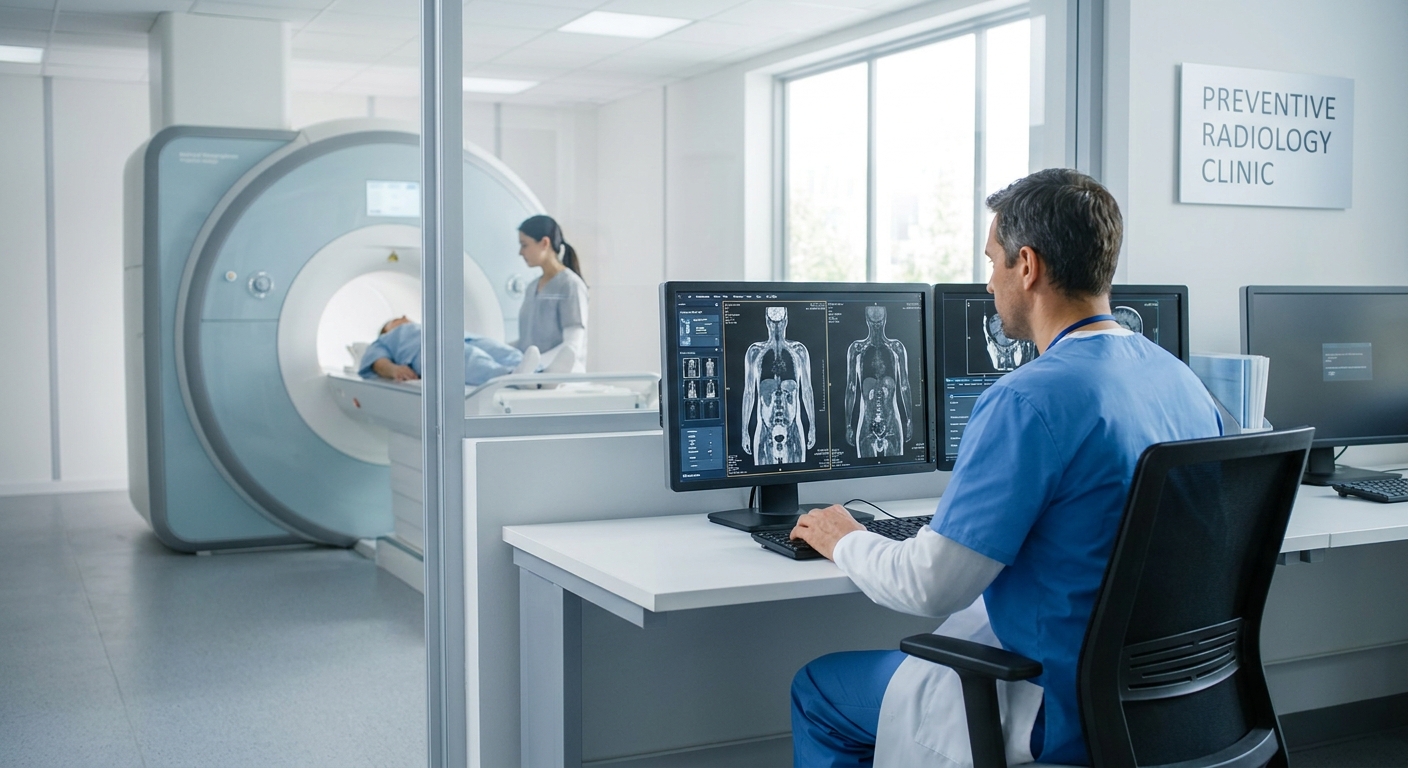
Whole-body MRI radiologist jobs at preventive screening clinics ask you to read six organ systems in one exam instead of chasing a single subspecialty niche. This guide breaks down what the roles actually pay, who thrives in them, and which openings are worth a second look in 2026.
- Whole body mri radiologist jobs pay on volume, not subspecialty prestige — expect RVU or per-scan models over straight salary.
- Body imaging-trained radiologists fit best: buy the role if you already read abdominal, MSK, and neuro without a fellowship silo.
- Preventive screening clinics lean on AI triage software for incidental findings — confirm the tool before signing, not after.
- Non-clinical roles at imaging-tech companies building whole-body MRI protocols are a viable off-ramp, not a fallback.
Why this matters
Whole-body MRI screening clinics went from a Silicon Valley curiosity to a real employer category by 2026, and radiologists who can read across subspecialties without a hand-off are in short supply. The catch: these clinics don't compensate like a hospital system or an academic department. Pay models, liability exposure, and read volume look nothing like a standard diagnostic radiology job, and the job titles don't always say so upfront.
Get the setup wrong and you're reading 40+ organ systems a day for salary math built around a 20-scan diagnostic shift. Get it right and it's one of the higher per-hour subspecialty-adjacent tracks in radiology right now. RadBoard tracks these listings alongside 5,000+ other radiology positions pulled from 20 sources, so you can compare a whole-body MRI opening against a standard body imaging role side by side before you apply.
Who this is for
This is written for radiologists who already read broadly — general diagnostic training or a body imaging fellowship, comfortable moving between abdominal, MSK, and neuro sequences in a single session. It's not the right fit for a subspecialist who only wants prostate MRI or only wants breast imaging; whole-body preventive screening panels bundle all of it into one report, and clinics expect you to sign off on the whole thing, not just your slice.
What to look for in whole-body MRI radiologist jobs
Read volume and turnaround expectations
Preventive screening clinics run on consumer-pay volume, and a busy site can push 15-25 whole-body exams a day per radiologist. Ask for the daily average before you sign, not the range — a clinic quoting "up to 25" often means 25 on a bad day and 12 on a slow one, and your compensation model needs to match the real number.
Subspecialty breadth, not subspecialty depth
A whole-body protocol touches brain, spine, chest, abdomen, pelvis, and MSK sequences in one sitting. If your training leans heavily toward one organ system, expect a steeper learning curve on the other five — clinics rarely provide six months of onboarding to close that gap.
Incidental finding protocol and liability coverage
Whole-body screening turns up incidentalomas at a documented higher rate than targeted diagnostic imaging, and every one of them needs a follow-up pathway. Confirm who owns communication with the patient's primary care physician and whether the clinic carries tail coverage for incidental-finding litigation before you're the one holding the bag.
AI-triage integration
Most 2026-era preventive screening clinics run AI-assisted lesion detection or triage software ahead of radiologist read, which changes your workflow and your liability exposure at the same time. Ask specifically what the software flags, what it misses, and whether you're liable for findings the algorithm didn't surface.
Compensation structure
RVU-based and per-scan pay are far more common here than fixed salary, because clinic revenue scales directly with scan volume. A per-scan rate of $150-$250 at 20 scans a day nets meaningfully more than a flat salary built around diagnostic-radiology assumptions — but only if the volume actually materializes.
On-site versus remote reading
Some preventive screening chains centralize reads through a remote hub model, others require on-site presence for same-day result consultations with patients. The remote model pays less per scan on average but removes commute and site overhead — decide which trade-off fits your life before you negotiate.
Top picks: whole-body MRI job pathways worth pursuing in 2026
Body imaging-trained roles at preventive clinics — the safe pick
Radiologists with abdominal imaging fellowship training map almost directly onto whole-body screening panels, since the abdominal and pelvic sequences carry the most diagnostic weight in a typical protocol. One spec that matters: clinics hiring for this track usually want board certification plus 2+ years of cross-sectional experience, not fellowship alone.
Verdict: Buy if you already read abdominal imaging daily and want a volume-based pay bump without switching subspecialties. Full listings for this track sit at body imaging radiologist jobs for abdominal imaging specialists.
Lung-screening combo roles — the volume play
Preventive clinics increasingly bundle low-dose CT lung screening with whole-body MRI in a single visit, and radiologists who can read both modalities command a premium at high-throughput sites. The number that matters: combo-trained readers often clear 20-30 combined studies a day versus 15 for MRI-only reads, which changes the per-scan math significantly.
Verdict: Consider if you're comfortable in both CT and MRI and want maximum volume-based earnings. See current openings under lung-cancer screening radiologist jobs for low-dose CT reads.
Prostate MRI-focused panel reads — the subspecialty premium
Some whole-body panels carve out PI-RADS-scored prostate MRI as a separate, higher-paying line item, since prostate MRI reimburses and prices at a premium versus general body sequences. This track suits a radiologist with formal PI-RADS training who wants to keep one subspecialty sharp inside a broader panel job.
Verdict: Buy if you hold PI-RADS certification and want the highest per-scan rate on the panel. Openings live at prostate MRI radiologist jobs for PI-RADS interpretation.
Non-clinical AI-triage roles at imaging tech companies — the wildcard
A smaller but growing set of whole-body MRI preventive screening companies hire radiologists into non-clinical roles building or validating the AI triage software itself, rather than reading scans day to day. This trades clinical volume for protocol design work, and pay structures here look nothing like RVU-based clinical roles — expect a flat salary model instead.
Verdict: Consider only if you want out of daily reads entirely and into imaging-tech product work; it's a real 2026 career track, but a narrow one.
What to avoid
- Clinics quoting salary with no volume floor. A flat salary that assumes 10 scans a day at a clinic actually running 20 means you're doing double the work for the same pay — get the daily volume commitment in writing.
- "Whole-body" listings that are actually single-sequence screening. Some job postings use the term loosely for a limited 3-sequence cancer-screening protocol, not the full six-system panel — ask for the actual sequence list before assuming scope.
- No mention of incidental-finding liability coverage. If the offer letter is silent on tail coverage for incidentalomas, that's a red flag worth raising before you sign, not after the first lawsuit letter shows up.
Compare whole-body MRI openings now
Search 5,000+ radiology jobs from 20 sources with AI-powered filters.
Verdict comparison
| Pathway | Read volume | Pay model | Best for | Verdict |
|---|---|---|---|---|
| Body imaging-trained panel role | 15-25 scans/day | RVU or per-scan | Abdominal-trained radiologists | Buy |
| Lung-screening combo role | 20-30 combined studies/day | Per-scan, volume-heavy | CT + MRI cross-trained readers | Consider |
| Prostate MRI panel line | Varies, premium per-scan | Per-scan premium rate | PI-RADS certified radiologists | Buy |
| Non-clinical AI-triage role | No daily reads | Flat salary | Radiologists exiting clinical volume | Consider |
FAQ
What do whole body MRI radiologist jobs pay in 2026?
Pay runs on RVU or per-scan models more often than flat salary, with per-scan rates commonly landing between $150 and $250 depending on volume and site. Combo roles reading both MRI and low-dose CT typically clear higher totals due to added scan volume.
Is whole body MRI radiology a real subspecialty?
It's not a formal ACGME subspecialty; it's a practice setting that draws on body imaging, MSK, and neuro reading skills at once. Radiologists with broad cross-sectional training, not a single-organ fellowship, tend to fit best.
Do whole body MRI preventive clinics require a fellowship?
Most listings want board certification plus 2+ years of cross-sectional imaging experience rather than a specific fellowship. A body imaging or abdominal imaging fellowship helps but isn't always mandatory.
How many scans does a whole body MRI radiologist read per day?
Busy preventive screening sites run 15-25 whole-body exams per radiologist per day in 2026, with combo lung-screening sites pushing 20-30 combined studies. Confirm the real daily average before accepting a volume-based pay structure.
Are whole body MRI jobs remote or on-site?
Both models exist: some chains centralize reads through a remote hub, others require on-site presence for same-day patient consultations. Remote roles typically pay less per scan but remove commute and facility overhead.
What's the biggest risk in whole body MRI screening jobs?
Incidental findings carry outsized liability exposure since whole-body scans surface more incidentalomas than targeted diagnostic imaging. Confirm tail coverage and the follow-up communication protocol before signing.
Can I do whole body MRI reading without clinical hours?
Yes — a small number of imaging-tech companies hire radiologists into non-clinical roles building or validating AI triage software for whole-body protocols. These pay a flat salary rather than per-scan or RVU rates.
Which radiologists fit whole body MRI screening roles best?
Radiologists with broad cross-sectional experience across abdominal, MSK, and neuro sequences fit best, since whole-body panels require sign-off across all six organ systems. Single-subspecialty readers face a steeper onboarding curve.
One last thing
The detail most radiologists miss: whole-body MRI preventive clinics often quote compensation against national averages instead of the site's actual scan volume, and the gap between a 12-scan day and a 25-scan day changes per-scan earnings by more than 2x. Ask for the trailing-90-day volume number at the specific site, not the company-wide average, before you compare any offer against a diagnostic radiology salary.