Best overall starting point: Duke University. Best for a cancer-center career: Memorial Sloan Kettering Cancer Center. Best for an academic research path: UCSF. Best for a Los Angeles career plan: UCLA. This 2026 guide compares breast imaging fellowship programs by career fit, clinical preparation, and the questions that should determine your rank list.
- The best breast imaging fellowship programs match your intended practice, procedure training, and mentorship needs.
- Duke University is the default shortlist choice for applicants seeking university-based breast imaging training.
- Memorial Sloan Kettering fits a cancer-center career; UCSF fits an academic research search.
- UCLA belongs on the shortlist when Los Angeles is your intended practice market.
- RadBoard connects fellowship planning with radiology job search across 5,000+ positions from 20 sources.
Why this matters
A breast imaging fellowship should prepare you for the work you intend to do as an attending: screening, diagnostic evaluation, image-guided procedures, patient communication, and multidisciplinary decisions. The institutional name does not tell you how those responsibilities reach the fellow.
Start with the endpoint. Review mammography radiologist jobs for breast imaging specialists, then identify the training experiences those roles require. RadBoard is a radiology job search platform for physicians comparing career opportunities, not a fellowship application service.
Breast imaging fellowships commonly run for 12 months. That makes the weekly schedule consequential: research, conferences, service coverage, and clinical rotations all compete for the same training year.
What makes the best breast imaging fellowship programs?
Use these criteria before comparing institutional reputations. A strong answer includes an actual schedule, a defined responsibility, or a named supervisor—not simply a description of the department.
- Clinical breadth: Ask how screening mammography, diagnostic mammography, ultrasound, and breast MRI enter the fellow's schedule.
- Procedural ownership: Establish who performs ultrasound-guided, stereotactic or tomosynthesis-guided, and MRI-guided procedures, and how responsibility progresses.
- Patient management: Look for participation in communicating findings, imaging-pathology concordance, and follow-up recommendations.
- Mentorship: Identify faculty whose clinical or research interests match your intended career, then confirm their role in fellowship teaching.
- Career alignment: Compare the training environment with your target practice: community breast imaging, academic medicine, cancer care, or a specific geographic market.
- Schedule transparency: Request the rotation structure, non-breast responsibilities, call expectations, and research requirements before ranking.
For your 2026 application decisions, distinguish institutional resources from fellow access. A department can offer an examination or procedure without assigning meaningful participation to every fellow.
Breast imaging fellowships at a glance
This is an ordered shortlist by intended use, not a measured national quality ranking. The limitations below describe decision trade-offs; they are not claims of documented training deficiencies.
| Program | Best for | Standout consideration | Key limitation |
|---|---|---|---|
| Duke University | University-based clinical preparation | Breast imaging training within an academic medical center | You must establish how clinical responsibility progresses |
| Memorial Sloan Kettering Cancer Center | A cancer-center career | Training in a dedicated cancer-care institution | A cancer-focused environment is not identical to a community screening practice |
| UCSF | An academic research path | Breast imaging within a university research environment | Institutional research activity does not establish protected fellow research time |
| UCLA | A Los Angeles career plan | University-based training in your intended regional market | Geographic fit does not establish procedural or mentorship fit |
1. Duke University: best for university-based clinical preparation
Duke University offers breast imaging fellowship training within its academic radiology department. Put Duke first on your initial shortlist if you want to investigate a university-based route into breast imaging without making cancer-center specialization or geography your starting requirement.
The next step is specific. Ask the program to walk through a representative clinical week and explain how a fellow moves from supervised participation toward managing a diagnostic workup.
Duke University pros:
- An academic medical center provides a relevant setting for applicants considering university practice.
- A dedicated breast imaging fellowship gives your training a defined subspecialty focus.
- The university setting lets you evaluate clinical teaching and academic mentorship together.
Duke University cons:
- An academic setting alone does not establish the amount of independent decision-making you receive.
- Duke is not a substitute for training in your intended regional market if local professional connections are your priority.
Best for: Applicants seeking university-based clinical preparation who have not committed to a cancer-only career setting.
Ask current fellows who performs each biopsy type, how feedback is delivered, and what happens when several learners want the same procedure. Request examples of how fellows handle discordant pathology and difficult patient discussions.
Those answers matter more than a department-wide procedure total. Duke University verdict: Hold on your shortlist until fellow-level clinical responsibility is clear.
2. Memorial Sloan Kettering: best for a cancer-center career
Memorial Sloan Kettering Cancer Center offers breast imaging fellowship training in a dedicated cancer institution. The setting makes it a direct shortlist candidate if your intended career centers on breast oncology and multidisciplinary cancer care.
Evaluate the fellowship against that goal, not against a generic prestige hierarchy. Ask how fellows participate in imaging decisions around diagnosis, treatment, and follow-up, and how those responsibilities intersect with surgery, pathology, and medical oncology.
Memorial Sloan Kettering pros:
- The institutional mission directly matches a cancer-center career goal.
- The setting supports evaluation of breast imaging's role within multidisciplinary oncology.
- Cancer-focused faculty interests give applicants a clear basis for assessing mentor fit.
Memorial Sloan Kettering cons:
- Cancer-center practice is not interchangeable with a community practice built around screening and diagnostic callbacks.
- Institutional cancer expertise does not establish how procedures or clinical responsibilities are distributed among learners.
Best for: Applicants who intend to pursue cancer-center breast imaging rather than choosing oncology exposure as a secondary interest.
For a 2026 comparison, ask how routine screening fits alongside complex oncology work. You need to understand both the referral environment and the cases you personally manage.
Also ask where graduates practice and which parts of fellowship prepared them for those roles. Memorial Sloan Kettering verdict: Hold for a cancer-center career; skip as an automatic first choice based on name alone.
3. UCSF: best for an academic research path
UCSF offers breast imaging fellowship training within a university radiology department with an established research mission. Shortlist UCSF if your intended attending role includes investigation, teaching, and clinical breast imaging.
A research-oriented choice requires more than recognizing faculty names. Identify a question you want to study, then ask whether a suitable mentor, feasible project, and workable schedule exist for a fellow.
UCSF pros:
- The university environment aligns with an academic career search.
- Clinical and research interests can be assessed within the same institution.
- Faculty research areas give you concrete subjects for mentorship discussions.
UCSF cons:
- A research-active department does not guarantee protected research time for fellows.
- A project without a defined scope can compete with the clinical training you need.
Best for: Applicants who can explain how research fits their intended academic breast imaging career.
Ask about project supervision, data access, approvals, and expected deliverables. Then return to the clinical schedule: research fit does not replace adequate experience in diagnostic assessment and image-guided procedures.
Request examples of completed fellow projects rather than treating publication expectations as proof of support. A useful project has an achievable question and a supervisor who remains involved. UCSF verdict: Hold if you can identify both a suitable mentor and a feasible project.
4. UCLA: best for a Los Angeles career plan
UCLA offers breast imaging fellowship training in Los Angeles. Include UCLA when you want university-based training and intend to investigate a longer-term career in that regional market.
Geography is a legitimate selection criterion. It affects where you train and the professional community you encounter, but it does not establish a hiring outcome or replace a close review of the curriculum.
UCLA pros:
- The training location matches a Los Angeles career plan.
- The university setting fits applicants considering academic breast imaging.
- Regional alignment lets you assess the local practice environment during training.
UCLA cons:
- Training in Los Angeles does not guarantee a Los Angeles attending position.
- Location alone does not establish sufficient procedural participation or the right mentor.
Best for: Applicants who have a clear reason to build their breast imaging career in Los Angeles.
Ask where clinical rotations occur and how the fellow's responsibilities differ across training settings. Confirm the actual travel requirements, supervision arrangements, and procedure allocation rather than inferring them from the university name.
If Los Angeles is not a priority, compare UCLA with programs closer to your intended practice market. UCLA verdict: Hold for regional fit; skip choosing it solely for location before checking training fit.
How to compare programs after interviews
Use the same questions at every interview. A consistent comparison prevents a memorable conversation from outweighing a weak answer about your core training needs.
- Clinical breadth: Which examinations do fellows interpret, and how does the schedule distribute them?
- Procedural ownership: Who performs procedures, and what responsibility does the fellow assume?
- Mentorship: Who supervises clinical development and any research project?
- Career alignment: Where do graduates work, and how does the program support your intended path?
Keep notes under those headings immediately after each interview. Separate a promised opportunity from a scheduled responsibility; they are not equivalent.
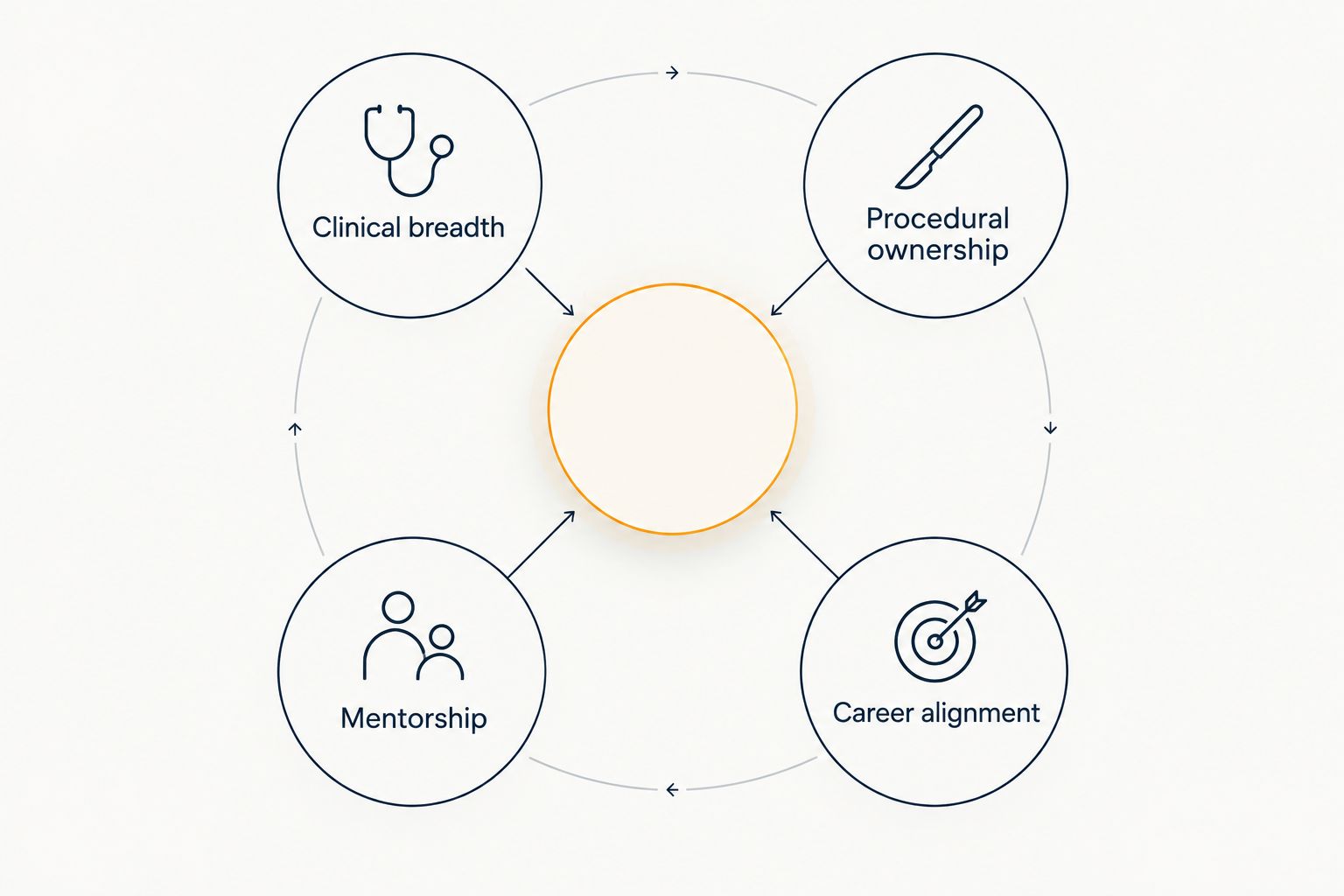
For your 2026 rank list, ask current fellows for a recent example under each heading. Their descriptions should help you understand how the published curriculum becomes a working week.
How the shortlist is ordered
The order starts with a general university-based training candidate, then separates cancer-center, research, and regional career goals. It does not assign unsupported scores for teaching quality, procedural volume, selectivity, or graduate placement.
The named institutions have breast imaging fellowship programs; their institutional settings provide the basis for these use-case distinctions. Your final ranking should follow current program information and fellow-level answers, not this article's order. Confirm application requirements and timelines directly with each program and the Society of Breast Imaging's fellowship resources.
Which breast imaging fellowship should you choose?
Start with Duke University if you need a default program to investigate. Move Memorial Sloan Kettering ahead when a cancer-center career is your explicit goal, UCSF when a defined academic research path drives the decision, and UCLA when Los Angeles is central to your plan.
Before finalizing your 2026 preferences, compare the training with actual attending responsibilities. RadBoard aggregates 5,000+ radiology positions from 20 sources and offers search and swipe-to-save features; use job descriptions to identify skills and practice settings you want to prepare for.
A job search platform does not replace fellowship advising. Its role here is to make the career endpoint concrete before you commit to a training environment.
Compare radiology career opportunities
Search RadBoard's 5,000+ radiology positions aggregated from 20 sources.
FAQ
What are the best breast imaging fellowship programs in 2026?
Duke University, Memorial Sloan Kettering Cancer Center, UCSF, and UCLA form a useful shortlist for different career goals. Compare university-based clinical preparation, cancer-center practice, academic research, and geographic fit rather than treating the order as a measured national ranking.
Which breast imaging fellowship should I investigate first?
Duke University is the default starting point in this guide for university-based clinical preparation. Put another program first when your cancer-center, research, or regional goal gives you a clearer selection criterion.
Is a cancer-center fellowship better than a university fellowship?
A cancer-center fellowship is not automatically better than a university fellowship. Compare the cases you personally manage, procedural responsibilities, mentorship, and preparation for your intended attending role.
How long does a breast imaging fellowship take?
Breast imaging fellowships commonly last 12 months. Confirm the duration and rotation structure with each program, particularly when considering a research-focused or otherwise distinct training arrangement.
What should I ask about breast biopsy training?
Ask who performs each biopsy type and how responsibility progresses during fellowship. Request a fellow-level explanation of ultrasound-guided, stereotactic or tomosynthesis-guided, and MRI-guided procedure participation.
Should I choose a fellowship near where I want to work?
Geographic alignment is a valid reason to prioritize a fellowship, but it does not guarantee a local job. Evaluate regional fit alongside clinical training, procedures, and mentorship.
Can RadBoard help me choose a breast imaging fellowship?
RadBoard can help you compare radiology career opportunities with the training you are considering. It aggregates 5,000+ radiology positions from 20 sources; fellowship curriculum and application questions belong with the individual programs.
One last thing
Ask a current fellow to describe the last difficult imaging-pathology discordance they handled: what they recognized, whom they consulted, and how the follow-up decision reached the patient. That question connects interpretation, judgment, communication, and supervision in one concrete example.
For a 2026 fellowship decision, choose demonstrated responsibility over a list of available technologies. The useful distinction is not whether the institution performs an examination—it is whether you learn to manage the decisions around it.