Best overall: dedicated overnight final-read coverage. Best for supporting a local daytime group: preliminary-read coverage. Best for a defined staffing gap: locum overnight coverage. When comparing teleradiology companies for nighthawk coverage in 2026, choose the coverage model first, then evaluate the company and the actual assignment.
- For teleradiology companies nighthawk coverage, compare reporting responsibility, emergency radiology workload, backup, and schedule before company names.
- Dedicated final-read coverage is the default shortlist for physicians seeking a recurring overnight role.
- Preliminary-read coverage fits workflows with an explicitly assigned final interpreting radiologist.
- RadBoard is best for radiologists comparing nighthawk job opportunities across multiple sources.
Why this matters
Nighthawk describes overnight coverage, not a uniform job. A position can involve preliminary interpretations, final reports, a narrow subspecialty queue, or a shared emergency worklist. Those differences determine what you accept clinically and contractually.
RadBoard aggregates 5,000+ radiology positions from 20 sources and offers search and swipe-to-save features. Use that breadth to compare assignments, but judge each opportunity by its written responsibilities rather than the employer's name.
For your 2026 shortlist, separate the hospital's service requirements from your employment terms. A hospital needs reliable overnight interpretation; you also need a workable schedule, clear reporting responsibility, and defined support when demand exceeds your capacity.
What makes the best nighthawk coverage?
Use these criteria before ranking an overnight position:
- Reporting responsibility: Establish whether you issue preliminary interpretations, final reports, or both, and who handles subsequent changes.
- Schedule definition: Require start and finish times, the governing time zone, weekend obligations, holidays, and shift-change expectations.
- Case mix: Identify modalities, patient populations, emergency studies, and examinations outside your intended scope.
- Workload evidence: Request actual assignment-level workload information, including peak periods and work carried across shift changes.
- Clinical backup: Identify the escalation contact, overflow process, consultation pathway, and downtime procedure.
- Contract alignment: Match the written agreement to the recruitment discussion, including malpractice responsibilities, equipment, and termination terms.
The best nighthawk assignment defines who owns the report, who supports the reader, and what happens when the shift ends. A familiar company name does not answer those questions.
Nighthawk coverage options at a glance
This ranking orders coverage models by the problem they solve. Use it to decide which companies and assignments belong on your shortlist—not to treat every overnight position as interchangeable.
| Rank and coverage model | Best for | Defining feature | Key limitation |
|---|---|---|---|
| Dedicated overnight final-read coverage | A recurring overnight career | Final interpretations during an assigned night shift | Requires explicit ownership of follow-up and shift-end work |
| Preliminary-read overnight coverage | Supporting a local final-reading group | Overnight preliminary interpretation with subsequent final review | Creates a handoff that needs defined discrepancy handling |
| Subspecialty overnight coverage | A focused clinical scope | A worklist built around specified expertise | Exclusions and general coverage expectations need agreement |
| Locum overnight coverage | A defined staffing gap | A time-limited overnight assignment | Temporary status does not remove onboarding requirements |
| Supplemental overnight coverage | Adding selected nights to another role | Overnight work alongside an existing position | Requires coordination with your primary obligations |
1. Dedicated final-read coverage: best for a recurring overnight career
Dedicated overnight final-read coverage means your overnight interpretation becomes the final report within the assigned workflow. For a radiologist seeking a regular nighthawk role, this is the default model to evaluate first.
Ask exactly which examinations enter your queue and which responsibilities continue after interpretation. Final-read work needs a defined process for critical-result communication, addenda, clinician questions, and work remaining at shift change.
Dedicated final-read coverage pros:
- Establishes a clear reporting endpoint for examinations within scope.
- Supports evaluation of a recurring overnight schedule.
- Lets you assess the complete interpretation workflow before accepting.
Dedicated final-read coverage cons:
- Final-report responsibility makes escalation and follow-up terms essential.
- A remote position still requires detailed review of site-specific workflows.
- An undefined shift-end queue leaves your finishing time unresolved.
For a 2026 offer, request a sample schedule and a written description of report ownership. Ask whether the person recruiting you can connect you with a physician working the proposed assignment.
Best for: Radiologists who want recurring overnight work with final interpretation responsibility.
Verdict: Buy into this model only when workload, backup, and reporting responsibilities are explicit.
2. Preliminary-read coverage: best for supporting a local group
Preliminary-read coverage provides an overnight interpretation before the designated final reader completes the final report. Its defining issue is the handoff—not simply the fact that the work occurs at night.
Confirm who finalizes the examination and how the final reader receives the preliminary interpretation. You also need a written process for discrepancies, urgent communication, and questions that arise after your shift.
Preliminary-read coverage pros:
- Separates overnight preliminary interpretation from subsequent final review.
- Fits a workflow that retains a designated final-reading group.
- Provides a clear basis for discussing handoff responsibilities.
Preliminary-read coverage cons:
- Adds a transfer of reporting responsibility that needs active management.
- Requires agreement on discrepancy notification and documentation.
- Does not eliminate your responsibility for the interpretation you provide.
Do not interpret the word preliminary as a promise of a lighter workload or fewer clinical obligations. Ask about the actual queue and communication duties, just as you would for final-read coverage.
Best for: Radiologists comfortable working within a defined preliminary-to-final reporting process.
Verdict: Hold until the final-reader handoff and discrepancy process are documented.
3. Subspecialty overnight coverage: best for a focused clinical scope
Subspecialty overnight coverage centers the assignment on a specified area of practice. The key question is whether that focus describes the actual worklist or merely the preferred training of the applicant.
Ask which studies remain outside your scope and where those examinations go. A subspecialty title does not establish that you are exempt from general emergency interpretation, cross-coverage, or overflow.
Subspecialty overnight coverage pros:
- Makes clinical scope a central selection criterion.
- Supports a direct discussion about expertise and case routing.
- Gives you specific exclusions to confirm before signing.
Subspecialty overnight coverage cons:
- A focused title alone does not define the assignment.
- Cross-coverage expectations can conflict with your intended scope.
- Backup arrangements must address studies outside your expertise.
For 2026 recruiting conversations, request the inclusion and exclusion rules in writing. Ask how the company handles an examination that does not fit the designated subspecialty queue.
Best for: Radiologists whose priority is a clearly bounded overnight subspecialty practice.
Verdict: Buy only when the worklist rules match the advertised clinical scope.
4. Locum overnight coverage: best for a defined staffing gap
Locum overnight coverage is a time-limited assignment rather than an open-ended commitment. Evaluate it when you want a bounded period of overnight work or are considering a temporary coverage arrangement.
Temporary work still needs complete clinical onboarding. Confirm the sites, reporting permissions, workstation arrangements, support contacts, and conditions that must be satisfied before your first shift.
Locum overnight coverage pros:
- Creates a defined assignment period.
- Lets you evaluate overnight work without assuming a permanent position.
- Makes start dates, end dates, and scheduled shifts central contract terms.
Locum overnight coverage cons:
- Each assignment requires review of its own clinical workflow.
- Scheduling depends on completing the required onboarding steps.
- Cancellation, extension, and malpractice terms need careful examination.
Ask whether an extension changes the agreement or requires a new one. Also establish what happens if onboarding is incomplete when the proposed assignment begins.
Best for: Radiologists seeking a defined overnight assignment rather than a recurring permanent role.
Verdict: Hold until onboarding responsibilities and cancellation terms are settled.
5. Supplemental overnight coverage: best for selected additional shifts
Supplemental overnight coverage adds selected night shifts alongside another position. Its main selection question is compatibility with your existing clinical duties and contractual obligations.
Review your primary employment agreement before accepting outside work. Then compare the proposed night schedule with your daytime responsibilities, recovery time, and any restrictions on external practice.
Supplemental overnight coverage pros:
- Lets you evaluate a limited overnight commitment.
- Keeps the decision focused on specific shifts rather than a full career change.
- Provides a basis for comparing outside-work requirements with your current role.
Supplemental overnight coverage cons:
- Requires coordination across separate schedules and agreements.
- Creates additional licensing, credentialing, and insurance questions.
- Can conflict with daytime obligations if recovery time is not protected.
Do not accept an assignment merely because the scheduled hours do not overlap. Consider the work immediately before and after the overnight shift, including required meetings and call responsibilities.
Best for: Radiologists seeking selected additional nights while retaining another position.
Verdict: Skip any arrangement that conflicts with existing obligations or leaves recovery time unresolved.
How to compare companies after choosing the model
Start with 3 documents: the job description, the proposed schedule, and the contract. Compare them side by side. A statement in one document should not contradict an obligation in another.
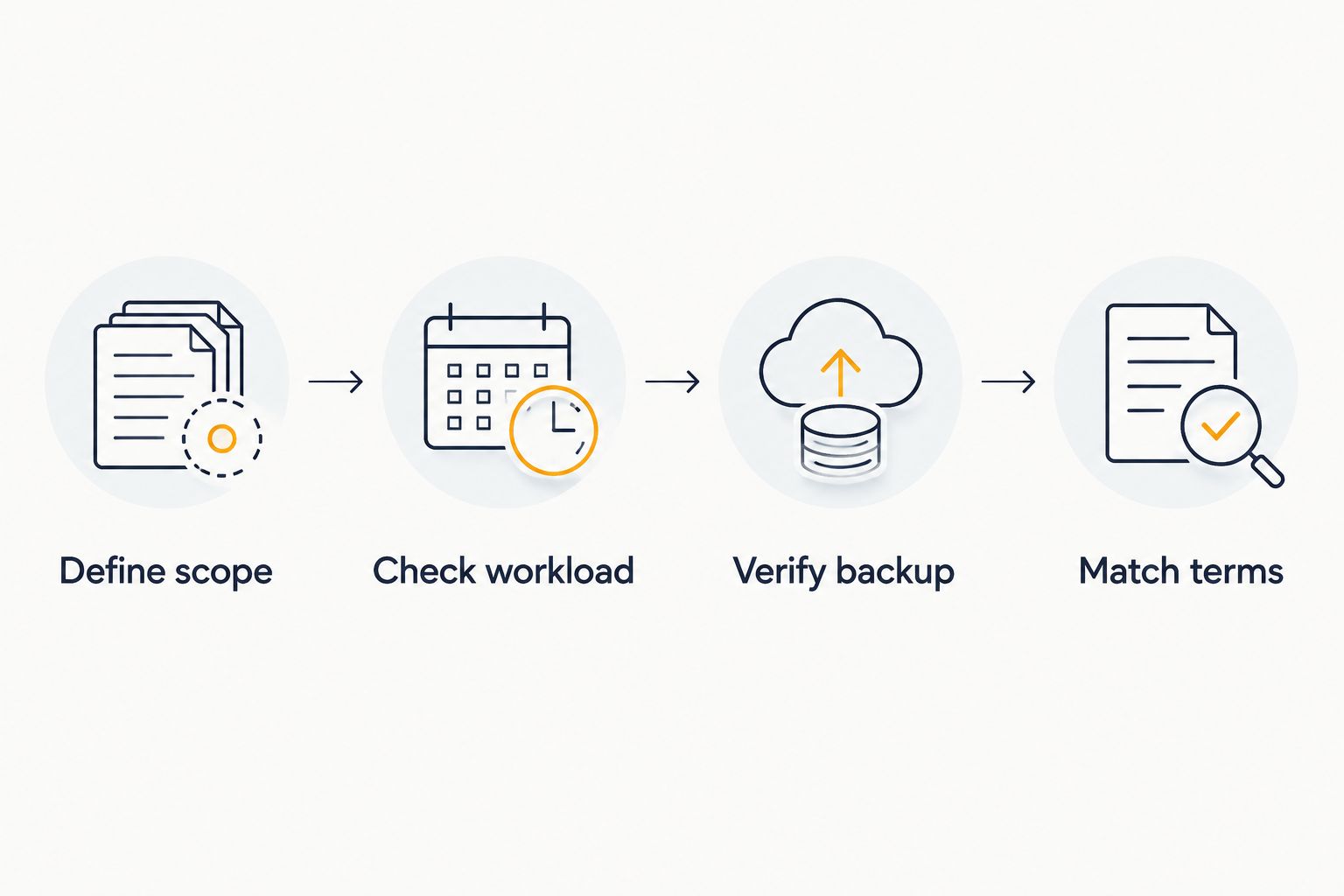
Use this sequence for your 2026 interviews:
- Define scope: Identify reporting type, modalities, patient populations, and exclusions.
- Check workload: Request assignment-level information and ask how peaks are managed.
- Verify backup: Establish who responds to clinical questions, overflow, and technical failures.
- Match terms: Confirm that the agreement reflects the schedule and responsibilities discussed.
Ask for examples rather than assurances. Instead of asking whether support is good, ask who takes the call when image transfer fails during your shift and how unresolved studies are handed over.
For the written agreement, use the guide to evaluating a teleradiology contract before signing. Keep clinical workflow questions separate from legal interpretation, and obtain qualified advice for the agreement you will sign.
How the coverage models are ranked
Dedicated final-read coverage ranks first as the default for a recurring overnight career. Preliminary-read coverage follows for a local-group handoff, subspecialty coverage for scope control, locum coverage for a bounded assignment, and supplemental coverage for additional shifts.
The ranking reflects fit, not measured company performance. Compare employers within the model that matches your goal; comparing an occasional supplemental shift with a permanent final-read role obscures the decision.
Which nighthawk coverage should you choose?
Choose dedicated final-read coverage if you want a recurring overnight role, then reject assignments with undefined workload or backup. Choose preliminary-read coverage when the local final-reading workflow is the intended arrangement.
Use subspecialty coverage when clinical scope is your deciding factor. Use locum coverage for a defined period and supplemental coverage for selected nights that fit your existing obligations.
RadBoard supports the radiology job search; it is not the clinical coverage provider. Save relevant opportunities, then apply the same questions to every employer so that your shortlist reflects comparable responsibilities.
Compare overnight radiology opportunities
Search across 5,000+ radiology positions from 20 sources, then save opportunities for closer review.
FAQ
What's the best teleradiology company for nighthawk coverage?
The best fit is the company whose assignment matches your reporting scope, schedule, workload, and backup requirements. Choose the coverage model first, then compare written assignment details rather than relying on company names.
Is final-read coverage better than preliminary-read coverage?
Final-read coverage fits a workflow that needs a final overnight interpretation; preliminary-read coverage fits a workflow with subsequent final review. Neither model removes the need for clear communication, escalation, and reporting responsibilities.
Does a nighthawk job always mean final interpretations?
No. Nighthawk describes overnight coverage, while the assignment determines whether you provide preliminary interpretations, final reports, or both. Confirm the reporting type before accepting.
Can I work nighthawk shifts alongside a daytime radiology job?
Consider supplemental overnight work only after checking your existing agreement and schedule. Confirm outside-work permissions, insurance responsibilities, and recovery time before committing.
What should I ask about overnight workload?
Ask for assignment-level workload information, case mix, peak-period expectations, and the overflow process. Also establish who handles studies remaining when your scheduled shift ends.
Does remote nighthawk work let me read from any location?
No. Confirm that the proposed location satisfies the assignment's licensing, credentialing, security, insurance, and employer requirements before working there. Remote describes the reading arrangement, not unrestricted permission to practice.
How does RadBoard help with a nighthawk radiology job search?
RadBoard aggregates 5,000+ radiology positions from 20 sources and offers search and swipe-to-save features. Use the platform to build a shortlist, then confirm overnight responsibilities directly with each employer.
One last thing
Ask who owns the next unread examination when your shift ends. That question forces a practical discussion about handoffs, overflow, and the difference between scheduled hours and actual obligations.
For a 2026 nighthawk decision, do not sign until you can explain that answer in plain language. A defined finish is part of a defined job.