
Breast imaging radiologist career planning is the process of matching your training, procedural skills, and preferred practice setting to a sustainable breast imaging role. This 2026 guide focuses on the decisions that distinguish breast imaging jobs: diagnostic responsibility, biopsy access, patient communication, and the balance between onsite and remote work.
- Build your breast imaging radiologist career around case mix, procedure access, and documented coverage expectations—not the job title alone.
- RadBoard is best for radiologists who want one radiology job search across 20 sources.
- Compare academic, private practice, hospital-employed, locum, and remote roles against the same written criteria.
- Verify mammography qualifications, facility privileges, and follow-up responsibilities before accepting a breast imaging position.
Why career planning matters for breast imaging radiologists
A breast imaging position combines image interpretation with decisions that affect the patient's next step. Screening reads, diagnostic workups, image-guided procedures, pathology review, and communication with referring clinicians create different working days—even when employers use the same title.
Choose the clinical workflow before choosing the employer. A screening-focused position does not provide the same procedural experience as a diagnostic breast center. A role advertised as breast imaging also needs scrutiny for general radiology coverage, travel between facilities, and call obligations.
Start with the scope described in mammography radiologist jobs for breast imaging specialists. Then use the framework below to test each employer's actual expectations.
For your 2026 search, treat a posting as an introduction, not a complete job description. The useful evidence is the schedule, case mix, staffing plan, and written agreement behind it.
How to build your breast imaging career plan
Define your clinical scope before searching
Write a 1-page career brief before contacting employers. Separate work you want to perform regularly from work you can cover but do not want to define your position.
Distinguish screening mammography from diagnostic mammography, breast ultrasound, breast MRI, and procedures. Include whether you want patient-facing work, multidisciplinary conferences, teaching, or leadership responsibilities. These preferences give recruiters something more precise than a request for a breast imaging job.
Make your boundaries explicit. If you want subspecialty-only practice, a general call requirement is a substantive mismatch, not a detail to settle after interviewing.
- List the modalities you want in your regular schedule.
- Identify procedures you intend to maintain or develop.
- Mark general radiology coverage as acceptable or excluded.
- Specify geographic limits and willingness to travel between sites.
- Record your requirements for onsite, hybrid, or remote work.
Verify your qualifications and procedure readiness
Review your training and documentation against the work you intend to perform. Fellowship training, board status, mammography interpreting qualifications, state licensure, and facility privileges are separate questions; do not treat one credential as proof of all the others.
For US mammography practice in 2026, verify current Mammography Quality Standards Act requirements with the facility's credentialing team and current FDA guidance. Ask the employer to identify any documentation gaps before you agree to a start date.
For procedures, describe your experience accurately. Recent case logs and references help an employer assess readiness, but the facility still determines privileges through its credentialing process.
- Gather training certificates and current license documentation.
- Organize mammography continuing education and experience records.
- Separate procedure logs by technique and guidance modality.
- Confirm which privileges require additional documentation or proctoring.
- Ask who owns the credentialing checklist and tracks unresolved items.
Build a shortlist across multiple search channels
Start manually: review employer career pages, contact professional connections, and record suitable roles in a spreadsheet. Use consistent fields so an appealing description does not obscure missing information.
RadBoard offers a consolidated radiology job search with 5,000+ positions from 20 sources and swipe-to-save features. Those figures cover radiology broadly; they are not a count of breast imaging vacancies. The platform helps you collect possibilities, while employer conversations establish clinical fit.
Search adjacent terms as well as the exact specialty name. Mammography, breast MRI, diagnostic breast imaging, and breast procedures describe different parts of the role. Women's imaging requires particular care because the scope can extend beyond breast imaging.
- Record employer, location, clinical scope, and original posting source.
- Search both breast imaging and modality-specific terms.
- Consolidate duplicate advertisements for the same position.
- Mark unanswered questions instead of filling gaps with assumptions.
- Confirm the role's scope directly with the hiring practice.
Audit the working day rather than the headline schedule
Request 2 sample schedules: a routine clinical day and a procedure-heavy day. Ask how the practice handles add-on diagnostic examinations, unexpected staff absences, and cases requiring additional discussion.
A daytime schedule does not establish the workload. You need to understand how screening interpretation competes with diagnostic consultations, biopsies, phone calls, and pathology follow-up. Ask whether the same radiologist is responsible for all these tasks simultaneously.
For a 2026 hybrid search, separate tasks that can be performed remotely from responsibilities requiring onsite coverage. The employer should explain who examines patients, performs procedures, and manages immediate clinical questions.
- Request workload information separated by examination and procedure type.
- Identify protected procedure time and interruption expectations.
- Confirm technologist, nursing, scheduling, and administrative support.
- Establish who covers absences and unfinished diagnostic work.
- Clarify evening, weekend, general call, and cross-site obligations.
Compare the full offer against your clinical responsibilities
Build a side-by-side offer sheet before negotiating. Compare compensation structure, benefits, leave, professional expenses, malpractice terms, and clinical duties without assuming that a larger headline package means a better job.
Productivity-based arrangements need a clear explanation of what counts toward performance. Ask how procedures, consultations, teaching, conferences, quality work, and administrative responsibilities are recognized. A breast imaging position includes work that is not captured by counting screening examinations alone.
For partnership or leadership tracks, distinguish eligibility from a commitment. Ask for the decision process, written criteria, and consequences if the expected transition does not happen.
- Request the complete compensation formula and performance definitions.
- Match expected output to the proposed clinical schedule.
- Clarify leave coverage and workload after time away.
- Review malpractice coverage, tail responsibility, and outside-work restrictions.
- Have a physician employment attorney assess the actual agreement.
Interview the team that controls the workflow
Speak with the breast imaging radiologists and the people who support their work. A section leader explains priorities; technologists and schedulers explain how the day actually functions.
Use specific questions rather than asking whether the culture is supportive. Ask how a delayed biopsy is rescheduled, who resolves missing outside images, and how radiology-pathology discordance is handled. Request examples of escalation pathways without seeking identifiable patient information.
Ask to observe the workflow when feasible. A site visit can show how reading rooms, ultrasound rooms, procedure spaces, and patient communication fit together, but observation does not replace written terms.
- Meet a radiologist whose schedule resembles the proposed role.
- Ask technologists how diagnostic add-ons enter the schedule.
- Identify responsibility for pathology tracking and concordance review.
- Discuss access to breast surgery and oncology collaboration.
- Request permission to contact 3 professional references for the practice.
Put the transition and development plan in writing
Before accepting, document how you will move from recruitment into independent work. Your start plan should address privileges, systems access, orientation, scheduling, and an identified clinical contact for questions.
Early-career radiologists should ask how they will receive feedback on diagnostic decisions and procedures. Experienced radiologists changing settings should clarify differences in protocols, reporting expectations, and follow-up processes. Neither group benefits from an orientation limited to software access.
Connect the position to your next professional objective. If you want education, research, quality leadership, or section management, identify the work and time attached to that path—not just the title.
- Assign an owner to each onboarding requirement.
- Confirm orientation for reporting, procedures, and communication workflows.
- Identify a clinical escalation contact and backup coverage.
- Document any mentorship or protected nonclinical responsibilities.
- Set an early review meeting to compare promised and actual duties.
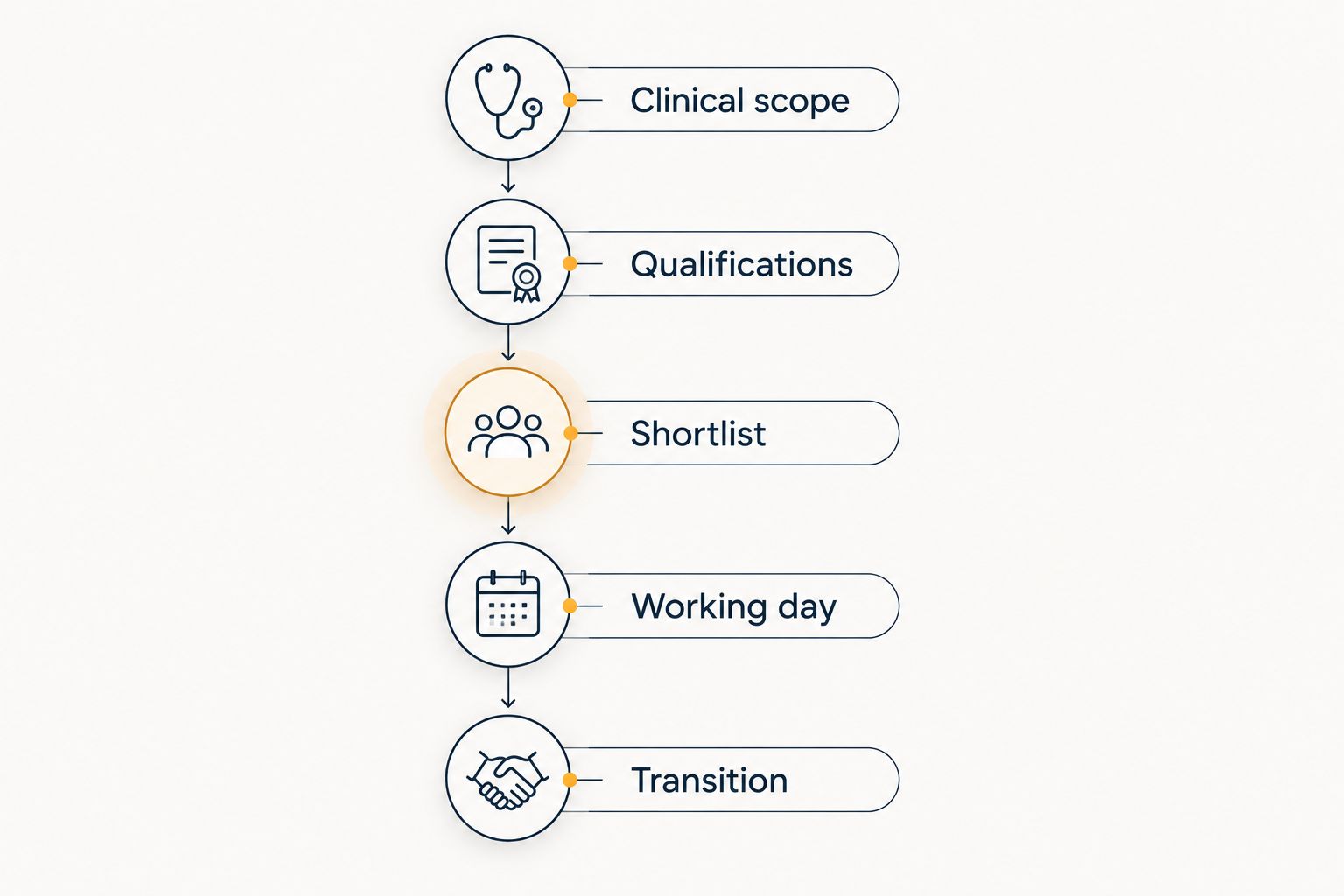
The sequence matters: define your scope, verify qualifications, compare opportunities, and test the workflow before committing. Keep the same career brief throughout the search so your criteria do not change with each persuasive interview.
Compare breast imaging career options
The best practice setting is the one that supports your intended clinical scope. These are decision criteria, not promises about every employer. Verify each feature in the specific position you are considering.
| Option | Best for | Main advantage to assess | Key limitation to check |
|---|---|---|---|
| Academic practice | Radiologists prioritizing teaching or research | Access to educational and scholarly responsibilities | Whether nonclinical work has protected time |
| Private practice | Radiologists interested in practice operations or ownership | A defined route into governance or partnership | Whether the route is documented and attainable |
| Hospital-employed practice | Radiologists seeking work within a hospital system | Coordination with hospital-based clinical services | Cross-site duties and limits on scheduling control |
| Locum or per-diem work | Radiologists seeking discrete coverage assignments | Ability to assess different practice environments | Repeated onboarding and assignment-specific responsibilities |
| Remote or hybrid work | Radiologists seeking remote interpretation time | Separation of reading work from some onsite duties | Procedure access and responsibility for onsite clinical needs |
A breast imaging career can also change setting over time. Fellowship graduates can prioritize supervision and diagnostic breadth, while established radiologists can place more weight on procedural focus, leadership, or schedule control. Neither choice is a universal progression.
Compare ways to find those roles
Search channels solve different problems. Use aggregation for discovery, direct conversations for detail, and a written comparison sheet for decisions.
| Search option | Best for | Advantage | Limitation |
|---|---|---|---|
| Employer career pages | Radiologists targeting named institutions | Direct access to the employer's description | Requires checking employers separately |
| Professional contacts | Radiologists seeking context about a practice | Opportunity to ask about day-to-day work | Personal accounts do not establish contract terms |
| RadBoard radiology job search | Radiologists comparing positions across sources | Aggregates 5,000+ radiology positions from 20 sources | Listings do not replace employer verification or credentialing |
Common mistakes breast imaging radiologists make
Treating women's imaging as an exact specialty match
A women's imaging title does not establish a breast-only workload. Ask for the actual modality mix, including any pelvic, obstetric, or general ultrasound responsibilities. Accept the scope, not the label.
Assuming breast imaging means no general call
A subspecialty position can still include broader coverage obligations. Obtain the call schedule and coverage expectations before discussing the role as a breast-only career move. Ask whether those duties change during staffing shortages.
Comparing productivity without comparing case mix
A screening-heavy day and a procedure-heavy day involve different tasks. Ask how the employer sets expectations for each, including consultations and follow-up work. Do not accept a single daily volume figure as a complete workload description.
Choosing remote work without checking procedural continuity
Remote interpretation and onsite intervention are different responsibilities. If maintaining biopsy skills matters to your career, establish where those procedures fit into your schedule. A future promise of onsite days is not a documented procedural role.
Leaving follow-up ownership undefined
Pathology review, concordance assessment, and communication need clear ownership. Ask who handles outstanding results when you are absent or an assignment ends. A job transition should not leave clinical responsibilities ambiguous.
FAQ
What's the best setting for a breast imaging radiologist career?
The best setting matches your desired case mix, procedure involvement, and professional goals. Compare academic, private practice, hospital-employed, and temporary roles using the same schedule and workflow questions rather than assuming one setting is better.
Do I need a breast imaging fellowship for every mammography job?
A breast imaging fellowship is not the sole basis for determining mammography interpreting eligibility. Verify current federal qualifications, employer requirements, and facility privileges separately; a position can require fellowship training even when that is not the only regulatory qualification pathway.
Can a breast imaging radiologist work remotely?
Remote breast imaging roles can include image interpretation, but biopsies and other hands-on responsibilities require onsite clinicians. Confirm the examination mix, technical requirements, privileges, and division of clinical responsibility before accepting a remote position.
How should I compare breast imaging compensation offers?
Compare the complete compensation structure against the work required. Include productivity definitions, call, procedures, benefits, leave, malpractice responsibilities, and any partnership conditions rather than judging the offer by its headline figure.
Is RadBoard only for breast imaging jobs?
RadBoard is a radiology job search platform covering 5,000+ positions from 20 sources, not a breast-only board. Use breast imaging and modality-specific search terms, then confirm each role's scope with the employer.
What should I ask during a breast imaging job interview?
Ask who owns diagnostic workups, procedures, pathology follow-up, and patient communication. Request sample schedules, workload information by examination type, staffing details, and an explanation of general call obligations.
What should a new breast imaging attending prioritize in 2026?
A new breast imaging attending should prioritize accessible clinical support, a defined case mix, and clear procedural expectations. Confirm how feedback, escalation, orientation, and increasing independence work in the specific practice.
One last thing
Ask the hiring team to walk through a hypothetical diagnostic callback that leads to biopsy and pathology review. Follow the responsibilities from initial interpretation to final communication, including what happens when the interpreting radiologist is away.
A complete workflow explanation is more useful than another description of practice culture. For your 2026 decision, keep unresolved ownership questions on the same page as unresolved contract terms. Both define the job you are accepting.