
Contrast reaction coverage radiologist jobs require a physician to be physically present on-site, immediately available to manage acute IV contrast reactions rather than reachable by phone from a teleradiology desk. That distinction changes how you read a job posting, what you negotiate for call pay, and which facilities will even consider a remote-heavy CV in 2026.
- Contrast reaction coverage radiologist jobs mean on-site physician presence, not remote backup, under ACR standards.
- Freestanding imaging centers and ASCs without in-house ER staff drive most of this hiring category in 2026.
- Hybrid onsite/remote schedules only satisfy the requirement if contrast days are worked fully on-site.
- Confirm ACLS certification, crash cart stocking, and response-time language before signing a contrast coverage contract.
Why on-site contrast coverage matters for this segment
The ACR Manual on Contrast Media requires a physician trained in recognizing and treating contrast reactions to be immediately available whenever intravascular contrast is administered. That's the operative standard behind every contrast reaction coverage radiologist job posted in 2026 — 'immediately available' means in the building, not on a pager two states away.
Search RadBoard and the pattern shows up fast: freestanding imaging centers, ambulatory surgery centers, and outpatient CT and MRI sites without an ER down the hall need a physician physically on the premises during contrast hours. RadBoard aggregates more than 5,000 radiology positions from 20 sources, and postings for these outpatient and ASC-based roles almost always spell out the on-site requirement rather than leaving it implied.
“Immediately available is the operative phrase — a radiologist reading from a home workstation two states away does not meet it.”
How to evaluate a contrast reaction coverage job
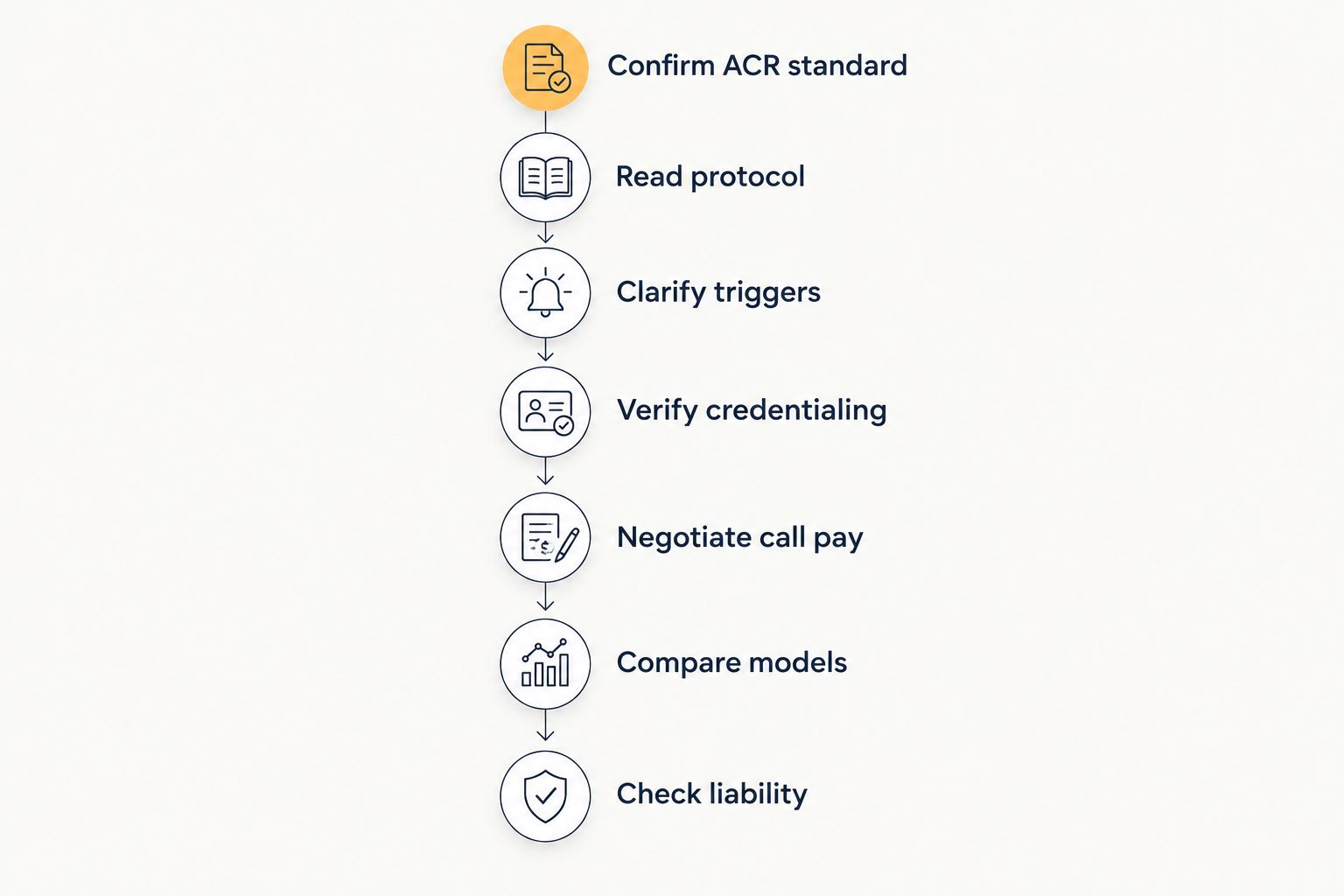
Confirm the ACR standard actually applies to the site
Not every posting labeled 'on-site' is describing a contrast coverage role, and not every contrast site has the same trigger conditions. Check the basics before you go further:
- Whether the facility performs contrast-enhanced CT, MRI, or fluoroscopy on-site
- Whether the facility carries ACR accreditation, which typically references the same immediate-availability language
- Whether an ER or urgent care unit is co-located and covered by separate staff
- Whether the posting distinguishes 'on-call' from 'on-site' anywhere in the description
- Whether state scope-of-practice rules allow a non-radiologist physician to satisfy the requirement instead
Read the contrast reaction protocol before you sign
A written protocol tells you more about the job than the salary line does. Ask for it during the interview, not after you start:
- Crash cart location and restocking schedule
- Posted epinephrine dosing chart and who is authorized to administer it
- Code team activation time from the imaging suite
- Documentation requirements after a reaction event
- Who covers you if you're mid-reaction and a second contrast case is called
Clarify which modalities and hours trigger coverage
Contrast reaction coverage doesn't mean every hour of every shift. It usually maps to specific procedure types and specific blocks of the schedule:
- IV contrast CT versus non-contrast CT reads
- Gadolinium-based MRI studies
- Iodinated contrast fluoroscopy and myelography
- Add-on or after-hours contrast cases outside posted business hours
Cross-checking modality and hour language against 20 different job sources by hand eats an afternoon. Searching hybrid onsite and remote radiology jobs or a straight on-site listing on RadBoard's radiology job platform surfaces that language directly from the original posting instead of a recruiter's paraphrase.
Verify credentialing and ACLS timelines
Credentialing delays are the most common reason a contrast coverage start date slips. Confirm before you count on a specific start:
- Current ACLS certification and renewal date
- State medical license status in the facility's state
- Hospital or facility privileging timeline, separate from state licensure
- Malpractice tail requirements from your current employer
Negotiate call pay and response-time language
Contract language on response time protects you as much as it protects the facility. Push for specifics:
- A defined maximum response time written into the contract, not left as 'reasonable'
- Separate compensation for on-site contrast hours versus standard reading shifts
- Stipend or differential pay for weekend or evening contrast coverage
- Clear language on what happens if you're the only physician on-site during a reaction
Compare on-site, hybrid, and locum coverage models
Before comparing dollar figures, compare structure. A locum contract, a hybrid split, and a straight on-site role solve different problems and carry different risk.
Check liability and malpractice terms for reaction response
Reaction management carries its own liability profile, separate from diagnostic reads. Confirm coverage specifically names contrast reaction response, not just general radiology practice.
Comparing coverage models side by side
The table below lines up the four structures you'll see most often in 2026 postings.
| Option | Best for | Key limitation |
|---|---|---|
| Full-time on-site radiologist | High-volume ASCs and outpatient centers running contrast studies daily | Ties you to one location and one fixed call schedule |
| Locum tenens on-site fill-in | Covering a staffing gap while a group recruits permanently | Credentialing and privileging can take weeks per new site |
| Hybrid onsite/remote split | Groups that want a physician in-house only during contrast blocks | Only works if contrast and non-contrast blocks are cleanly separated |
| Teleradiology with on-site backup physician | Sites outsourcing routine reads while keeping a local physician on call for reactions | The on-site backup is often not a radiologist, creating a scope-of-practice gap |
Verdict: a straight on-site role is the safest fit if you want contract language that matches the actual ACR standard; hybrid and teleradiology-backed models work only when the contrast hours are explicitly carved out in writing.
Search live contrast coverage postings now
Filter RadBoard's aggregated radiology listings for on-site contrast coverage roles.
Common mistakes radiologists make with contrast coverage jobs
- Assuming on-call means on-site. Postings blur the two constantly, and radiologists find out the difference on the drive in at 2 a.m.
- Skipping the crash cart check. Nobody wants to discover during a live reaction that the epinephrine is expired.
- Treating hybrid schedules as a loophole. A facility flagged in an ACR site survey for contrast days worked remotely puts your credentialing at risk too.
- Not asking who else is credentialed to respond. Some radiologists sign on as the only physician equipped to manage reactions across every modality in the building, at every hour.
- Comparing pay to standard diagnostic-only roles. Immediate-availability contrast coverage carries a different risk and time burden than a straight reading shift, and the comparison should reflect that.
FAQ
What is contrast reaction coverage in radiology?
Contrast reaction coverage is a job requirement where a physician must be physically on-site and immediately available to manage acute reactions whenever IV contrast is administered. It's distinct from general on-call coverage, which can be handled remotely.
Is contrast reaction coverage the same as teleradiology backup?
No. Teleradiology backup means a physician reads or consults remotely, while contrast reaction coverage requires physical presence on the premises. A remote radiologist cannot satisfy the ACR immediate-availability standard.
Does MRI contrast require the same coverage as CT contrast?
Yes, gadolinium-based MRI contrast falls under the same immediate-availability standard as iodinated CT contrast. Both require a physician trained in reaction management to be on-site during administration.
Can a nurse practitioner or PA satisfy the immediate-availability requirement instead of a radiologist?
It depends on state scope-of-practice rules and the facility's protocol; some sites allow a credentialed physician extender under radiologist supervision. Confirm this in writing before assuming coverage responsibility shifts off you.
What certifications does a radiologist need for contrast reaction coverage jobs?
Current ACLS certification is standard, along with active state licensure and facility-specific privileging. Some sites also require documented contrast reaction training beyond residency.
Is contrast reaction coverage required for oral contrast studies?
Generally no, since oral contrast carries a far lower reaction risk than IV or intravascular contrast. The immediate-availability standard is built around intravascular administration.
How do locum tenens radiologists handle contrast reaction coverage?
Locum radiologists taking on-site contrast coverage assignments need to confirm credentialing timelines and the facility's protocol before the assignment starts, since privileging delays are common on short-term contracts. Response-time language should be written into the locum agreement, not assumed.
How much does on-site contrast coverage pay compared to standard reading shifts?
Pay structures vary widely by site, volume, and region, so there's no fixed benchmark to quote. Compare the call burden and response-time obligation against the rate offered rather than against a general diagnostic-only shift.
One last thing
Ask one question before signing anything: are you the only immediately available physician for the entire site, or just for your reading room? The ACR standard doesn't care where you sit — it cares whether a trained physician can reach the patient in time, and in a lot of 2026 postings, that physician is you for every modality in the building, not just the one you were hired to read.