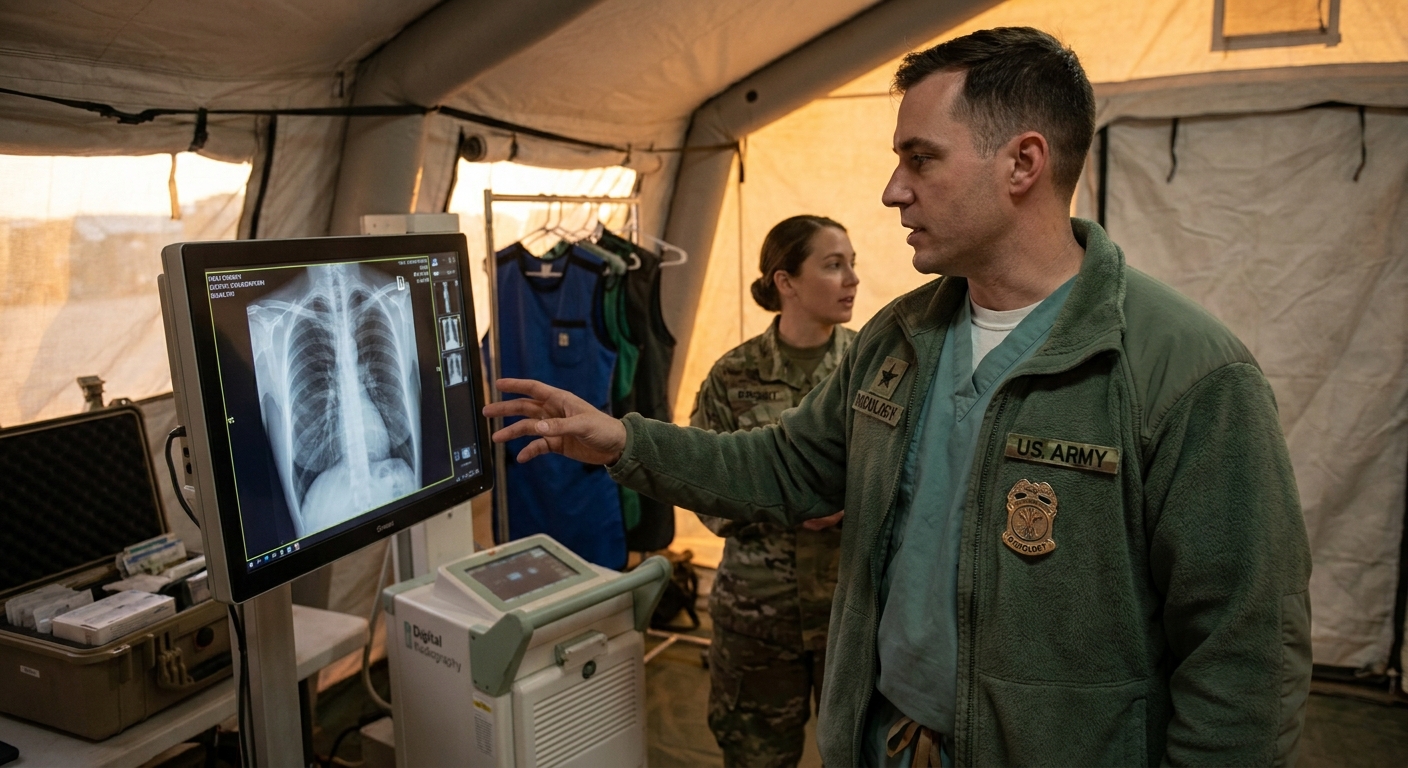
Military radiology jobs cover more ground than most physicians realize — active-duty commissions, VA hospital staff positions, Reserve and National Guard slots paired with civilian practice, and contract work supporting DoD and VA imaging volume. This guide breaks down the pathways by duty status, pay structure, and deployment risk so you can pick the one that actually fits your obligations in 2026.
- Active-duty Military Treatment Facility radiologist roles suit residents with HPSP or USUHS obligations to pay down in 2026 — Buy.
- VA hospital radiologist jobs offer GS-scale federal pay and no deployment risk — Buy for physicians who want government stability without uniform commitment.
- Reserve and National Guard radiologists pair drill pay with a civilian job; locum tenens radiology jobs are the most common civilian pairing — Consider.
- Teleradiology contracts supporting DoD and VA caseloads let non-military-affiliated radiologists contribute without relocating — Consider.
- Nighthawk radiology jobs covering overnight trauma volume near military treatment facilities fill a real staffing gap in 2026 — Consider for night-shift-tolerant physicians.
Why this matters
Military and federal radiology hiring doesn't behave like the private-practice market. Pay is set by tables, not negotiation. Deployment and PCS orders override lifestyle preferences. And obligation periods — HPSP paybacks, USUHS commitments, GS tenure — decide whether a position is a career or a bridge to one.
Getting the pathway wrong costs years, not months. A radiologist who signs Reserve orders expecting minimal disruption and ends up activated for a 9-month deployment learns this the hard way. The distinctions below matter more here than in almost any other radiology job search.
Who this is for
This guide is for physicians finishing residency with an HPSP or USUHS obligation to fulfill, prior-service physicians considering a return to uniform, Reserve or National Guard members weighing a civilian radiology job to pair with drill duty, and any radiologist curious about VA or DoD-adjacent work without a military commitment. If you're choosing between military radiology jobs and a purely civilian track in 2026, the criteria below apply whether you're obligated or opting in voluntarily.
What to look for in military radiology jobs
Duty status and commitment length
Active duty, Reserve, National Guard, and civilian-federal (VA) are four different legal and career categories, not shades of the same job. Active duty means full relocation control by the service branch; VA employment is federal civilian service with none of that. Know which one you're actually signing before you compare pay.
Obligation and payback structure
HPSP scholarships, USUHS attendance, and military GME residencies all carry payback years — typically one year of service per year of funded training, with a four-year floor for many programs. A radiologist finishing residency in 2026 with three unpaid HPSP years left doesn't have the option to skip active duty without a financial penalty attached.
Pay structure and total compensation
Military pay follows fixed tables: base pay by rank and years of service, plus Basic Allowance for Housing and Basic Allowance for Subsistence. VA radiologists sit on the GS or Title 38 scale instead. Neither moves the way private-practice or locum tenens radiology jobs pay does, where posted rates shift with subspecialty demand.
Deployment and mobility risk
Active duty carries real deployment exposure; Reserve and Guard carry activation risk tied to global operational tempo. VA and DoD civilian contractor roles carry none. If overnight-notice relocation is a dealbreaker, that alone should route you away from active duty toward VA or teleradiology support work.
Practice setting and case mix
Military treatment facility radiology skews toward trauma, combat casualty follow-up, and a young, high-acuity patient population — different from the oncologic and chronic-disease-heavy caseload typical of VA hospitals. Match the case mix to your training, not just the paycheck.
Subspecialty training access
Military GME programs fund fellowships in neuroradiology, interventional radiology, and body imaging, often in exchange for extended service commitments. If subspecialty credentialing matters to your long-term plan, weigh the extra obligation years against what a civilian fellowship would cost you in lost income instead.
Top picks by pathway
Active-duty Military Treatment Facility radiologist — the direct commission. Base pay plus BAH for a mid-career Army or Air Force radiologist runs well above resident pay, and MTF postings include funded CME days that many civilian employers don't match. For a physician exiting residency in 2026 with an unpaid HPSP obligation, this is the default path, not a choice — but even for volunteers, the combined pay-and-benefits package is competitive against comparable civilian salary bands once you factor in tax-advantaged allowances. If you're weighing this against a civilian first job, the diagnostic radiology jobs for physicians finishing residency breakdown shows what a comparable civilian offer looks like on salary alone. Buy for anyone with a service obligation or a genuine interest in trauma-heavy caseloads.
VA hospital radiologist — the steady federal path. GS-scale pay, a defined pension track, and zero deployment risk make this the lowest-volatility federal option in radiology. VA radiologist openings have grown as the agency works through backlog imaging volume in 2026, and the radiology jobs at VA hospitals for federal benefits page details the specific benefit structure — pension vesting, TSP matching, and locality pay adjustments. Buy for physicians who want to serve veterans without wearing a uniform.
Reserve or National Guard radiologist with a civilian practice — the hybrid path. Drill pay alone won't replace a full-time salary, so almost every Reserve or Guard radiologist pairs it with civilian work that tolerates a once-a-month and two-week-a-year absence. Locum tenens radiology jobs are the most common pairing because contracts are built around defined blocks rather than open-ended coverage. Review locum tenens radiology jobs for flexible contracts before signing Reserve orders. Consider if you want to serve without leaving civilian practice; Skip if your civilian employer won't accommodate activation risk.
Teleradiology supporting DoD and VA contracts — the remote support role. Some teleradiology groups hold contracts to read overflow imaging for military and VA facilities, giving radiologists a way to contribute to federal caseloads without any duty-status commitment at all. The teleradiology jobs for radiologists who want remote flexibility guide covers licensing and credentialing requirements across states, which matter more here since federal contract reads often span multiple jurisdictions. Consider for radiologists who want DoD/VA-adjacent work with a civilian schedule.
Nighthawk radiology near military treatment facilities — the overnight specialist. MTFs and VA hospitals with limited overnight staff often route trauma and stroke reads to nighthawk coverage groups, and demand for that coverage has held steady through 2026 as facilities manage radiologist shortages. The nighthawk radiology jobs for physicians who prefer overnight shifts page covers typical shift structures and pay differentials. Consider if overnight hours don't wreck your schedule; Skip if you need daytime hours for family obligations.
What to avoid
- Reserve contracts that don't disclose activation history for the unit. Some units activate far more often than the baseline two-weeks-a-year assumption. Ask for the unit's activation record over the last five years before signing.
- Locum tenens listings that market themselves as "military-adjacent" without VA or DoD facility credentialing already in place. Credentialing at a federal facility can take 90 days or more; a contract that assumes you'll start in three weeks isn't accounting for that.
- HPSP payback calculations that ignore interest and program-specific service multipliers. A four-year obligation can stretch to five or six depending on branch-specific rules — get the exact payback schedule in writing, not a verbal estimate.
Compare military and civilian radiology jobs
Search 5,000+ radiology openings across VA, DoD-adjacent, and civilian tracks in one place.
Verdict comparison
| Pathway | Duty status | Pay structure | Deployment risk | Verdict |
|---|---|---|---|---|
| Active-duty MTF radiologist | Active duty | Base pay + BAH/BAS | High | Buy (obligated or trauma-focused) |
| VA hospital radiologist | Civilian federal | GS/Title 38 scale | None | Buy (stability-focused) |
| Reserve/Guard + civilian job | Reserve/Guard | Drill pay + civilian salary | Moderate | Consider |
| Teleradiology (DoD/VA contract) | Civilian contractor | Per-read or salaried contract | None | Consider |
| Nighthawk near MTF/VA | Civilian contractor | Shift differential pay | None | Consider |
FAQ
Do military radiologists get paid less than civilian radiologists?
Base military pay alone is lower than most civilian radiologist salaries, but tax-free allowances like BAH and BAS close much of the gap. Total compensation is competitive for junior-to-mid-career radiologists, though it typically plateaus below top civilian private-practice earnings by year ten.
How long is the service commitment for a military radiology residency?
Most HPSP and military GME programs require one year of active duty per year of funded training, with a four-year minimum for many radiology tracks. USUHS graduates typically owe seven years. Confirm the exact multiplier with your branch before signing.
Can a Reserve radiologist also work teleradiology?
Yes, and it's one of the more common pairings because teleradiology contracts are easier to schedule around drill weekends and annual training than a fixed in-person job. Multi-state licensing is the main administrative hurdle to plan around.
Is VA radiology work the same as military radiology?
No. VA radiologists are civilian federal employees on the GS or Title 38 pay scale with no deployment obligation, while active-duty and Reserve radiologists serve under military command with deployment risk attached.
What's the difference between active duty and National Guard radiology jobs?
Active duty means full-time service under military control with relocation authority; National Guard radiologists serve part-time under state or federal activation and hold a separate civilian job the rest of the time.
Do military radiologists get subspecialty fellowship training?
Military GME programs fund fellowships in neuroradiology, interventional radiology, and body imaging, usually in exchange for extended active-duty service. The extra commitment is worth weighing against the cost of a civilian fellowship.
How often are Reserve radiologists activated?
Baseline commitment is two weeks a year plus monthly drill weekends, but activation frequency varies significantly by unit and current operational tempo. Ask for the specific unit's five-year activation history before signing.
Can civilian radiologists support VA or DoD imaging without joining the military?
Yes. Teleradiology contracts and on-site VA hospital positions let civilian radiologists read for federal caseloads without any duty-status commitment or deployment risk.
One last thing
The overnight staffing gap at military treatment facilities is real and underdiscussed: MTFs with limited in-house radiology coverage increasingly route trauma and stroke reads to nighthawk groups rather than adding permanent night staff, which means the fastest way into DoD-adjacent work in 2026 might not be a uniform at all — it might be a nighthawk contract with a group that already holds the facility relationship.