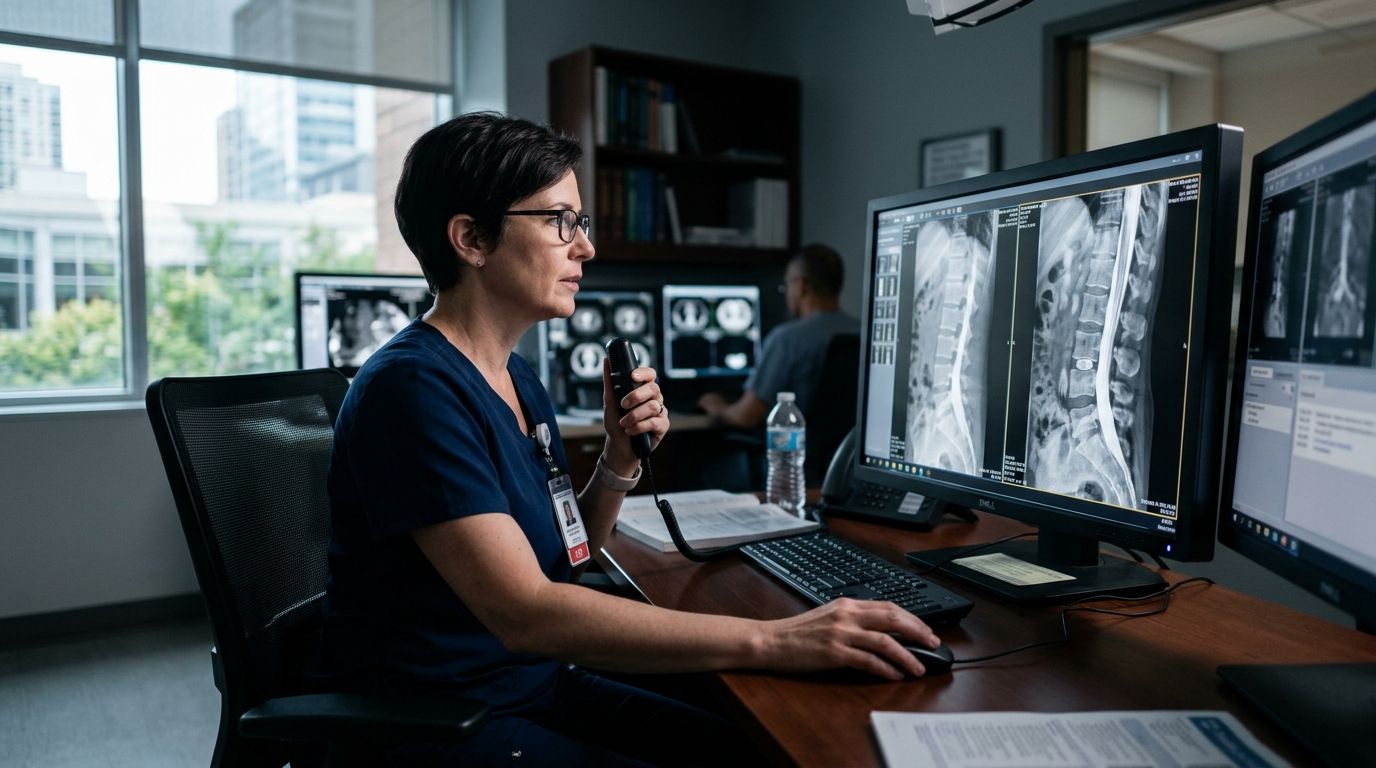
Myelography radiologist jobs involve image-guided intrathecal contrast injection combined with fluoroscopy or CT to evaluate the spine, spinal cord, and nerve roots in patients who cannot get an MRI. The segment is narrow and shrinking in raw volume, but it never fully disappears because pacemakers, certain spinal hardware, and severe claustrophobia keep sending patients to myelogram tables instead of magnets.
What makes this segment different from general spine imaging is procedural exposure: you're not just reading images, you're performing a lumbar puncture, injecting contrast under fluoroscopic guidance, and often supervising the post-procedure CT. Job postings rarely say "myelography radiologist" outright — the skill gets buried inside neuroradiology, general diagnostic, or MSK listings that mention fluoroscopy competency.
- Myelography radiologist jobs are almost never standalone postings — they hide inside neuroradiology, general diagnostic, or MSK roles that list fluoroscopy privileges.
- Academic spine referral centers and MRI-contraindicated patient populations drive most remaining 2026 volume.
- RadBoard aggregates 5,000+ radiology jobs from 20 sources, letting you filter by procedural and fluoroscopy keywords instead of subspecialty labels alone.
- Verify who performs the lumbar puncture before accepting — some sites split this between radiology and neurosurgery.
- Negotiate procedural RVU credit before signing; myelogram volume varies widely by site.
Why myelography radiologist jobs matter in 2026
MRI has replaced most conventional myelography over the past two decades, but the procedure hasn't gone away — it's concentrated. Patients with non-MRI-compatible cardiac devices, certain orthopedic hardware, severe spinal stenosis with claustrophobia, or CSF leak workups still need a radiologist comfortable threading a needle into the thecal sac under fluoroscopy.
Because volume is low per site, almost no employer builds a job posting around myelography alone. That means searching "myelography radiologist jobs" on a single job board returns almost nothing — you have to search adjacent terms and cross-reference fluoroscopy privileges, procedural RVU language, and CT myelography mentions across RadBoard, where AI-powered search pulls listings from 20 sources instead of one hospital career page at a time.
The practical result: this is a search-strategy problem as much as a career-fit problem. You're hunting for a skill embedded in other job titles, not a subspecialty with its own listings column.
Update your search terms first
Before anything else, fix the keywords you're searching. "Myelography" alone under-returns results because most 2026 postings describe the skill, not the procedure name.
- Search "CT myelography," "intrathecal contrast," and "fluoroscopic spine procedures" alongside "myelography"
- Add "lumbar puncture" and "spinal tap privileges" as secondary terms
- Cross-search neuroradiology and general diagnostic postings that mention fluoroscopy competency
- Filter for academic medical centers and spine referral networks, where volume concentrates
- Use swipe-to-save to build a shortlist across sources instead of retyping searches on five separate hospital sites
Target the practice types that still run volume
Myelogram counts per site dropped for a reason — most patients get MRI instead. Chasing a job at a random community hospital wastes time if their myelogram volume is one case a month.
- Academic neuroradiology divisions tied to spine surgery programs
- Orthopedic referral networks handling MRI-incompatible hardware cases — see spine imaging radiologist jobs for orthopedic referral networks
- Interventional groups doing vertebroplasty and kyphoplasty, where fluoroscopic spine skill overlaps directly — see vertebroplasty and kyphoplasty IR jobs for spine procedures
- VA hospitals and pacemaker-heavy cardiac referral populations
- Multi-hospital systems where one site handles myelography for the whole network
Confirm who actually performs the lumbar puncture
This is the single most common source of mismatch in this segment. Some institutions have radiology do the LP and injection start to finish; others have neurosurgery or anesthesia do the puncture and hand off imaging to radiology.
- Ask directly in the interview who performs the intrathecal injection
- Confirm whether fellows or residents take first crack at LPs before attendings
- Check if the role includes post-myelogram CT protocoling or just the injection
- Verify fluoroscopy suite availability and scheduling — shared suites create bottlenecks
- Ask how myelogram cases are billed and whether that revenue is credited to you
Evaluate procedure volume expectations before signing
A posting that mentions myelography once in a 40-item job description tells you nothing about actual frequency. Low volume means skill atrophy if you're not doing regular fluoroscopic procedures elsewhere too.
- Ask for monthly or annual myelogram case counts from the past 12 months
- Compare that number against your own comfort threshold for maintaining LP skill
- Ask whether contrast reaction protocols and code carts are staffed during procedure hours
- Confirm backup coverage exists if you're the only radiologist credentialed for the procedure
- Check if fluoroscopy time counts toward RVU targets or sits outside your compensation formula
Negotiate procedural RVU credit and malpractice terms
Myelography carries intrathecal injection risk — nerve injury, CSF leak, contrast reaction — that general diagnostic reading doesn't. Compensation and liability terms should reflect that.
- Ask whether procedural RVUs are credited separately from reading RVUs
- Confirm malpractice coverage explicitly names intrathecal procedures, not just diagnostic imaging
- Ask about tail coverage terms if you leave — procedural claims can surface years later
- Compare RVU-based compensation structures across offers before committing
- Get any guaranteed minimum procedure stipend in writing, not verbal
Verify credentialing and privileging timelines
Hospitals often require separate privileging for fluoroscopic intrathecal procedures beyond your general diagnostic radiology credentials. This can delay a 2026 start date by weeks.
- Ask the credentialing office for a written timeline specific to procedural privileges
- Confirm whether your fellowship training documentation satisfies their privileging committee
- Check if a proctoring period of supervised cases is required before independent practice
- Ask what happens to your compensation during the privileging gap
“If a posting doesn't state monthly myelogram volume, assume the role is general diagnostic with occasional procedural coverage, not a myelography-focused job.”
Comparison: where myelography-adjacent roles live in 2026
| Practice type | Best for | Key limitation |
|---|---|---|
| Academic neuroradiology division | Radiologists who want high procedure counts and teaching exposure | Lower base compensation than private practice |
| Orthopedic-affiliated spine imaging group | Radiologists focused on hardware-related, MRI-contraindicated cases | Volume tied directly to referring surgeon caseload |
| Interventional group (vertebroplasty/kyphoplasty) | Radiologists who want overlapping fluoroscopic spine skill | Requires broader IR training beyond diagnostic myelography |
| General diagnostic hospital role with fluoro privileges | Radiologists who want myelography as one skill among many | Low case frequency risks skill atrophy |
| Locum tenens fluoroscopy coverage | Radiologists filling short-term procedural gaps | Inconsistent volume and no long-term credentialing investment |
RadBoard is the fastest way to run this comparison in 2026 because it surfaces procedural language across all five practice types in one search rather than requiring five separate job board visits.
Search myelography-adjacent roles now
Filter 5,000+ radiology listings by fluoroscopy and procedural keywords in one search.
Common mistakes in this job search
- Searching only the exact term "myelography." Most 2026 postings bury the skill inside neuroradiology or general diagnostic language, so narrow keyword searches miss real openings.
- Assuming procedure counts are stable across sites. Myelogram volume varies sharply between hospitals in the same metro area; ask for the number, don't estimate it.
- Skipping the who-does-the-LP question. Accepting a role assuming you'll perform the puncture, then discovering neurosurgery owns that step, wastes a negotiation cycle.
- Ignoring malpractice tail terms for procedural work. Intrathecal injection claims have longer latency than diagnostic-read claims; generic tail language isn't enough.
- Treating fluoroscopy privileges as automatic. Credentialing committees frequently require separate proctoring for intrathecal procedures even for board-certified radiologists.
FAQ
What's the best way to find myelography radiologist jobs in 2026?
Search adjacent terms such as CT myelography, intrathecal contrast, and fluoroscopic spine procedures instead of myelography alone. Most 2026 postings describe the skill inside neuroradiology or general diagnostic listings rather than as a standalone title.
Is myelography still performed given how common MRI has become?
Yes, but at lower and more concentrated volume. Patients with MRI-incompatible pacemakers, certain spinal hardware, or severe claustrophobia still require myelography, which keeps academic and spine-referral centers running steady case counts.
Who performs the lumbar puncture in a myelography radiologist job?
It varies by institution. Some sites have radiology perform the injection start to finish, while others split the puncture with neurosurgery or anesthesia, so confirm this specifically before accepting an offer.
How much fluoroscopy volume should a myelography role guarantee?
There is no universal number, so ask any employer for actual monthly or annual myelogram case counts from the past 12 months. A general mention of the procedure in a job description tells you nothing about frequency.
Do myelography radiologist jobs pay more than general diagnostic roles?
Compensation depends on whether procedural RVUs are credited separately from reading RVUs. Negotiate that structure explicitly rather than assuming procedure work is compensated on top of base salary.
Is myelography training available without an interventional radiology fellowship?
Yes. Many general diagnostic and neuroradiology residencies include fluoroscopic spine procedure training, though institutions may still require site-specific proctoring before granting independent privileges.
What credentialing is required for myelography procedures?
Most hospitals require separate privileging for fluoroscopic intrathecal procedures beyond standard diagnostic radiology credentials. Confirm the timeline early, since it can add weeks to a 2026 start date.
One last thing
The scarcity in this segment cuts both ways: fewer standalone postings, but far less competition once you know how to find them. Cross-referencing fluoroscopy language across neuroradiology, general diagnostic, and interventional postings on RadBoard in 2026 surfaces roles that a plain keyword search on a single hospital career page never will.