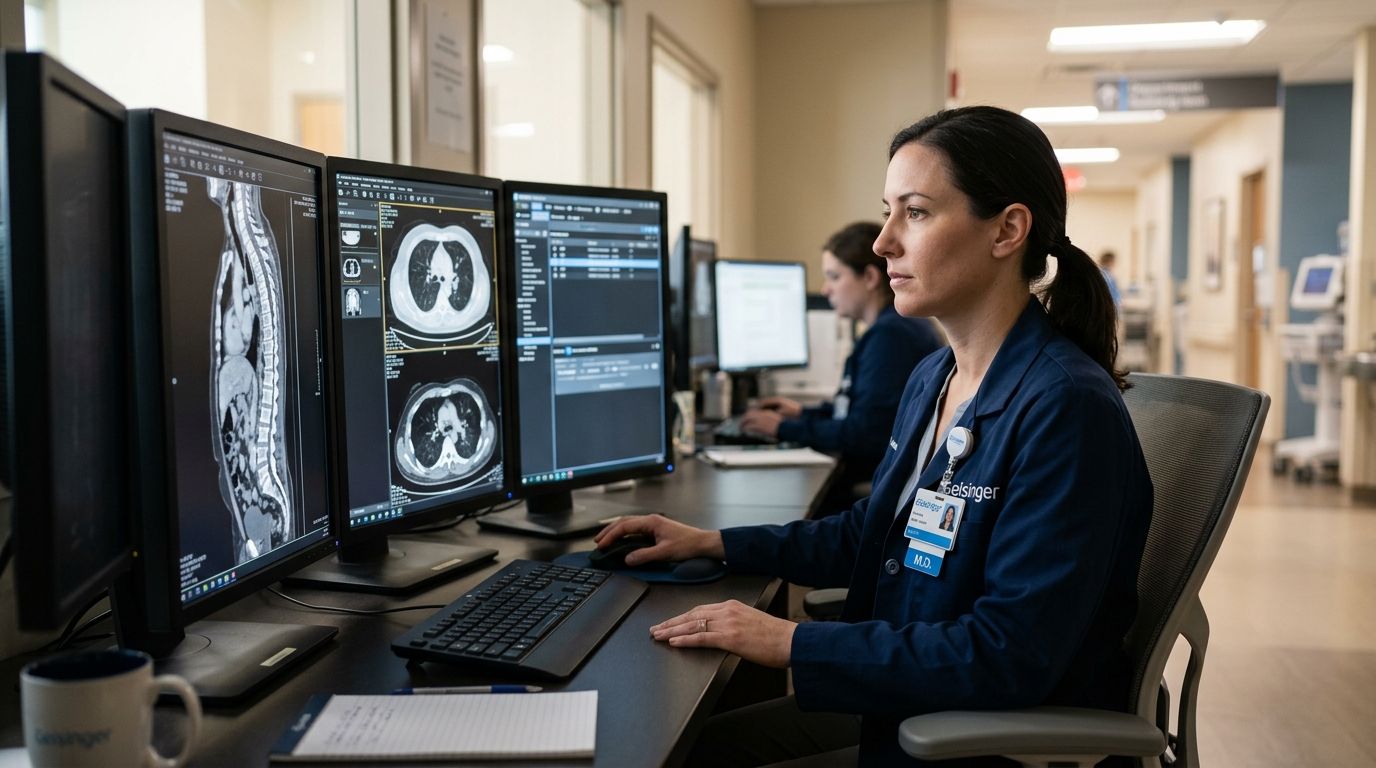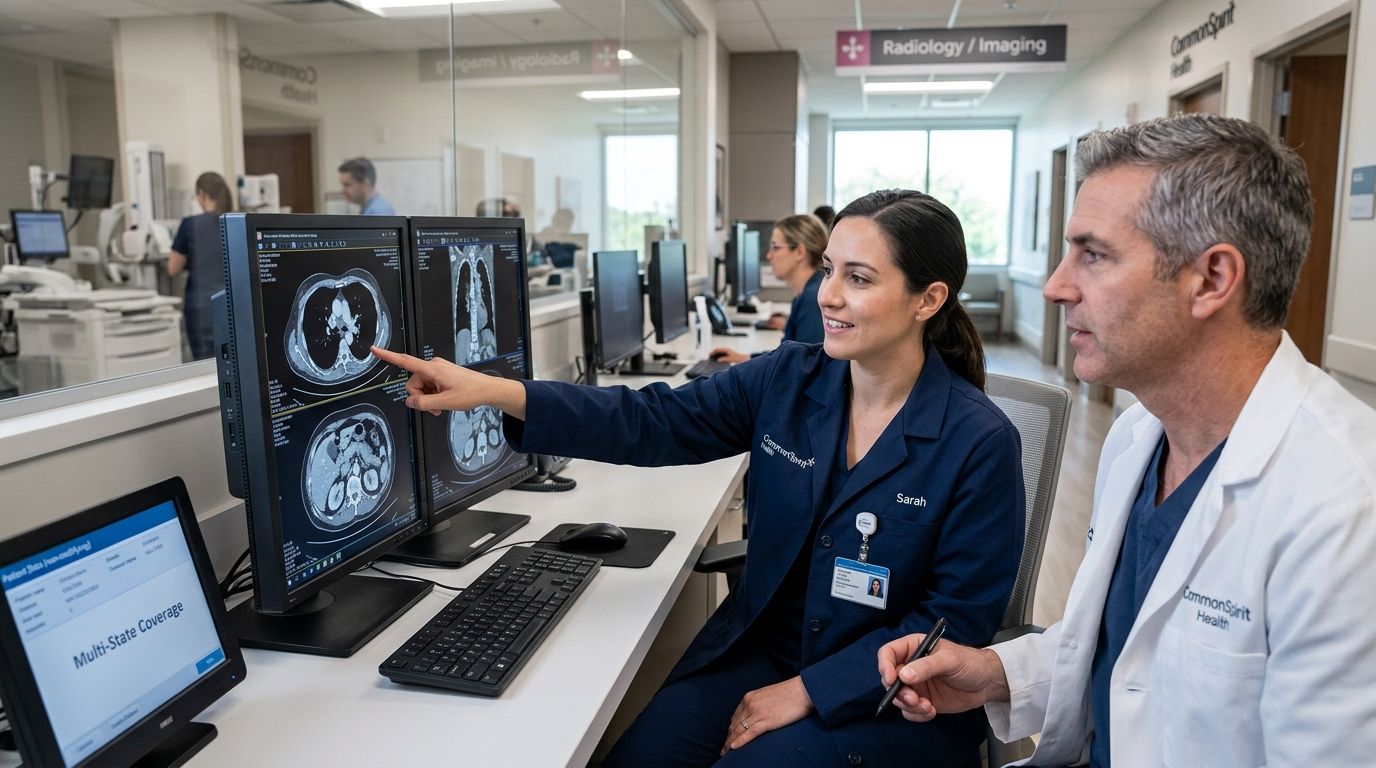
POCUS supervision radiologist jobs place a board-certified radiologist in charge of image quality, credentialing, and compliance for point-of-care ultrasound performed by emergency physicians — not reading a standard diagnostic queue, but overseeing a program run by someone else. The role sits between emergency radiology and quality assurance, and it rewards a different skill set than volume reading: chart review, protocol writing, and comfort signing off on scans you didn't personally acquire.
- POCUS supervision radiologist jobs pair diagnostic credentials with ED point-of-care ultrasound QA and credentialing oversight.
- Freestanding ER and community hospital ED roles hire radiologists for POCUS image review and archiving compliance.
- Academic POCUS director tracks add curriculum design and a joint appointment with emergency medicine.
- Protected non-RVU time belongs in the contract before you accept any ED oversight duties in 2026.
- RadBoard aggregates emergency radiology jobs and ultrasound-focused radiologist jobs from 20 sources for POCUS-adjacent openings.
Why POCUS supervision matters for radiologists in 2026
Emergency departments run point-of-care ultrasound because it's fast at the bedside — FAST exams, cardiac views, DVT screens, ectopic pregnancy rule-outs. None of that replaces a formal diagnostic study, but every credentialed EM physician performing POCUS needs a supervising physician attached to the program for image quality review and archiving compliance, per American College of Emergency Physicians (ACEP) POCUS guidelines.
Radiologists get pulled into this because most EM residency programs don't produce enough ultrasound fellowship-trained faculty to run the QA process internally, especially at freestanding ERs and smaller community hospitals. That gap is where POCUS supervision radiologist jobs show up on job boards — sometimes as a standalone title, more often as an add-on to an existing emergency radiology or medical director position.
The demand pattern favors radiologists who already read emergency radiology jobs and want a leadership line on their CV without leaving clinical practice. It also favors radiologists coming from an ultrasound-focused radiologist background who understand probe technique well enough to critique someone else's images.
Confirm the exact scope of supervision before you apply
"Supervision" means different things at different sites, and the job posting rarely spells it out. Some programs want real-time image review; most want retrospective QA on a rolling batch of saved studies.
- Ask whether review is real-time, same-day, or weekly-batch
- Ask who has final sign-off authority on a discordant read
- Ask if you're reviewing images only or also clinical documentation
- Ask how many EM physicians and PAs are on the credentialing roster
- Ask whether trauma, cardiac, and obstetric POCUS are all in scope or split across supervisors
Learn the credentialing and privileging process first
Every hospital medical staff office runs its own privileging pathway for point-of-care ultrasound, and as the supervising radiologist you'll often be asked to co-sign it. Skipping this step before accepting a job is the fastest way to inherit a program with no paper trail.
- Review the hospital's current POCUS privileging policy before your first day
- Confirm minimum scan-count thresholds for each EM physician
- Check whether recredentialing happens annually or biennially
- Verify who tracks competency logs — you, the ED, or medical staff services
- Ask for the last QA audit results before you sign anything
Build or audit an image quality assurance workflow
A functioning QA workflow is the backbone of the job. If one doesn't exist, building it is the actual work — not a side project.
- Set a sampling rate (many programs review 5-10% of studies, some review all cardiac and FAST scans)
- Define discordance categories: technical failure, missed finding, indication mismatch
- Route flagged studies back to the performing physician with documented feedback
- Store QA data separately from the clinical chart for peer-review protection
- Report aggregate QA metrics to the ED medical director quarterly
Get comfortable with the billing and compliance side
POCUS billing depends on permanent image storage and a documented interpretation, and it's often the weakest link in an ED program. A radiologist who understands billing compliance is worth more to a hospital than one who only reviews clinical accuracy.
- Confirm images are archived to PACS, not deleted after the shift
- Check that a written interpretation exists for every billed study
- Flag any pattern of billing without adequate documentation
- Coordinate with hospital compliance on permanent record retention rules
- Review CPT code usage for limited vs. complete studies
Negotiate protected non-RVU time
Oversight work doesn't generate reads, and unpaid "extra duty" is the single most common complaint from radiologists in these roles. If the contract doesn't name a specific block of protected administrative time, the job is asking you to do QA for free.
- Request a defined number of non-clinical hours per month, in writing
- Ask whether administrative time is compensated at your clinical hourly rate or a stipend
- Clarify whether QA work counts toward productivity bonuses
- Get committee attendance (P&T, credentialing) written into the job description
- Confirm malpractice coverage extends to your supervisory sign-off, not just your reads
Choose your setting: freestanding ER, hospital ED, or academic center
Where you take this role changes almost everything about the day-to-day. A freestanding ER radiology oversight role looks nothing like an academic POCUS director track.
- Freestanding ER: smaller staff, faster decisions, less PACS/IT support
- Community hospital ED: existing credentialing infrastructure, but oversight is often layered onto a full read list
- Academic medical center: curriculum-building and resident teaching, slower institutional decision-making
- Multi-site health system: one oversight role covering several EDs, heavier travel or virtual QA load
- Locum/per diem: retrospective review only, no program-design input
Search the right channels for these openings
These jobs rarely use "POCUS supervision" as the exact title in a hospital's HR system — they get buried under "medical director," "emergency radiology," or "quality assurance" postings. A general-title-only job search misses most of them.
- Search for "ED ultrasound medical director" and "POCUS oversight physician" as alternate titles
- Filter quality assurance radiologist postings for ED-specific language
- Check freestanding ER staffing groups directly, since many don't post to major boards
- Use an AI-powered search tool that reads full job descriptions, not just titles, to catch these mislabeled roles on RadBoard
- Ask an EM department chair directly — many of these roles fill through internal referral before they're ever posted
Find POCUS-adjacent radiology openings
Search 5,000+ radiology jobs from 20 sources with AI-powered filters.
Comparing your options for POCUS oversight work
| Setting | Best for | Key limitation |
|---|---|---|
| Freestanding ER oversight | Radiologists wanting a hands-on leadership title outside a hospital system | Limited PACS/IT and QA staffing support |
| Community hospital ED oversight | Radiologists already reading ED trauma who want an added role | Often layered onto a full clinical read list with little extra time |
| Academic POCUS director | Radiologists wanting curriculum and teaching duties | Slower institutional approval and joint-appointment negotiation |
| Per diem/locum QA reviewer | Radiologists testing the work before committing | Retrospective review only, no program design input |
| Non-clinical POCUS informatics | Radiologists interested in image archiving and AI-assisted QA systems | Away from direct clinical practice, may affect board maintenance |
A freestanding ER oversight role gives you the most direct control over program design; an academic POCUS director track gives you the most teaching exposure but the slowest path to change anything.
Common mistakes radiologists make with POCUS supervision roles
- Accepting the title without protected time in the contract — QA work without dedicated hours becomes unpaid overtime within months.
- Confusing supervision with real-time overread — most programs are retrospective, and expecting live oversight sets you up to fail a workflow that doesn't exist.
- Not clarifying who owns billing — if the ED bills for POCUS studies without your sign-off process attached, compliance risk lands on you anyway.
- Skipping the credentialing bylaws review — walking into a program with no documented privileging pathway means you're building one from scratch, unpaid, in year one.
- Assuming freestanding ER hours mirror hospital ED call — freestanding sites often run leaner staffing models with different escalation paths for discordant reads.
FAQ
What is a POCUS supervision radiologist job?
It's a role where a radiologist oversees image quality, credentialing, and compliance for point-of-care ultrasound performed by emergency physicians. The radiologist doesn't scan the patient — they review saved images and sign off on the program's quality assurance process.
Do radiologists get paid extra for POCUS oversight?
It depends entirely on the contract. Many programs add oversight duties to an existing role without separate pay, which is why negotiating protected non-RVU time before signing matters more than the title itself.
Is POCUS supervision the same as reading ED ultrasound studies?
No. Reading ED ultrasound studies means interpreting a formal diagnostic exam for the medical record. POCUS supervision means reviewing bedside scans performed by emergency physicians for quality and credentialing purposes, usually after the fact.
What credentials do you need for ED POCUS oversight?
Board certification in diagnostic radiology is the baseline; hospitals also look for documented ultrasound experience and, at some sites, prior QA or committee work. Specific privileging requirements are set by each hospital's medical staff office.
Can teleradiologists do POCUS supervision remotely?
Retrospective QA review can often be done remotely since it involves reviewing archived images rather than live scans. Real-time supervision, where it exists, typically requires on-site or on-call availability.
How is POCUS quality assurance different from a full diagnostic read?
QA review checks whether the scan was technically adequate and appropriately indicated, not whether every finding was fully worked up. It's a program-level accuracy check, not a substitute diagnostic interpretation.
Are freestanding ER POCUS oversight jobs full-time?
Many are part-time or added to an existing radiology role rather than standalone full-time positions. Full-time dedicated POCUS director roles are more common at larger health systems or academic centers.
What's the difference between POCUS supervision and a medical director role?
POCUS supervision is scoped specifically to ultrasound QA and credentialing, while a medical director role usually covers the entire imaging department's operations, staffing, and budget. Some jobs combine both under one title.
One last thing
Most POCUS supervision postings never use the phrase "POCUS supervision" — they hide inside medical director listings, quality assurance postings, or informal referrals from an EM department chair, which means a title-only search on a generic job board misses the majority of them in 2026. Cross-reference emergency radiology and quality assurance titles directly instead of searching for the exact term, and ask about the credentialing bylaws before you ask about compensation — a program with no documented privileging pathway is unpaid setup work disguised as a supervision role.