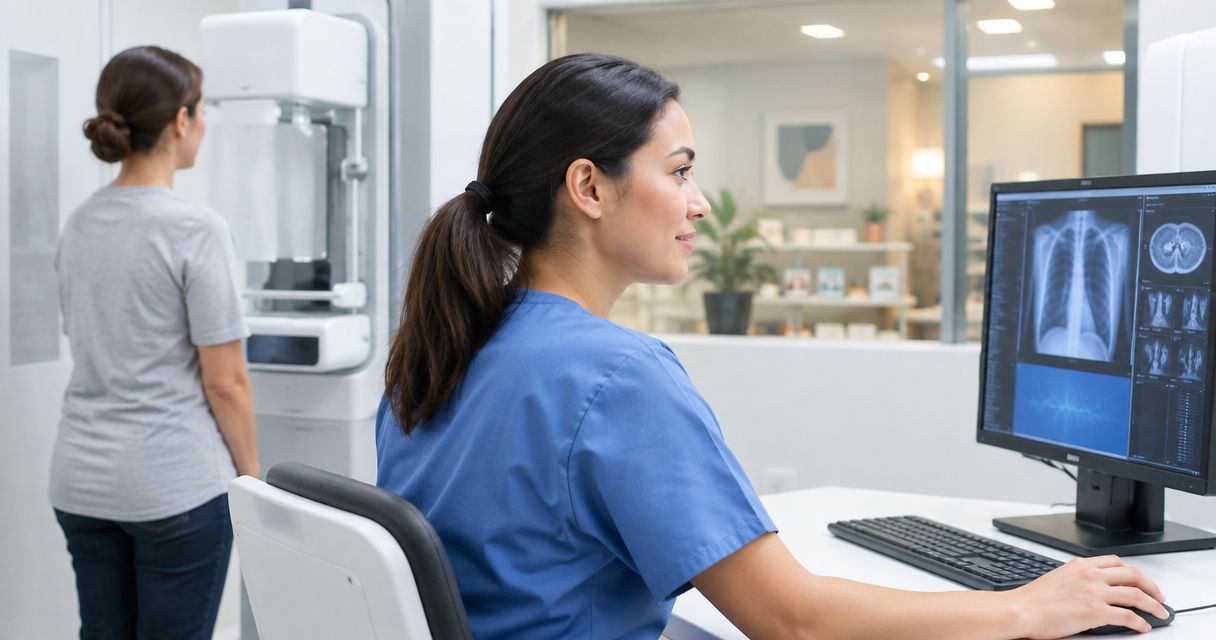
Retail clinic radiology jobs place radiologists inside walk-in retail health clinics and employer-run workplace health centers, reading plain film and point-of-care ultrasound for a high-volume, lower-acuity patient base. The setting differs from a hospital or full-service outpatient center in three concrete ways: a narrower modality mix, daytime-only hours, and pay tied to visit volume rather than subspecialty RVU targets.
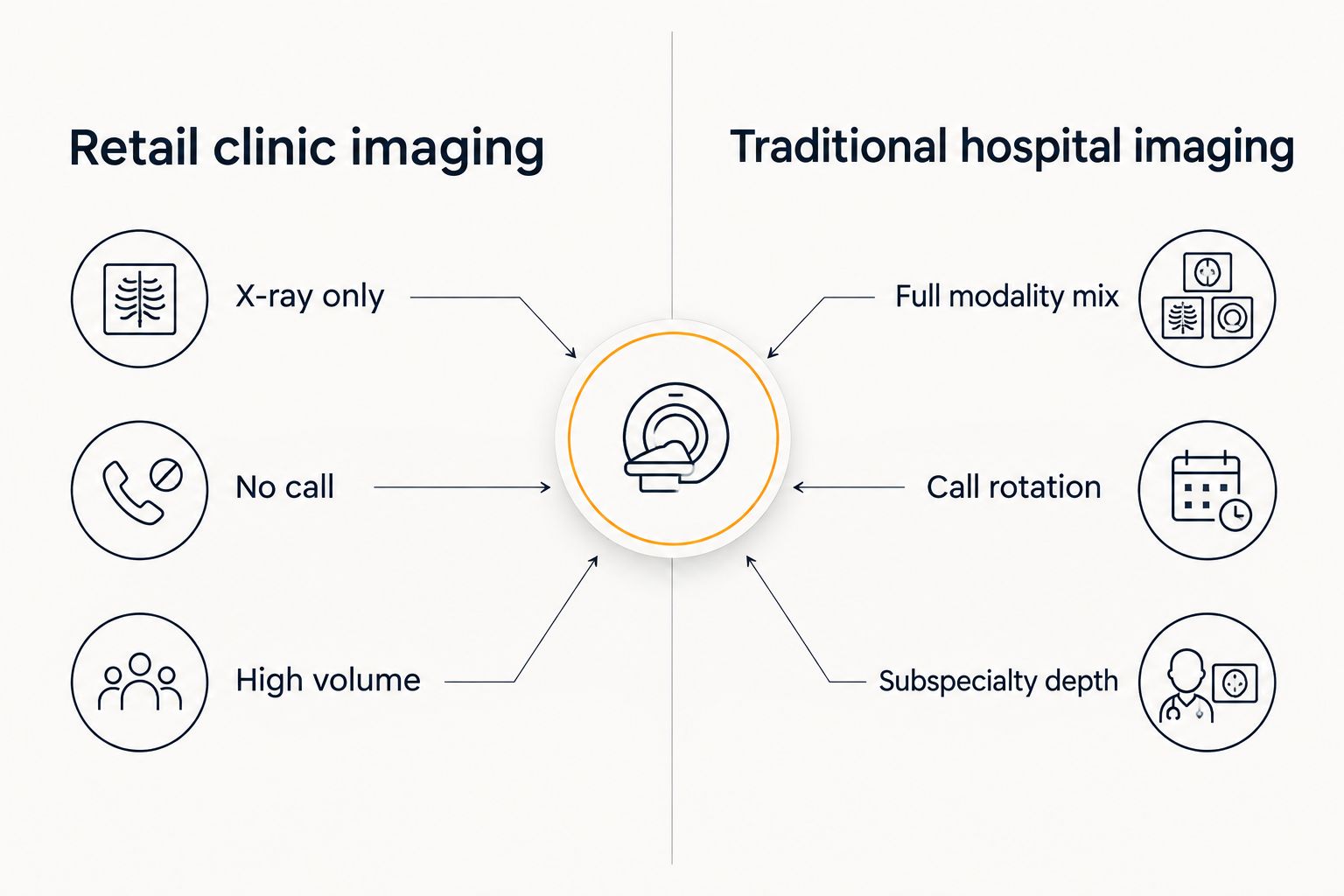
- Retail clinic radiology jobs cover X-ray and point-of-care ultrasound, not CT or MRI, across retail and workplace health sites.
- Daytime shifts with no weekend call make this segment attractive to radiologists prioritizing predictable hours over subspecialty depth.
- RadBoard aggregates listings from 20 sources, and retail clinic roles often get buried under generic urgent care or occupational health titles.
- Best for radiologists who want fixed daytime hours; skip it if you need CT/MRI volume to keep subspecialty reads sharp.
Why this matters
Retail clinic and workplace health imaging postings rarely carry a clean job title. A retail chain running X-ray at a walk-in site might list the opening as "urgent care radiologist" or fold it into an occupational health contract, which means a search for "retail clinic radiology jobs" on a generic board misses half the relevant listings. RadBoard pulls postings from 20 sources into one search so a role's actual site type, not just its title, becomes visible before you apply.
The practical stakes are scheduling and scope. A radiologist coming off a full CT/MRI hospital rotation who takes a retail clinic role without checking modality scope in 2026 can end up reading nothing but chest and extremity films for a year, which narrows the case mix fast. The steps below cover what to confirm before signing, in the order that actually protects you.
Confirm the imaging scope before applying
Retail and workplace health sites vary widely in what they actually image. Some run X-ray only; others add point-of-care ultrasound or DEXA. Get this in writing before you negotiate anything else.
- X-ray-only sites (most common at pure retail walk-in locations)
- X-ray plus limited point-of-care ultrasound
- Sites offering in-house DEXA for occupational screening programs
- Sites that image on-site but route CT/MRI referrals elsewhere
- Occupational health screening imaging (pre-employment films, fitness-for-duty exams)
Check the shift structure and call requirements
"No call" at a retail clinic doesn't always mean no weekends. Many chains run Saturday and even Sunday hours to match retail traffic patterns.
- Confirm whether hours are strictly daytime or extend into evening/weekend retail schedules
- Ask if holiday closures follow the retail calendar or a separate clinical calendar
- Check whether per diem shifts are available for supplemental coverage
- Look for overlap with urgent care evening hours if the site runs both services
- Verify whether on-call coverage exists for after-hours reads at all
Verify the compensation model before you negotiate
Retail clinic pay structures skew toward hourly or per-visit models more than RVU-based hospital contracts. Know which one you're signing.
- Hourly rate versus per-study rate for imaging reads
- Productivity bonus tied to visit count rather than RVU thresholds
- Benefits eligibility thresholds at part-time FTE levels
- W-2 employment versus 1099 contractor classification
- Sign-on incentives specific to chain-owned versus independently owned sites
Map credentialing across every clinic location in the chain
A multi-site retail chain often requires state licensing wherever it has sites, even if you're assigned to one location initially.
- State medical licensing required for every state the chain operates in
- Hospital privileging generally not required at freestanding retail sites
- Malpractice tail coverage terms if the chain closes or reassigns a site
- Whether credentialing is centralized chain-wide or repeated per site
Weigh the subspecialty ceiling honestly
The narrow case mix at retail and workplace health sites is the biggest long-term trade-off in this segment.
- Limited modality exposure keeps reads concentrated on chest films and extremity X-ray
- No routine cross-training on CT or MRI protocols
- Teleradiology side coverage can maintain broader read volume outside clinic hours
- Skill narrowing is a real risk if you plan to move toward a subspecialty or academic track later
Compare chain-owned versus independently owned clinics
Ownership structure changes how much flexibility and standardization you get.
- National chains run standardized protocols and centralized scheduling across sites
- Independent clinics offer more schedule flexibility but less backup coverage
- Private equity-backed chains often attach bonus structures to site-level volume targets
- Locally owned clinics have fewer sites, which limits multi-site coverage options
Use AI-powered search to separate retail clinic listings from urgent care and freestanding ER postings
Manually scanning job boards means opening dozens of listings just to find the ones that actually match retail or workplace health site types. RadBoard's AI-powered search and swipe-to-save tool filters by site type and schedule structure directly, which is faster once you already know the four criteria above.
- Filter by site type (retail clinic, workplace health, urgent care, freestanding)
- Filter by call requirement and shift structure
- Filter by modality scope (X-ray only versus X-ray plus ultrasound)
- Save shortlisted postings for side-by-side comparison
- Cross-reference chain postings against staffing agency listings for the same site
Search retail clinic radiology openings
Filter 5,000+ listings from 20 sources by site type and schedule.
Comparison: retail and workplace health imaging settings
| Setting | Best for | Key limitation |
|---|---|---|
| Retail clinic imaging chain | Radiologists wanting fixed daytime hours and no call | Limited to X-ray and basic ultrasound, no CT/MRI reads |
| Workplace health / occupational imaging center | Radiologists focused on pre-employment and screening imaging | Case mix skews toward musculoskeletal and chest films |
| Urgent care walk-in imaging chains | Radiologists wanting higher volume than retail clinics, still no call | Inconsistent staffing and pace across sites |
| Freestanding non-hospital imaging sites | Radiologists wanting CT/MRI access without hospital call | Separate credentialing per site, possible non-compete terms |
| Teleradiology overflow for retail/workplace sites | Radiologists supplementing a clinic role with remote reads | Pay tied to study volume, not a guaranteed base |
Verdict: retail clinic imaging chains win on predictable daytime hours and zero call; freestanding non-hospital sites win on modality range if you still want CT/MRI access without a hospital call schedule.
Common mistakes radiologists make in this segment
- Treating "no call" as "no weekend shifts." Many retail chains run Saturday and Sunday hours to match retail traffic, which is not the same as a hospital call-free schedule.
- Assuming per diem retail hours count toward hospital credentialing requirements. Most hospital credentialing committees want documented hospital-based case volume, not retail clinic hours.
- Not confirming whether reads happen on-site or route to a remote teleradiology group. Some retail chains outsource all reads, which changes the actual job you're applying for.
- Ignoring the subspecialty ceiling before signing a multi-year contract. A narrow case mix for two or three years can complicate a later move toward a subspecialty track.
- Skipping the malpractice tail question when a chain closes or reassigns a site. Retail chains restructure site footprints more often than hospital systems, and tail coverage terms matter when that happens.
“No call at a retail clinic doesn't always mean no weekends; check the actual calendar, not the headline.”
FAQ
What is a retail clinic radiology job?
A retail clinic radiology job is a diagnostic imaging role at a walk-in retail health clinic or employer-run workplace health center, typically limited to X-ray and point-of-care ultrasound. These roles usually run daytime hours with no hospital-style call rotation.
Do retail clinics offer CT or MRI imaging?
Most retail and workplace health clinics do not offer CT or MRI on-site in 2026. Referrals for advanced imaging typically route to a partnered hospital or freestanding imaging center.
Is retail clinic radiology work better than urgent care radiology work?
Retail clinic radiology work generally has lower patient volume and a narrower modality mix than urgent care imaging, which tends to run higher volume with a similarly no-call structure. The better fit depends on whether you want lower acuity or higher case volume.
Can retail clinic radiology jobs be per diem?
Yes, many retail and workplace health imaging sites offer per diem or part-time shifts alongside full-time roles. Confirm benefits eligibility thresholds separately, since part-time FTE cutoffs vary by chain.
Do workplace health imaging jobs require occupational medicine training?
No formal occupational medicine certification is typically required for the radiologist reading the images, but familiarity with pre-employment and fitness-for-duty imaging protocols helps. The imaging itself (chest X-ray, extremity films) uses standard diagnostic radiology skills.
Will a retail clinic radiology job hurt my subspecialty skills?
A narrow case mix concentrated on X-ray and basic ultrasound can narrow your skill set over a multi-year period. Radiologists planning a later move to subspecialty or academic work often add teleradiology side coverage to keep broader read volume.
How do I find retail clinic radiology jobs if they aren't labeled that way?
Retail and workplace health imaging roles frequently get posted under urgent care or occupational health job titles. Filtering by site type rather than job title, through an aggregator pulling from multiple sources, surfaces more of these listings than a single job board search.
One last thing
Retail clinic and workplace health imaging roles almost never show up as a clean, standalone posting titled exactly that way in 2026. They get bundled into urgent care postings, occupational health contracts, or generic "clinic radiologist" listings, which means the search term matters less than the site-type filter. Search by what the site actually does, not by the job title someone typed into the posting.